
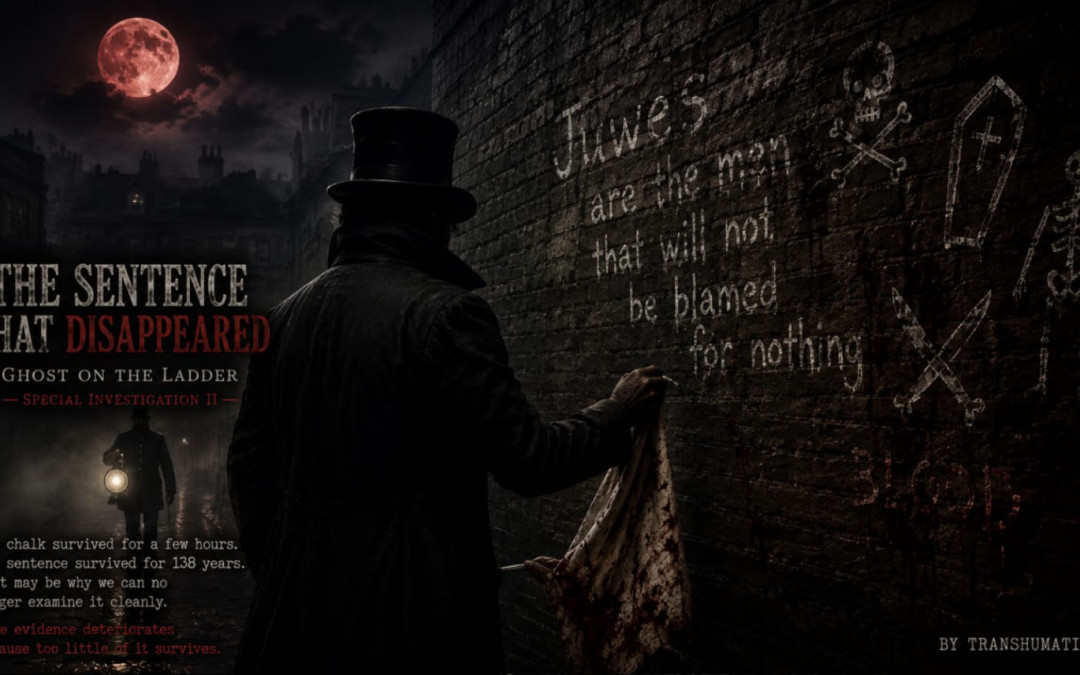
Ghost on the Ladder — Special Investigation II
The chalk survived for a few hours. The sentence survived for 138 years. That may be why we can no longer examine it cleanly.
At some point before dawn on 30 September 1888, a policeman entered the passage of the Wentworth Model Dwellings in Goulston Street and found two things that should never have become intellectually inseparable: a bloodstained piece of Catherine Eddowes’s apron and, above or close to it, a sentence written in chalk.
The cloth was physical evidence. It could be handled, compared with the remaining apron and placed within the geography of the night. The sentence was more troublesome. Police Constable Alfred Long recorded one version; other officers preserved slightly different ones. Even the position of the word not was not stable. Before anyone photographed the wall, Metropolitan Police Commissioner Sir Charles Warren ordered the writing erased, fearing that an apparent reference to Jews might inflame an already dangerous atmosphere in the East End.
That decision is usually described as the destruction of evidence. It was. But from the perspective of information, something stranger happened.
The chalk disappeared almost immediately.
The sentence escaped.
It passed into notebooks, reports, books, films, websites and eventually databases searched by machines. The physical object died before sunrise; its descendants multiplied for more than a century. We now possess vastly more material about the inscription than any policeman standing in Goulston Street possessed that morning.
And yet we may be in a worse position to study its origin.
The sentence survived so successfully that it may have contaminated the environment in which we are trying to understand it.
Four Letters in the Wrong Place
The familiar version is usually given approximately as:
The Juwes are the men that will not be blamed for nothing.
Already, this gives an impression of stability that the original evidence does not deserve. Contemporary transcriptions vary. The strange first word appears in several forms, and the placement of not changes between witnesses. There is no photograph to arbitrate between them because the wall itself was cleaned.
Normally a difference of four letters would seem trivial.
Here those four letters are not.
That matters because the sentence contains a double negative, and double negatives behave differently depending on how the reader treats them. In non-standard English, I didn’t do nothing can simply mean I did nothing. Read in that vernacular way, will not be blamed for nothing may be emphatic rather than logically inverted.
But blame introduces another layer.
To be blamed for nothing can mean to be blamed without cause. Add not before that expression and a literal reading begins drifting toward the opposite: they will not be blamed without cause.
Move not elsewhere, as one surviving transcription appears to do, and the balance shifts again.
Nothing here makes the graffito a formal logical paradox. It is not the liar saying, I am lying. The more interesting point is that a sentence made entirely from ordinary words begins changing once the observer changes the rules under which it is read.
A child can understand every word.
A linguist, historian and logician may still disagree about the proposition.
That is not because the words became more complicated.
The observer did.
Looking for the Sentence Before Jack
There is an obvious way to test whether we are making too much of it.
Forget the murder.
Forget the apron.
Forget Jack.
Treat the sentence as a piece of nineteenth-century English and search backward.
Was blamed for nothing an ordinary expression? Does will not be blamed for nothing appear in newspapers, court reports, sermons or novels before September 1888? Was this merely a familiar East End construction that sounds peculiar because modern English has moved elsewhere?
Those are empirical questions, and modern technology ought to help answer them. Historical newspaper databases, digitized books and searchable corpora allow us to examine language on a scale no Victorian investigator could have imagined.
But the fame of Goulston Street creates a peculiar obstacle.
Search too broadly for the phrase and the results begin filling with Jack himself: reproductions of the graffito, books quoting it, websites discussing it, later fiction borrowing from it, articles quoting those websites. Its descendants crowd the search space where we are trying to locate its ancestors.
That does not make serious linguistic work impossible. A well-constructed corpus restricted to material printed before September 1888 could still provide useful evidence. It does mean that a simple search result is no longer innocent.
The phrase has acquired a cultural wake.
And that gives us a genuinely unusual historical problem. We are accustomed to evidence becoming difficult because too little survives. Here the opposite may be occurring.
Fame has changed the sample.
The more often the sentence was repeated, the easier it became to preserve—and the harder it became to distinguish an independent linguistic ancestor from something produced under its influence.
The DNA on the Wall
The comparison with DNA is imperfect, which is exactly why it is useful.
DNA and written language are not the same kind of information. A genetic sequence operates through biological machinery; a written sentence operates through interpreters who know a language. But both demonstrate a deceptively simple property: order matters.
Move one element and sometimes almost nothing changes.
Move another and the consequences can be enormous.
In the graffito, not is physically tiny. Informationally, it may change the proposition. The difference between Juwes, Juews and Jews may be one of spelling, transcription or something more meaningful. The original material change is negligible; the interpretive change can be large.
And both biological and historical evidence can be contaminated.
The difference appears when we ask what happens next.
A biological sample is finite. It can decay, be consumed, mixed with later material or eventually become unusable. A sentence can leave its original body and continue reproducing.
Chalk becomes a notebook entry.
The notebook becomes a report.
The report enters print.
Print becomes a digital image.
The image becomes searchable text.
Searchable text enters an algorithm.
Each transition preserves something and creates an opportunity to alter something.
Now imagine that an early transcription contains a small error. A later author copies it. Another author cites both. A website reproduces the later book. Ten thousand pages now contain the same form.
A future observer may encounter ten thousand examples.
But those are not ten thousand independent witnesses.
They are one ancestor with ten thousand descendants.
That is informational contamination of a different kind. The contaminant does not merely sit beside the sample.
It can reproduce inside the sample’s genealogy.
When the Copy Starts Looking Older Than the Original
This is where artificial intelligence becomes particularly interesting.
A system trained to detect patterns benefits from seeing large quantities of material. But large quantities can become misleading when the examples are not independent. Frequency can create an illusion of confirmation.
The Goulston sentence has existed for long enough to influence culture. Later writers may quote it directly. Others may imitate its rhythm unknowingly. Search engines may rank frequently repeated versions higher than rare historical ones. Models may learn from pages whose apparent agreement comes from copying the same source.
Then a future researcher asks:
Was this syntax already common before 1888?
The machinery looks through an informational world that the sentence itself helped create.
The object being investigated has altered the archive in which the investigation occurs.
That does not mean we are trapped forever. Provenance, dating and carefully designed historical corpora can still separate much of what came before from what came after. But there is no genuine reset. We cannot ask the internet what it would look like in a history where the graffito was never written.
That is why the analogy with a contaminated crime-scene sample becomes so useful.
The difference is that the informational version may never naturally disappear.
If future systems continue preserving and reproducing the phrase, its descendants can remain in circulation indefinitely.
The biological sample dies.
The informational contaminant can become immortal.
The Strange Choice of Blame
There is another reason the graffito deserves attention, although here we have to separate observation from temptation.
Suppose, only for the experiment, that the murderer wrote it.
The semantic centre of what may be his only message physically associated with the aftermath of a murder is not blood, death, knife or police.
It is blame.
That would not demonstrate empathy. Understanding that another person can be accused, feared or misjudged is not the same as emotionally sharing that person’s suffering. A manipulator may be extremely skilled at modelling other minds precisely because doing so makes manipulation easier.
Still, blame is a social concept. It requires more than an event.
Someone acts.
Someone is judged.
Someone assigns responsibility.
The writer, whoever he was, is operating one level above the event itself. He is thinking about how events become interpreted by other people.
That is what makes the sentence more interesting than an ordinary threat.
Richard Speck later produced a very different but useful comparison when he remarked that if people knew how well he was enjoying prison, they would let him out. The line is memorable because it inverts the structure of punishment: if imprisonment becomes pleasurable, punishment appears to fail at its intended function.
Once the mechanism is explained, however, the sentence is transparent.
Goulston Street remains more resistant.
We cannot agree confidently on the exact wording, the first noun, the intended use of negation, the identity of the writer or even whether the sentence belongs to the murder at all.
This does not prove that its author was unusually intelligent.
It means the information object itself has become unusually difficult.
Part of the mystery may reside in the writer.
Part in Victorian language.
Part in imperfect transcription.
Part in the destroyed wall.
And part in us.
The Test Is to Make It Boring
This is the point where fascination becomes dangerous.
A sentence surviving 138 years of argument can begin to acquire the aura of genius simply because people continue arguing about it. That would be circular. Perhaps it was clumsy grammar. Perhaps the strange spelling meant nothing. Perhaps the murderer never touched the chalk. Perhaps an anonymous resident wrote it days earlier and a bloodstained piece of cloth happened to be discarded beneath it.
Every one of those possibilities deserves a fair attempt.
So the right question is not:
How brilliant is the graffito?
It is:
How much strangeness remains after we deliberately try to make it ordinary?
Treat the double negative as dialect. Does the puzzle disappear?
Treat Juwes as bad spelling. Does anything remain?
Assume the writer had little education. Does the structure cease to be unusual?
Search genuinely pre-1888 material for analogues. Do we find them?
Separate the writing from the apron completely. Does coincidence become the cleaner explanation?
Each mundane explanation that succeeds should reduce our fascination. If an ordinary explanation accounts for everything, we should prefer it.
That is the purpose of the radical realist inside Transhumation. The romantic is allowed to notice the strange object. He is not allowed to protect it.
But the reverse is also true.
Scepticism should not become a method for making every anomaly disappear by declaring it coincidence before the comparison has been done.
The graffito earns attention not because it is mysterious.
It earns attention only to the extent that the mystery survives attempts to remove it.
The Sentence That Destroyed Its Own Body
There is one feature of the episode that does not depend on Jack’s authorship at all.
The sentence changed the physical world.
Police officers saw chalk marks. They interpreted their apparent meaning. That interpretation created a fear of antisemitic disorder. Sir Charles Warren ordered the writing removed.
Information therefore helped destroy its own material carrier.
But by then it had already escaped.
Someone had copied it.
Others had remembered it.
Reports existed.
The chalk died while the pattern was already moving into new matter.
That sequence is almost a miniature model of Transhumation:
matter carries pattern → an observer reads pattern → interpretation produces action → action changes matter → pattern moves to another carrier
Then mutation begins.
The wall disappeared from the experiment almost immediately. The sentence continued moving through civilization.
Today the original chalk does not exist.
The arrangement does.
A Sample That Cannot Be Reset
A forensic scientist occasionally has the luxury of returning to a sealed specimen untouched since the crime.
We do not have that luxury here.
There is no original graffito waiting in a drawer. The surviving transcriptions were already different before the case became history. And after that, every generation added another layer of repetition and interpretation.
We can clean the methodology.
We cannot clean the past.
The sentence now exists inside books, websites, scholarship, fiction, databases and machine-readable corpora. Any future investigation begins in a world already altered by its survival.
Perhaps that is the most interesting thing Goulston Street gives us.
Not proof that Jack wrote a brilliant message.
Not a solution to Juwes.
Not even a solution to the placement of not.
It gives us an example of information whose persistence has become part of the difficulty of studying it.
The chalk survived for hours.
Its descendants may survive as long as civilization continues copying them.
We began by looking for the author of a sentence.
What we found instead was something closer to heredity.
Watch the Video
How to Read the World

Current Knowledge
During the early hours of 30 September 1888, a bloodstained portion of Catherine Eddowes’s apron was discovered in the entrance to the Wentworth Model Dwellings in Goulston Street. A chalk inscription was observed nearby. Contemporary witnesses and police records preserved differing versions of the wording, including variations in spelling and the placement of not.
The inscription was erased before it could be photographed because police authorities feared that its apparent reference to Jews might contribute to antisemitic disorder. There is no surviving evidence proving that the murderer wrote the graffito.
The comparison with DNA in this article is structural. DNA and written language are different information systems, but both demonstrate that sequence and arrangement can affect meaning or function and that copying can preserve information while also introducing variation.
Open Questions
Can a sufficiently rigorous corpus of English printed before September 1888 establish how unusual the graffito’s complete syntax really was?
How much of its ambiguity belongs to nineteenth-century vernacular language, how much to imperfect transcription and how much to modern interpretation?
Can a famous informational object reproduce so widely that its descendants begin interfering with attempts to reconstruct its own ancestry?
And if an object changes the archive through which later generations study it, can its origin ever again be examined in a truly uncontaminated environment?
Transhumation Interpretation
Transhumation treats the Goulston Street graffito as an experiment in what happens when information survives the loss of its original carrier.
The sequence is simple:
chalk → observer → transcription → archive → print → digital copy → algorithm
At each stage, something is preserved and something can change.
The important distinction is between survival and fidelity. Information can survive extraordinarily well while its exact original form becomes increasingly difficult to recover. Copies protect a pattern from disappearance, but every new carrier also creates the possibility of mutation, reinterpretation and feedback.
The deeper question is therefore not merely whether information survives.
It is whether successful survival can eventually alter the environment in which the information is understood.
Goulston Street suggests that it can.
The sentence may have become so culturally successful that its descendants are now part of the evidence we must control when studying its ancestor.
That gives us a useful Transhumation question:
Can information survive so well that survival itself becomes contamination?
FAQ
What did the Goulston Street graffito say?
Several contemporary versions survive, and they differ in spelling and word order. The original was erased before photography, so its exact wording cannot now be recovered with certainty.
Did Jack the Ripper write it?
It remains possible, but unproven. The presence of a genuine piece of Catherine Eddowes’s apron makes the proximity important, while unrelated pre-existing graffiti remains a viable alternative.
Why is the word not important?
Its placement changes between surviving versions, and the sentence contains a double negative. Different grammatical readings can therefore produce different meanings.
What does “informational contamination” mean here?
Later copies, quotations and interpretations can become so numerous that they complicate efforts to reconstruct the source’s original linguistic environment.
Why compare the graffito with DNA?
Not because language and genetics are identical, but because both illustrate how arrangement can carry information, how small changes can matter and how copied information can mutate.
What is the central idea of the article?
Some evidence becomes difficult because too little survives. Goulston Street may represent the opposite problem: a sentence whose copies survived so successfully that they became part of the difficulty of studying the original.
Continue the Transhumation Series
- Forgotten Religion | Ancient Gods, Symbols and the Hidden Structures of Human Civilization
- The Last Religion | Death, Immortality and the Future of Humanity
- The New Theurgy | AI, Information and the Future of Human Civilization
- End of Branding: You Were Never Meant to Become a Product
- Baal vs Ishtar: Why Ancient Gods Never Disappeared