
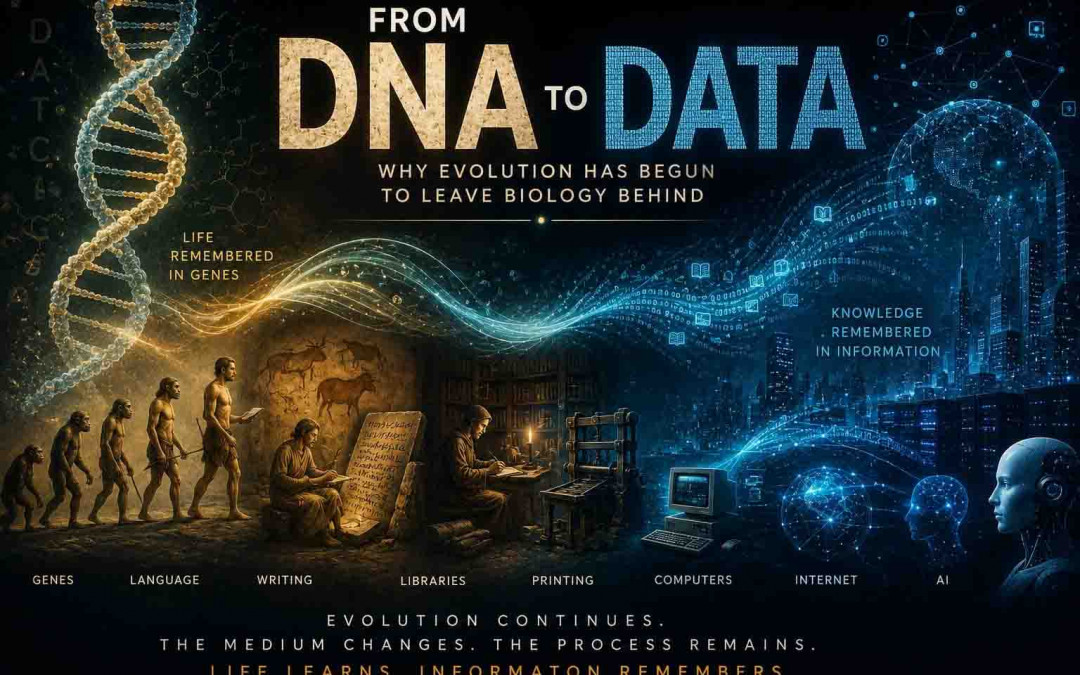
From DNA to Data
Biology gave humanity inheritance. Culture gave it memory. Artificial intelligence may be changing who gets to interpret what civilization remembers.
Imagine two children separated by twenty thousand years.
Biologically, the distance between them is surprisingly small. Both belong to the same species. Both arrive with brains shaped by an evolutionary history vastly older than either of their societies. Both must learn language, relationships, danger, cooperation and the peculiar rules of the world into which they are born.
Yet the second child may inherit things the first could not have imagined: algebra, antibiotics, maps of other planets, orchestras recorded before birth, photographs of ancestors, constitutional law, aviation, quantum mechanics, satellite navigation and instant access to libraries containing the thoughts of people dead for thousands of years.
Almost none of that inheritance arrives through DNA.
It arrives through civilization.
This distinction may be one of the most important events in the history of our species. Biological evolution did not stop when culture appeared, and humanity did not somehow escape Darwinian processes. Bodies still reproduce biologically. Genes still mutate. Natural selection has not resigned.
But another mechanism became powerful enough to alter human life on a radically different timescale.
A useful genetic adaptation may take many generations to become widespread.
A useful idea can cross the planet before dinner.
That is the real transition from DNA to data.
Before Data, There Was Inheritance
DNA is often called the code of life, a metaphor useful enough to become almost unavoidable and dangerous enough to require caution. DNA is a molecule, not a manuscript written by nature. Genes do not contain a miniature blueprint from which organisms are mechanically printed, and biological development depends on interactions among genes, cells, chemistry, environment and developmental history.
Still, the informational language captures something important.
The sequence matters.
Biological inheritance allows structural information to pass between generations. Variation enters the process through mutation, recombination and other mechanisms, while natural selection can change which variants become common within populations.
For billions of years this provided life with an extraordinarily powerful form of continuity.
But it has a limitation.
An animal that discovers something useful during its lifetime does not generally rewrite its genome so that its offspring automatically inherit the discovery. Experience and genetic inheritance operate through different channels.
Culture changes that relationship.
A child can inherit knowledge the parent’s genes never contained.
The Second Inheritance System
Language created a remarkable shortcut.
A hunter who discovered where animals crossed a valley did not need descendants biologically predisposed to find the route. He could show someone.
A person who survived eating a poisonous plant could warn the group.
A technique for shaping stone could pass between unrelated individuals.
Information acquired during one lifetime could enter another without reproduction.
This is not unique in every sense to humans; social learning exists in many species. But human culture developed an extraordinary cumulative capacity. Knowledge did not merely circulate. It could be modified, combined and preserved.
One generation inherited the achievements of another and began from there.
Then writing altered the system again.
The teacher no longer had to remain alive.
That is an astonishing civilizational event.
A dead person could continue transmitting structured thought.

When Memory Left the Nervous System
Writing did not cause information to become non-physical. Clay, papyrus, ink and paper are perfectly physical things.
What changed was the carrier.
Memory that previously required a functioning nervous system could now persist in external artifacts.
A library extended this principle from individual memory to institutional memory. Printing increased replication. Telecommunications increased speed. Digital storage increased capacity and portability. Networks compressed geographic distance.
At every stage, human civilization became capable of retaining more acquired information outside individual bodies.
The biological organism did not become less important.
The informational environment around it became vastly larger.
A modern surgeon depends on a body shaped by evolution, but the expertise that makes surgery possible comes through universities, books, instruments, accumulated experiments and institutional traditions no genome encodes directly.
A pilot does not evolve wings.
Civilization stores aerodynamics.
This is the more precise sense in which adaptation begins to move faster than biology.
The Genome Is Not the Library of Civilization
Comparing the human genome with a digital archive can be misleading because they store radically different kinds of information, but the contrast still reveals something important.
The human genome contains roughly three billion base pairs. It participates in building and regulating an organism capable of language, memory, learning and culture.
But the genome does not contain Shakespeare, calculus, aviation law, the design of a semiconductor or the history of Rome.
Those structures belong to another inheritance system.
Civilization has effectively surrounded the biological human with an enormous external memory architecture.
We are born biologically incomplete in a particularly important sense: possessing the capacity for culture but without the culture itself.
A newborn does not contain English.
The language must be installed socially.
A newborn does not contain physics.
A civilization must teach it.
The genome builds an organism capable of receiving an inheritance far larger than the genome alone could specify.
Perhaps that is the more interesting achievement.
Ideas Move Differently From Genes
It is tempting to describe culture as evolution running faster, but the analogy has limits.
Genes and ideas do not reproduce in the same way.
Ideas can be intentionally designed.
They can be deliberately taught.
A person can reject one, combine two or recover another from a book written centuries earlier. Institutions can impose them. Markets can amplify them. Algorithms can select which ones become visible.
Cultural evolution therefore contains variation, transmission and selection-like processes without being reducible to genetics.
And speed changes everything.
A genetic population adapts across generations.
A software update can alter the behavior of millions of devices overnight.
A scientific discovery can change medical practice within years.
A social network can alter patterns of language or politics within months.
Human beings increasingly adapt by modifying the informational environment faster than biological evolution could plausibly redesign the organism.
Instead of evolving thicker fur, we invented clothing.
Instead of evolving better night vision, we invented lamps.
Instead of evolving perfect memory, we built libraries.
The organism stays comparatively stable.
The external system moves.
AI Does Something the Library Could Not
Artificial intelligence enters this history in a distinctive position.
Books preserve information.
Libraries organize it.
Search engines retrieve it.
AI increasingly participates in transforming and interpreting it.
That distinction matters.
For most of recorded history, accumulated knowledge required human specialists to reconnect information with use. Priests, scribes, teachers, translators, librarians, physicians, engineers and scholars stood between archive and action.
AI can now perform portions of that intermediary work at remarkable scale.
It can translate.
Compare.
Summarize.
Classify.
Generate.
Identify patterns across collections larger than an individual could inspect directly.
This does not make AI a new species or prove machine consciousness.
But it changes the architecture of cultural inheritance.
The archive is acquiring an interface capable of responding.
The library no longer merely waits on the shelf.
It begins to participate in the conversation.
The Faster System Can Still Forget
Speed should not be confused with progress.
Informational evolution can propagate nonsense as efficiently as knowledge. Networks can amplify error. Digital memory can preserve irrelevant data while allowing important context to disappear. AI can improve access while also producing confident mistakes.
The second inheritance system is faster than genetics partly because it is less constrained.
That is both its strength and its danger.
A bad mutation must survive biology.
A bad idea may need only a good slogan.
Civilization therefore requires filters that biological evolution does not provide automatically: education, criticism, evidence, institutions, replication, debate and memory of previous failure.
Information alone is not ascent.
The quality of the inheritance matters.
Watch The Video
How to Read the World
Current Knowledge
Biological evolution continues in humans and other species through heritable variation and changes in reproductive success. There is no scientific basis for saying that biological evolution has ended or that it has been replaced by technological development.
Humans also participate in cumulative cultural evolution. Language, social learning, education, institutions and recorded media allow acquired knowledge to move between individuals and generations much faster than genetic change generally spreads through populations.
DNA carries biological information in a technical sense, but it is not a complete instruction manual for an organism. Development depends on complex interactions among genes, cells and environment.
Writing, libraries, printing and digital networks significantly expanded humanity’s capacity for external memory. Artificial intelligence adds new tools for retrieving, organizing and generating information but does not establish that information itself has become independent of physical systems.
Open Questions
The first question is whether cultural evolution will continue depending primarily on biological humans or whether artificial systems will eventually become autonomous participants in it. A system that generates, selects and modifies ideas may occupy a different role from a passive archive, but autonomy and consciousness are separate questions.
There is also the problem of dependence. The more civilization externalizes memory and expertise, the less any individual understands the systems on which ordinary life depends. Does informational expansion increase resilience, or does it produce new forms of fragility?
Another question concerns selection. Biological evolution has no foresight, while culture can be deliberately directed. But who decides which ideas, technologies or values deserve propagation when networks and AI increasingly influence what becomes visible?
And beneath all of this lies a deeper uncertainty: are we seeing a genuine new evolutionary layer, or simply using evolutionary language to describe technological change because the metaphor feels natural?
Transhumation Interpretation
Transhumation should not describe the movement from DNA to data as humanity leaving biology.
That would misunderstand what happened.
Biology produced the organism capable of creating a second inheritance system.
The more interesting story is a migration of function.
Genes transmit biological structure.
Language transmits acquired experience.
Writing lets experience outlive the speaker.
Libraries accumulate dead minds.
Networks remove much of geography from transmission.
Artificial intelligence begins mediating between the archive and the living reader.
Every new layer changes what must be carried by the layer below it.
Humans no longer need genes for mathematical knowledge because mathematics can exist culturally. We do not need biological memory capable of retaining every fact because books and databases can hold them externally.
The function moves.
The carrier changes.
But the earlier carrier does not disappear.
This makes the transition from DNA to data less like an escape from biology and more like the construction of additional floors around it.
The biological human becomes embedded in an informational organism far larger than any individual brain.
Civilization remembers what individuals forget.
Libraries remember people who died.
Networks connect people who never meet.
AI may eventually connect patterns no individual would have noticed.
But Transhumation has to preserve one boundary.
Externalized knowledge is not externalized consciousness.
A library can carry thought without becoming the thinker.
An AI can reorganize cultural information without automatically becoming a conscious heir to humanity.
The mistake would be to climb from DNA to data and assume that consciousness must follow simply because memory did.
We know acquired information can change carriers.
We know culture can outpace genetic change.
We know civilization can preserve structures beyond individual lifetimes.
What we do not know is how far this migration can go.
Perhaps that is the actual meaning of the transition.
Humanity did not escape evolution.
It discovered that adaptation could acquire more than one clock.
Biology still moves.
Civilization moves faster.
And now, for the first time, we are building systems capable of participating in the movement of information itself.
FAQ
What does “From DNA to Data” mean?
It describes the growing importance of cultural and technological inheritance alongside biological inheritance. Humans increasingly adapt through knowledge, institutions and technology without waiting for genetic change.
Is biological evolution ending?
No. Human biological evolution continues. Cultural and technological change simply operates on much faster timescales.
Is DNA really information?
Yes, informational language is scientifically useful for describing genetic sequences and inheritance, although DNA is a physical molecule and organisms are more complex than programs executing genetic instructions.
Why was language such an important development?
Language allows information learned during one lifetime to pass directly to other people. Knowledge no longer has to wait for biological inheritance.
Why do libraries matter?
Libraries externalize collective memory. They allow information produced by one generation to remain accessible to later generations without depending on continuous oral transmission.
What makes AI different from earlier information technologies?
AI can participate in interpretation and transformation as well as storage and retrieval. It can connect and reorganize information at scales difficult for individual humans to manage.
Is AI a new stage of evolution?
It is clearly part of cultural and technological evolution. Whether future AI becomes an autonomous evolutionary participant rather than a human-created tool remains unresolved.
Are humans becoming digital?
Not in any simple biological sense. Human civilization is becoming increasingly dependent on digital information systems while human consciousness and bodies remain biological.
Does this connect to The New Theurgy?
Yes, at the level of interface. The New Theurgy examines what happens when individual humans increasingly reach civilization’s accumulated memory through symbolic and technological intermediaries, including AI.
What is the deeper Transhumation question?
Not whether data will replace DNA.
DNA built the organism capable of creating data.
The deeper question is how many functions once confined to living bodies can migrate into external systems while humanity remains recognizably continuous.
Memory has already crossed part of that boundary.
Knowledge has crossed much further.
Whether consciousness ever can is still unknown.
Continue the Transhumation Series
- Forgotten Religion | Ancient Gods, Symbols and the Hidden Structures of Human Civilization
- The Last Religion | Death, Immortality and the Future of Humanity
- The New Theurgy | AI, Information and the Future of Human Civilization
- End of Branding: You Were Never Meant to Become a Product
- Baal vs Ishtar: Why Ancient Gods Never Disappeared