
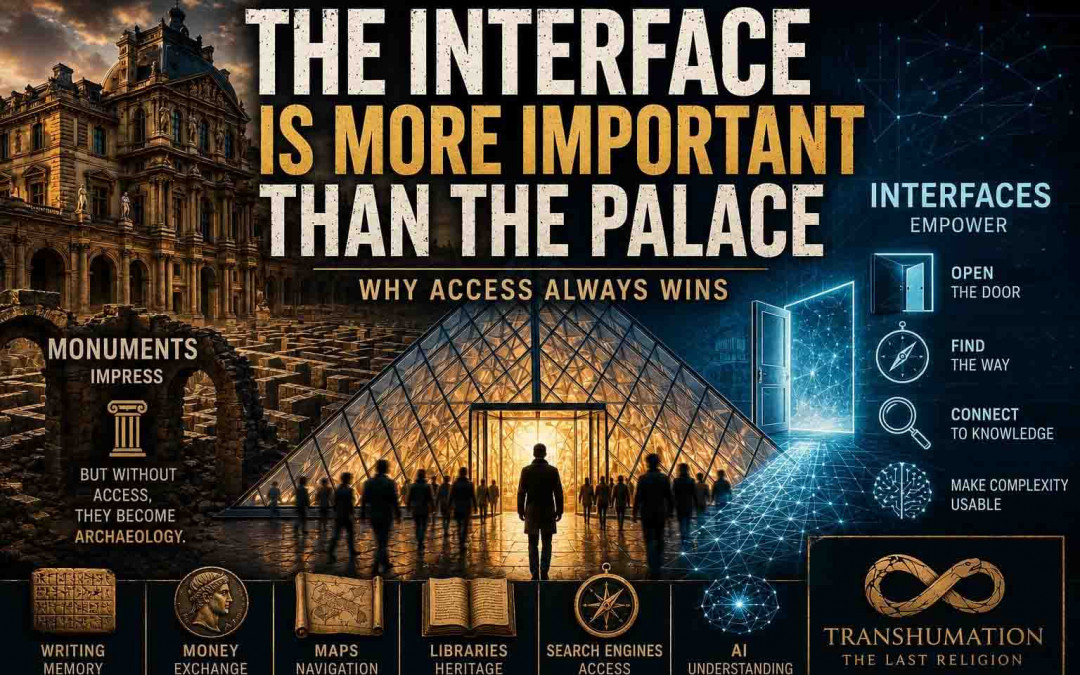
History celebrates monuments.
Palaces.
Cathedrals.
Libraries.
Empires.
Yet monuments rarely change civilizations by themselves.
People do.
And people first need a way inside.
Owning Is Not Understanding
Imagine the greatest library ever built.
Millions of books.
Thousands of years of knowledge.
Now remove the catalogue.
Remove the librarian.
Remove the entrance.
The knowledge still exists.
Yet it has become almost useless.
Civilization often mistakes possession for accessibility.
They are not the same thing.
The Louvre Lesson
The Louvre did not become one of the world’s greatest museums because it contained masterpieces.
Many collections were already extraordinary.
What changed was access.
The glass pyramid did not add more paintings.
It made millions of people capable of finding them.
The interface increased the value of everything that already existed.
Rome Built Roads
Rome did not dominate only because of its armies.
It dominated because of movement.
Roads.
Bridges.
Ports.
Postal systems.
Law.
Citizenship.
Every one of these was an interface.
They connected people to a civilization much larger than themselves.
Without them, Rome would have remained only another city.
The Internet Changed the Rule
The internet created more information than any civilization could absorb.
The winners were not those who owned the most information.
They were those who organized it.
Search engines became more valuable than directories.
Operating systems became more valuable than hardware.
Today AI may become more valuable than databases.
Not because it knows more.
Because it connects people to knowledge.
Every Civilization Builds Interfaces
Writing connected memory.
Money connected trade.
Maps connected geography.
Language connected minds.
Libraries connected generations.
Artificial intelligence may become the newest interface connecting humanity to its own civilization.
Perhaps this is why technology increasingly resembles religion.
Not because machines become divine.
Because both attempt to guide human beings through realities too vast to navigate alone.
The Palace Is Never Enough
Every civilization dreams of building something magnificent.
Few realize that greatness alone is not enough.
If people cannot enter it…
Understand it…
Or use it…
The monument slowly becomes archaeology.
The future belongs not only to builders.
But to those who create doors.
Conclusion
Perhaps history misunderstood power.
Power is not owning the palace.
Power is helping someone find the entrance.
The greatest civilizations are remembered for their monuments.
The greatest interfaces make those monuments usable.
And perhaps that is the hidden direction of civilization itself.
Not toward larger structures.
But toward simpler ways of entering them.
Want to Explore More..?
Watch The Video Below
Continue reading…
The Proteus: The Last God

FAQ
What does „The Interface Is More Important Than the Palace” mean?
It argues that access to knowledge, institutions, and civilization often matters more than the structures themselves.
Why is the Louvre Pyramid used as an example?
The pyramid transformed the visitor experience by simplifying access to an already existing museum, increasing the value of the entire institution.
What is an interface?
An interface is anything that helps people interact with a complex system, such as language, maps, libraries, search engines, or AI.
Why are Roman roads considered interfaces?
They connected people, armies, commerce, and ideas across an enormous empire, making Rome function as a unified civilization.
How does this relate to artificial intelligence?
AI may become humanity’s next great interface by allowing people to navigate overwhelming amounts of information naturally.
Why isn’t the palace enough?
Even the greatest structure has limited value if people cannot access, understand, or benefit from it.
What is the article’s main idea?
Throughout history, civilizations have advanced not only by building remarkable structures but by creating better ways for people to enter and use them.
How does this connect to The New Theurgy?
The New Theurgy studies the hidden structures that organize civilization. Interfaces are presented as recurring patterns that connect humans with increasingly complex realities.
How does this connect to Transhumation?
Transhumation sees civilization as a progression of interfaces—from myths and libraries to operating systems and AI—that make larger worlds accessible to human consciousness.
The Core Questions of Transhumation
Explore the full journey:
- End of Reality — Where Do You Really Exist?
- End of Physics — Are the Laws of Reality Real?
- End of the Real World — Reality Is No Longer Required
- End of Consciousness — Beyond the Human Mind
- End of Death — When Human Limits Disappear
- End of Religion — When Technology Replaces Faith