
How a Shadow Became Larger Than the World
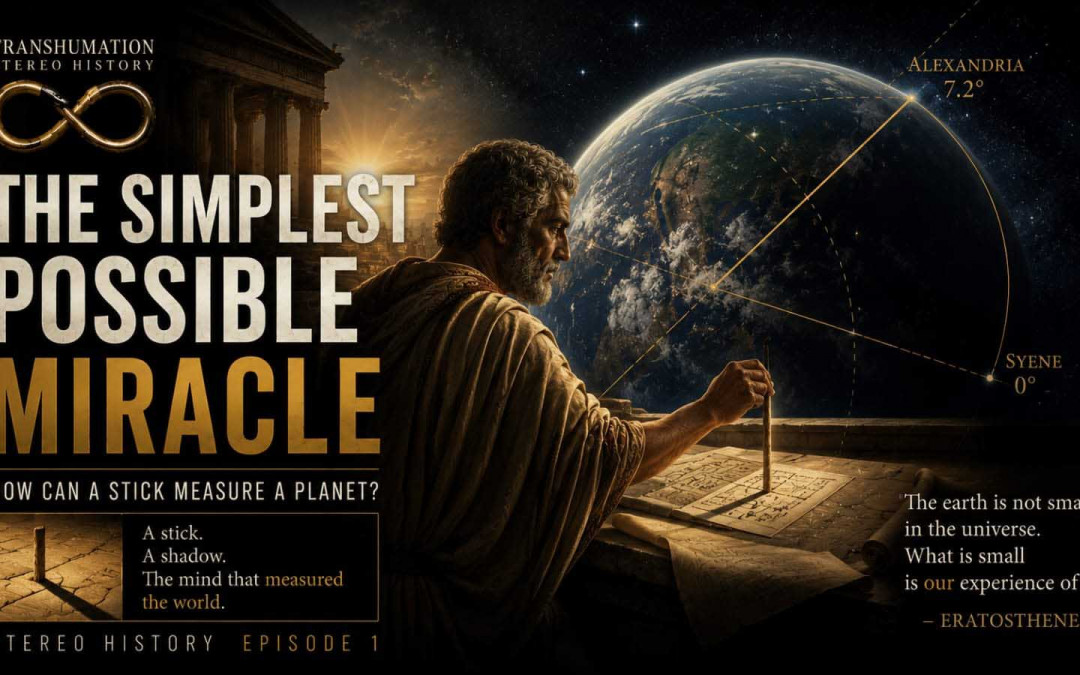
At noon, a stick does something almost offensively ordinary.
It casts a shadow.
No machinery moves. No lens opens. No satellite crosses the sky. A vertical object interrupts sunlight, and a dark line appears on the ground. A child can understand the event without understanding optics, astronomy or geometry.
More than two thousand years ago, however, someone looked at that shadow and realized that it contained information about an object too large for any human being to see.
Earth itself.
Eratosthenes did not need to climb above the atmosphere. He did not need a telescope, an aircraft or a photograph of the planet. He stood inside the system he wanted to measure and used one local relationship to infer the scale of the whole.
That is the part worth lingering over.
The miracle is not the stick.
It is the possibility that something small can reveal something enormously larger than itself.
Civilization begins to become dangerous, beautiful and strange at exactly that moment.
How Did Eratosthenes Measure the Earth?
The method is famous because it sounds almost too simple.
Eratosthenes knew that at Syene, near modern Aswan in Egypt, the midday Sun around the summer solstice was reported to stand almost directly overhead. In Alexandria, farther north, a vertical object cast a measurable shadow at approximately the same time.
That difference created an angle.
If Earth were curved, the angle between the Sun’s rays and the vertical in Alexandria could be related to the angular separation between the two locations on Earth’s surface. Estimate the distance between the cities, determine what fraction of a full circle the measured angle represented, and the circumference of the planet could be inferred.
The usual reconstruction gives an angle of about 7.2 degrees, roughly one fiftieth of a circle. Multiply the distance between Alexandria and Syene by fifty, and a planetary circumference emerges from a local observation.
There are uncertainties in the historical details. Ancient units such as the stadion are not perfectly straightforward to convert, and our accounts of Eratosthenes’ method come through later sources. Claims that his result was accurate to some spectacularly precise modern percentage therefore deserve caution.
But the intellectual achievement does not depend on winning a contest against modern geodesy.
He understood the geometry of the problem.
That is enough.
How Can a Shadow Reveal the Size of a Planet?
Because the shadow is not important by itself.
Its relation is.
A shadow in Alexandria contains no label saying Earth circumference: approximately forty thousand kilometres. The information becomes available only when the observation is placed inside a model.
This distinction sits at the heart of science.
Data is not explanation.
A measurement becomes powerful when it can be connected to something beyond the immediate measurement.
The thermometer does not contain weather.
The spectral line does not contain a star.
A fossil does not contain an extinct ecosystem.
A redshift measurement does not contain the history of cosmic expansion.
In every case, something local becomes evidence about something larger because there is a defensible relation connecting the two.
Eratosthenes’ stick therefore belongs to a much larger intellectual tradition.
Human beings learned that the world does not always need to be reached directly in order to be known.
Sometimes it can be inferred.
That may be one of the deepest inventions in the history of civilization.
The Planet Nobody Could See
This is easy to underestimate because modern people have seen Earth.
We have photographs.
Weather satellites show the planet every day.
Children grow up recognizing the blue globe before they understand how difficult it once was to establish its dimensions.
Eratosthenes inhabited a very different perceptual world.
He could walk on Earth.
Sail across part of it.
Look toward its horizon.
Read reports from travelers.
But he could not step outside the system and inspect the object from the outside.
That is the fascinating part.
He measured an object from inside the object.
Modern science does this constantly.
Cosmologists attempt to infer properties of a universe they cannot stand outside.
Neuroscientists use brains to study brains.
Human beings investigate consciousness while being conscious.
Scientists reconstruct the history of life despite arriving billions of years after its beginning.
We rarely receive the luxury of the God’s-eye view.
We build one from fragments.

Why Does Mathematics Let Us Measure Things We Cannot Reach?
Mathematics gives relations a form that can travel beyond immediate experience.
If two angles are related under certain geometric assumptions, distance can be transformed into circumference. If light follows predictable relationships, a spectrum can reveal chemical composition. If orbital motion behaves regularly, unseen masses can be inferred from their effects.
This does not mean mathematics is magic.
Nor does its effectiveness settle the old philosophical debate about whether mathematical structures are discovered or invented.
Human beings invent notation, definitions and formal systems. Yet those systems repeatedly allow us to encounter relationships we did not choose by preference.
Eratosthenes could not decide that the angle in Alexandria represented one tenth of a circle because ten was aesthetically more satisfying.
Reality constrained the answer.
This is where mathematics becomes more than elegant language.
It gives observations resistance.
A beautiful theory can still be wrong.
A shadow can disagree with it.
The universe does not need to speak.
It only needs to refuse certain predictions.
The First Telescope Was Not a Shadow
There is a tempting line here: the shadow was the first telescope.
It is beautiful.
It is also historically false.
People used astronomical instruments long before modern telescopes, and Eratosthenes’ method is not the technological ancestor of the James Webb Space Telescope in any simple sense.
But the comparison survives at another level.
The stick and Webb participate in the same epistemic strategy.
Both take a limited signal and turn it into access to something beyond ordinary perception.
Eratosthenes measured an angle.
Webb gathers extremely faint electromagnetic radiation.
The objects are radically different.
The infrastructure is incomparable.
The mathematics has grown vastly more sophisticated.
But the basic intellectual move remains recognizable:
let something small that reaches you stand in for something enormous that does not.
That is the continuity worth preserving.
Not tool descending from tool.
Question surviving through new carriers.
What Does the James Webb Space Telescope Actually Extend?
It extends more than sight.
This is an important distinction because humans often describe scientific instruments as enhanced senses. The phrase is useful, but incomplete.
Webb detects infrared radiation that human eyes cannot see directly. Its instruments collect signals, systems process them, data are calibrated, and researchers reconstruct information about objects whose light may have traveled for billions of years.
What eventually appears on a screen is not simply “what a superhuman eye would see.”
It is an interpreted measurement.
Scientific instruments therefore do something stranger than giving us larger eyes.
They translate inaccessible parts of reality into forms human cognition can work with.
Radio astronomy gives invisible signals graphs and images.
Microscopy gives tiny structures visible scale.
Spectroscopy gives chemistry lines.
Computational models give processes temporal and spatial forms we can inspect.
Civilization repeatedly gives the invisible a human-readable costume.
The costume is not the phenomenon.
But without it, much of the phenomenon would remain cognitively unreachable.
The Ladder of Information
The original metaphor of a Ladder of Information is useful if we remove the suggestion that human history is a simple upward staircase.
Knowledge does accumulate, but not evenly.
Libraries burn.
Languages disappear.
Civilizations forget.
Theories are abandoned.
Techniques can be rediscovered centuries later.
A better image may be scaffolding.
Each generation inherits structures built by previous generations, repairs some, removes others and extends a few into places their builders never saw.
Eratosthenes did not need modern orbital mechanics.
Newton did not need machine learning.
A modern astronomer does not need to reinvent Euclid before opening a dataset.
Civilization allows a mind to begin somewhere other than zero.
That is one of its strangest powers.
The individual remains biologically finite.
The intellectual structure becomes partially cumulative.
A child alive today can encounter a fact about the cosmos that required centuries of mathematical, technical and institutional development to make available.
The mind has not become infinitely larger.
The ladder beneath it has.
Can a Small Measurement Reveal a Much Larger Reality?
Yes, but only under conditions.
This is where the romance of Eratosthenes must meet the discipline of science.
A tiny sample can reveal a larger structure if the relation between sample and structure is valid.
Sometimes it is not.
One rainy afternoon does not establish climate.
One strange historical document does not establish a conspiracy.
One biological similarity does not establish common function.
One symbolic resemblance does not prove historical descent.
The power of inference comes with a corresponding danger.
Human beings are pattern-making creatures, and we can often build a large world from a very small clue even when the clue does not justify it.
Eratosthenes succeeded because geometry constrained the inference.
The same method that allows a shadow to reveal a planet also tells us why many seductive analogies fail.
The clue needs a bridge.
The bridge needs assumptions.
The assumptions need to survive contact with reality.
That is the difference between pattern recognition and pattern worship.
The Universe Looking Back at Itself
There is an irresistible poetic formulation: the universe became conscious of itself through us.
It should remain poetry.
The universe as a whole is not known to possess intention, awareness or a desire to be understood. Science gives us no reason to imagine stars waiting billions of years for someone to calculate them.
But something genuinely remarkable happened without requiring personification.
Matter organized into stars.
Stars produced heavier elements.
Planetary systems formed.
Chemistry became extraordinarily complex.
Life emerged on at least one known world.
Evolution eventually produced organisms capable not merely of responding to local conditions but of constructing mathematical models of objects far beyond their sensory horizon.
A portion of the universe became capable of representing other portions of the universe.
That statement is cautious enough for science.
It is also extraordinary enough for philosophy.
We do not need the cosmos to be a mind.
It is already strange that minds can contain models of the cosmos.
The Right Scale
Eratosthenes demonstrates another principle that matters throughout Transhumation: intelligence is partly the ability to choose the correct scale.
Stand beside the stick and you see wood and shadow.
Zoom outward and the shadow becomes evidence of planetary curvature.
Zoom too far back and you lose the local measurement that made the inference possible.
Both views are necessary.
This is why the best scientific models neither reproduce every detail nor ignore detail completely.
A map that reproduced every pebble would cease to be useful as a map.
A map that removed every road would fail for the opposite reason.
Eratosthenes did not need a complete model of Earth.
He needed the minimum sufficient structure.
Sunlight.
Angle.
Distance.
Curvature.
The brilliance lies partly in everything he successfully ignored.
That may be one of the most underestimated forms of intelligence.
Knowing what not to carry into the model.
The Simplest Possible Miracle
Perhaps the miracle, if we want to keep the word, is not that a Greek scholar guessed the size of Earth.
It is that reality permits this kind of inference at all.
A local shadow can contain information about planetary geometry.
A tiny spectrum can reveal the composition of a distant atmosphere.
A slight wobble in a star can betray an unseen planet.
Ancient light can carry information about a galaxy that no longer looks the way it did when the photons began their journey.
The universe is not transparent.
But neither is it mute.
Effects carry traces of causes.
Relationships leave signatures.
The small can contain evidence about the large.
This is why scientific instruments become powerful far beyond their physical dimensions.
A telescope mirror is small compared with a galaxy.
A detector is tiny compared with the universe.
A human brain is microscopic compared with the scales it models.
Yet measurement allows these differences in size to become intellectually negotiable.
The human body remains small.
The model does not.
Watch The Video
How to Read the World

Current Knowledge
Eratosthenes, working in the third century BCE, is credited by ancient sources with estimating Earth’s circumference by comparing solar geometry at Alexandria and Syene. The reconstruction traditionally involves an angular difference of roughly one fiftieth of a full circle and an estimated distance between the two locations. The precise numerical accuracy of his result depends partly on the uncertain length of the ancient stadion and details preserved through later reports.
The method works because Earth’s curvature creates a measurable relationship between local solar angles and larger planetary geometry. It is therefore an example of indirect measurement: a global property is inferred from local observations combined with a geometric model.
Modern astronomy relies extensively on the same broad epistemic principle. Scientists infer properties of objects they cannot physically reach from radiation, motion, gravitational effects and other measurable signals. The instruments and models are vastly more sophisticated, but indirect inference remains fundamental.
Scientific instruments do not simply enlarge ordinary human senses. They often detect phenomena outside normal sensory ranges and translate measurements into visual, numerical or other representations accessible to human analysis.
Mathematics is extraordinarily effective for expressing relationships discovered in nature, although the philosophical question of why mathematics works so well and whether mathematical structures are discovered or invented remains open.
Open Questions
One of the deepest questions is why relatively compact mathematical models can sometimes describe aspects of enormously complicated physical systems. The success is undeniable in many domains, but its philosophical significance remains contested.
Another concerns scientific representation. Every instrument and model selects certain features while ignoring others. How do we determine which simplifications preserve the relationship that matters and which distort it beyond usefulness? That problem connects Eratosthenes’ geometry directly with modern simulations and AI-assisted science.
There is also a question about intelligence itself. Is human scientific power primarily a product of individual cognitive ability, or does it depend more fundamentally on civilization’s ability to accumulate instruments, notation, institutions and knowledge across generations? Eratosthenes reminds us that extraordinary inference does not always require extraordinary machinery.
Finally, the same capacity that allows humans to infer invisible realities also allows us to invent patterns that are not there. The difficult boundary is not between imagination and measurement, because science needs both. It is between an interpretation that reality can constrain and one that has been made impossible to disprove.
Transhumation Interpretation
For Transhumation, the stick and its shadow demonstrate something more important than ancient ingenuity: scale does not determine access.
A mind can be physically smaller than the structure it understands because information about the larger structure can survive in a smaller local relation.
But the method works only when the bridge is real.
That is the Transhumation test. Find the pattern, compress the world, build the model — then return to the shadow and ask whether reality still agrees.
A good model makes the universe temporarily smaller without pretending that the model has become the universe.
That may be what every good library does too.
FAQ
How did Eratosthenes measure the Earth?
He compared solar geometry at two locations and used the angular difference, together with an estimated distance between them, to infer Earth’s circumference.
Did Eratosthenes really use only a stick?
The “stick” is a useful simplification. The achievement depended on geometric reasoning, astronomical knowledge, information about another location and an estimate of distance, not on one object alone.
Was his result perfectly accurate?
The historical result was impressive, but precise modern claims about its percentage accuracy are complicated by uncertainty over ancient distance units and details of the surviving accounts.
Why compare Eratosthenes with the James Webb Space Telescope?
Not because one instrument literally descended from the other, but because both illustrate indirect inference: limited signals can reveal realities far beyond direct human access.
Why can small observations reveal huge structures?
Because local effects can depend systematically on larger structures. If the relationship is understood and the assumptions are valid, a small measurement can constrain a much larger model.
What is the deeper Transhumation question?
The deepest question is not how a stick measured a planet.
It is why a fragment of reality can carry enough structure for a mind to reconstruct something vastly larger than the fragment itself.
Eratosthenes never saw Earth from space. He did not need to. A shadow contained a relationship, the relationship fitted geometry, and geometry allowed the mind to leave the scale of the body without the body going anywhere.
Two thousand years later, the instruments are different. The principle remains.
We collect a few photons and speak about galaxies.
We measure tiny motions and discover invisible planets.
We study traces inside matter and reconstruct events that occurred before humanity existed.
The astonishing part is not that human beings became large enough to understand the universe.
We did not.
We learned how to make the universe leave small enough clues.
Continue the Transhumation Series
- Forgotten Religion | Ancient Gods, Symbols and the Hidden Structures of Human Civilization
- The Last Religion | Death, Immortality and the Future of Humanity
- The New Theurgy | AI, Information and the Future of Human Civilization
- End of Branding: You Were Never Meant to Become a Product
- Baal vs Ishtar: Why Ancient Gods Never Disappeared