
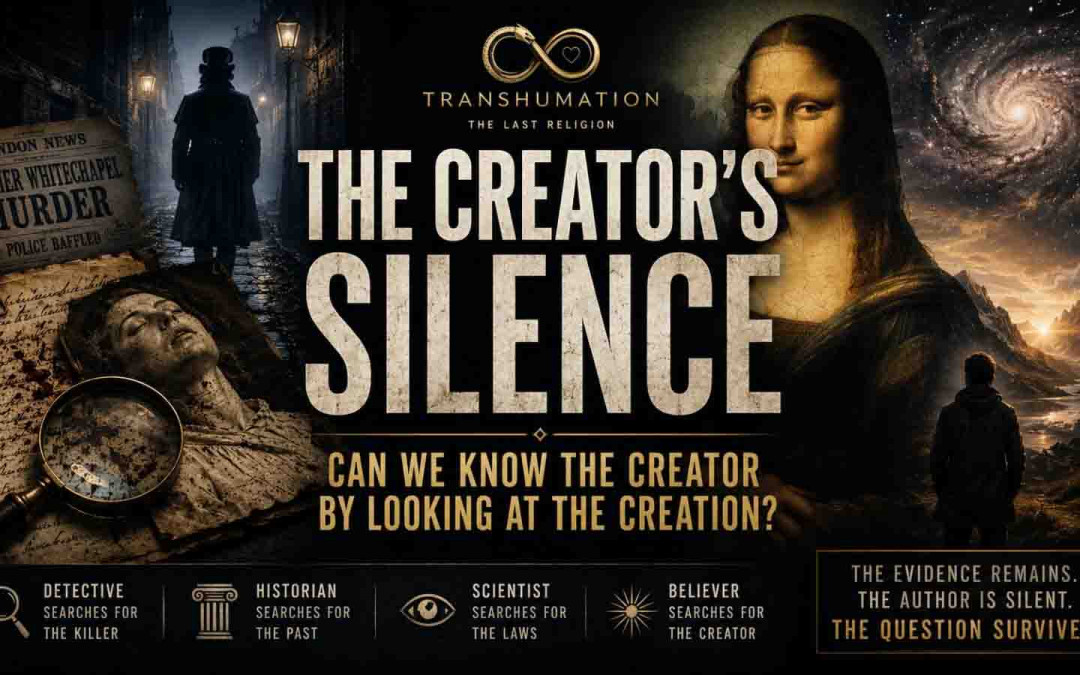
The Creator’s Silence
Can We Know the Creator by Looking at the Creation?
Every investigation begins after something has already happened.
The detective arrives after the killer has left. The archaeologist enters a city whose builders are dead. The art historian stands before a painting while the painter has been silent for centuries. The astronomer points an instrument toward a universe that offers no footnotes. In each case, the observer begins not with the source but with what remains of it.
This is such an ordinary structure that we rarely notice how much of civilization depends on it. We inherit effects and work backward toward causes. We see a wound and infer a weapon. A ruin and infer a settlement. A sentence and infer an author. A mathematical structure and infer rules. Sometimes the reconstruction is strong. Sometimes it is speculative. Sometimes two observers study the same object and produce incompatible stories.
The creator is absent.
The creation remains.
And between them stands interpretation.
The Detective Arrives Too Late
Consider Whitechapel in 1888.
By the time police arrived at a murder scene, the central fact of the case was already missing. The killer was gone. What remained were consequences: injuries, location, timing, blood, clothing, witness statements, geography, perhaps objects left behind. None of those things was the murderer. Yet investigators treated them as traces through which the invisible person might be partially reconstructed.
This is one of the oldest forms of reasoning: infer the absent cause from the surviving effect.
A particular wound may suggest a particular instrument. A sequence may suggest knowledge, speed or habit. Geography may suggest familiarity. Repeated choices may suggest a pattern. The detective never possesses the creator directly. He possesses the structure left by the creator’s actions.
But this method has limits.
The same wound can sometimes be produced in more than one way. The same location can fit more than one explanation. A pattern may belong to the offender, or it may belong to the observer who has selected the evidence.
That distinction is the entire danger.
The trace is real.
The interpretation may still be wrong.
A Painting That Refuses to Explain Itself
Now move from Whitechapel to the Louvre.
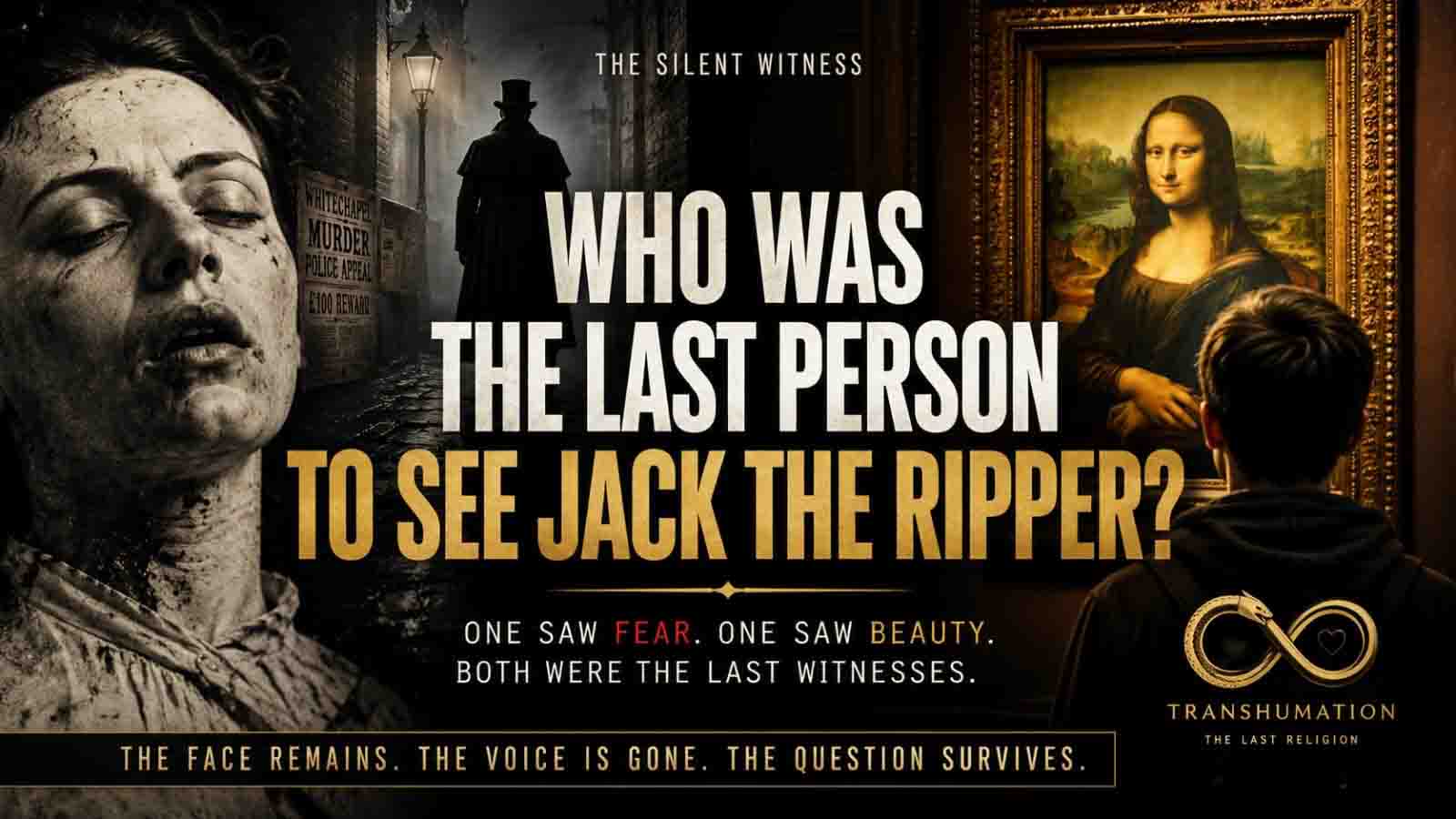
The Mona Lisa does not look like evidence because there is no crime. But the structure of the inquiry is surprisingly similar. Leonardo is absent. The painting remains. Viewers examine technique, composition, revisions, expression, materials and historical context, then ask questions that go beyond the visible surface.
Who was the sitter?
Why this expression?
What was Leonardo trying to do?
Which details were intentional?
Which effects emerged from technique rather than conscious design?
Art history has far more evidence than a casual museum visitor, but the central asymmetry survives: the work can be inspected; the maker cannot be interviewed.
The painting therefore becomes a kind of silent witness to the mind that produced it.
Yet even here, caution matters. A work can reveal competence, method, preference and cultural context without revealing every intention. Artists discover effects they did not consciously plan. Viewers bring meanings no creator anticipated. A painting can outlive the mental state that produced it and acquire new interpretive structures over centuries.
The creator made the work.
The future partly makes its meaning.
The Same Stars, Different Animals
The observer’s role becomes even clearer when no human creator is involved.
Look at the night sky.
The stars are there. Their positions can be measured. Their spectra can be analysed. Distances can be calculated. But cultures have repeatedly grouped those same points of light into different constellations, different animals, different heroes and different stories.
The physical arrangement remains the same.
The pattern changes with the observer.
This does not mean all patterns are arbitrary. Astronomy discovers structures that are not matters of cultural preference: orbital relationships, stellar evolution, spectral classes, gravitational interactions. But the constellation offers a useful reminder that seeing structure and assigning meaning to structure are not identical acts.
We often perform both at once.
A cluster becomes a shape.
A coincidence becomes a sign.
A repetition becomes a law.
A triangle becomes stability.
The question is not whether humans should stop recognizing patterns. Civilization would collapse immediately if we did.
The question is more difficult:
Which patterns are in the world, and which become visible only because of the observer?
When the Universe Becomes Evidence
At this point the same structure enters religion and philosophy.
For thousands of years, people have looked at the order, regularity, complexity or beauty of the world and asked whether these features reveal something about an origin beyond the world itself. Arguments from design, order or contingency take many forms, but they share a broad direction: move from creation toward creator.
Science approaches the same universe under stricter methodological constraints. It asks which observed structures can be explained through physical processes, testable models and natural history. Biological complexity, for example, no longer requires direct inference to a designer once evolution by natural selection is understood as a mechanism capable of generating adaptation over time.
But science does not simply answer every metaphysical question by refusing to ask it. It establishes a boundary around what evidence can currently support.
This distinction matters.
A believer may see order and infer intention.
A naturalist may see order and infer emergent structure under lawful processes.
A skeptic may conclude that the evidence is insufficient to infer anything beyond the universe.
The stars do not change between those positions.
The interpretive threshold does.
That does not make every conclusion equally strong. Evidence constrains interpretation. Some claims can be tested, others cannot. Some explanations make predictions, others do not.
But the observer still decides how far inference is allowed to travel.
The Problem of the Silent Author
Silence has a peculiar effect on interpretation.
When the creator cannot answer, the work becomes larger.
Leonardo cannot correct our reading of the smile.
The builders of Stonehenge cannot explain every decision.
Jack the Ripper cannot tell investigators which apparent patterns were intentional and which were accidents.
Ancient authors cannot clarify every metaphor.
If God exists, there is no universally available interview in which disputed theological questions are settled line by line.
Absence removes a final authority.
The result is not pure freedom. Evidence remains. Context remains. Constraints remain. But the space of interpretation widens because no living creator can close it.
This is why old works often become more culturally powerful rather than less. Each generation encounters the same object through different knowledge, assumptions and anxieties.
The work stays still.
The observer moves.
Civilization Is a Second Author
We usually think civilization is preserved through creation.
Someone writes the book.
Builds the monument.
Paints the image.
Discovers the theorem.
But preservation alone would produce a museum with no visitors.
Civilization also depends on reinterpretation.
A text survives because later readers decide it still matters. A ruin becomes archaeology because someone reconstructs context around it. A religious symbol acquires a new philosophical meaning. A scientific theory is refined, attacked or replaced. A painting receives layers of commentary its maker could never have imagined.
In this sense, civilization is not merely a warehouse of inherited works.
It is a continuing negotiation between silent creations and changing observers.
That is why the same object can become many things without physically changing.
A Roman temple becomes a church.
A myth becomes literature.
A religious symbol becomes psychology.
A court record becomes historical evidence.
A murder letter becomes an object of linguistic analysis.
The carrier survives.
The interpretive system changes.
Can Creation Reveal the Creator?
The obvious answer is yes.
Sometimes it can.
A programmer’s code can reveal competence. A composer’s music can reveal habits of structure. A crime scene can reveal practical constraints. A painting can reveal technique. A building can reveal engineering knowledge. We infer creators from creations constantly, and often successfully.
But the stronger question is whether creation can reveal the creator completely.
That answer is much less comfortable.
A work is a projection through constraints. It contains choices, but also materials, accidents, conventions, collaborators, tools and circumstances. A creator may not fully understand what was created. A system may produce consequences nobody intended.
The creation therefore carries information about the creator without being a transparent window into the creator.
That is the boundary.
We can infer.
We cannot simply equate.
And that distinction may be the difference between investigation and projection.
The Observer in the Middle
There is a tendency in philosophical arguments to imagine two poles.
Creator.
Creation.
But there is always a third term.
Observer.
The observer chooses what counts as evidence.
The observer chooses which comparisons matter.
The observer decides when a pattern is strong enough to justify a conclusion.
The observer brings prior knowledge, language, expectations and blind spots.
This does not mean truth is invented by the observer. It means access to truth is mediated by one.
A detective can become better.
An art historian can learn more.
A scientist can build better instruments.
A civilization can correct inherited interpretations.
But there is no interpretation without some structure doing the interpreting.
This makes the creator question inseparable from the observer problem.
We do not merely ask:
What created this?
We also have to ask:
What kind of observer are we while trying to answer?
Watch The Video
How to Read the World
Current Knowledge
Forensic science, archaeology, art history and other disciplines routinely infer causes, authorship, processes or intentions from surviving evidence. The strength of those inferences depends on the quality, quantity and independence of the evidence.
Eyewitness and interpretive judgments are not infallible. Human perception and memory are selective, and observers can identify patterns that are meaningful, mistaken or coincidental. Scientific methods attempt to reduce these errors through replication, measurement, comparison and falsification.
The Mona Lisa is securely attributed to Leonardo da Vinci, but many questions about artistic intention remain debated. Historical works can often support strong conclusions about technique and context without resolving every question of meaning.
In science, explanations are generally preferred when they generate testable predictions and remain consistent with observed evidence. Scientific methods do not, by themselves, establish or refute every metaphysical claim about a creator of the universe.
Open Questions
How much can intention be reconstructed after a creator disappears? In some cases, surviving drafts, letters and contextual evidence provide strong support. In others, the work may allow several interpretations without enough evidence to decide among them.
There is also a deeper problem of pattern recognition. Humans are extraordinarily good at detecting structure, but this ability also produces false positives. How can we distinguish genuine hidden structure from meaning generated by the observer?
The largest version of the problem remains philosophical: can features of the universe justify conclusions about a creator beyond it, or do such conclusions exceed what the available evidence can establish?
Transhumation Interpretation
Transhumation treats the creator problem as a three-part system:
creator → creation → observer
The creator produces a trace.
The creation preserves part of the trace.
The observer reconstructs a model of what might have produced it.
At every step, information can be preserved.
At every step, information can also be transformed.
This is why the creator’s silence matters.
When the source disappears, the observer becomes more important. The work cannot explain itself. The trace cannot tell us which features are central. The universe does not attach a legend describing which structures should be read as necessity, accident, design or emergence.
We build the legend.
Then we test it.
The strongest interpretation is not the one that feels most meaningful.
It is the one that survives pressure from evidence.
This applies to a crime scene, a painting, a religious symbol and a philosophical model. The domains differ. The discipline should not.
The creator may remain silent.
The creation may remain incomplete.
The observer does not therefore gain permission to invent freely.
The observer gains responsibility.
Perhaps that is the real structure hidden beneath all these investigations. Civilization is not only a collection of things created by the dead.
It is a system in which the living repeatedly ask what those things allow us to know.
The silence is not the end of the conversation.
It is the moment the burden of interpretation passes to us.
FAQ
What does “The Creator’s Silence” mean?
It describes the situation in which a creator is absent and later observers must interpret the surviving work or trace without direct clarification.
Can we know a creator from the creation?
Sometimes we can infer important features such as method, competence, context or intention, but a creation rarely provides complete access to the creator.
How does Jack the Ripper fit the idea?
Investigators attempt to reconstruct an absent offender from surviving traces, choices and consequences.
Why is the Mona Lisa included?
It shows the same structure in art: a silent work becomes evidence from which later observers infer something about the absent artist.
Do patterns exist in the world or in the observer?
Both possibilities occur. Some structures are objectively measurable, while other perceived patterns depend heavily on classification and interpretation.
Does the article argue that religion and science are the same?
No. They use different standards and methods. The comparison concerns the structural act of moving from observed effects toward possible causes.
What role does the observer play?
The observer selects, compares and interprets evidence. Better methods can constrain interpretation, but no inquiry occurs without an observer or interpretive system.
How does this connect to Transhumation?
Transhumation studies how information survives across carriers and how observers reconstruct meaning from what remains.
What is the central idea?
The creator may disappear, but the creation continues to generate interpretations. The challenge is not merely to find meaning, but to distinguish what the evidence supports from what the observer has added.
Continue the Transhumation Series
- Forgotten Religion | Ancient Gods, Symbols and the Hidden Structures of Human Civilization
- The Last Religion | Death, Immortality and the Future of Humanity
- The New Theurgy | AI, Information and the Future of Human Civilization
- End of Branding: You Were Never Meant to Become a Product
- Baal vs Ishtar: Why Ancient Gods Never Disappeared