
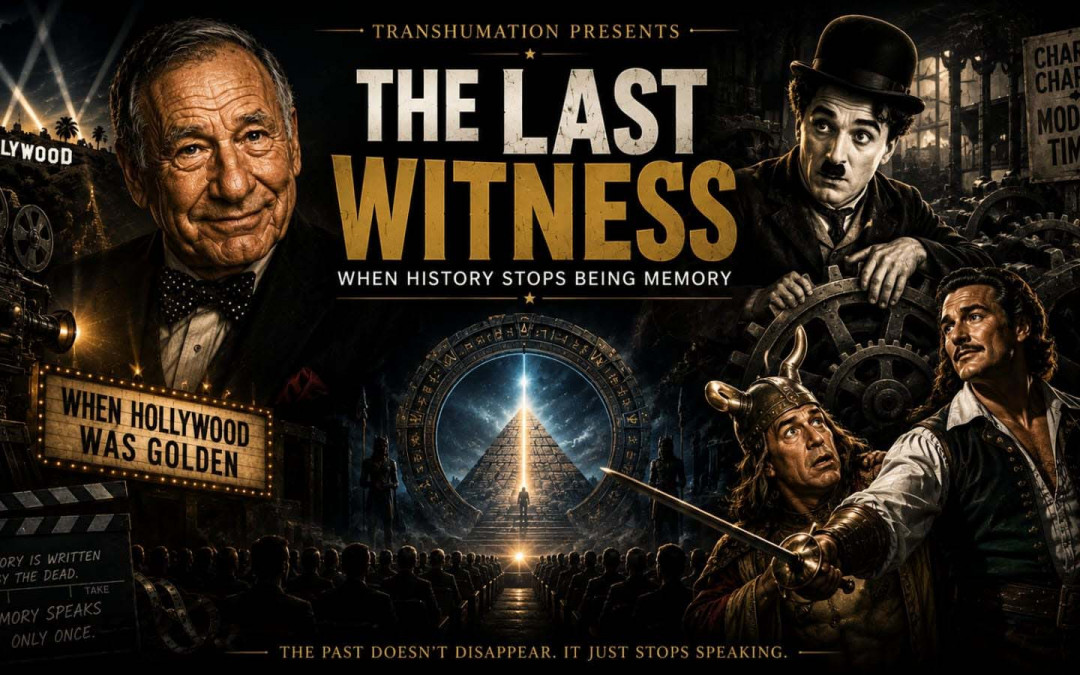
The Last Man Standing
In an archive, a dead person can still answer a question.
Up to a point.
Press play and the voice returns. The speaker clears his throat, hesitates, laughs at something the interviewer said forty years ago and begins describing a street that no longer exists. The accent is intact. So is the rhythm of thought. There may even be a moment when the listener forgets that the person speaking has been dead for decades.
Then a new question occurs to you.
Perhaps it is obvious now but was not obvious when the interview was recorded. Perhaps the speaker mentions a colleague nobody followed up on, an unfamiliar expression, a smell, a routine, a minor disagreement. You want to interrupt. You want to say: Wait. What did you mean by that?
The recording continues.
That is the boundary.
An archive can preserve an answer with astonishing fidelity. It can preserve the voice that gave it, the face that formed it and sometimes the room in which it was spoken.
What it cannot preserve is the original speaker’s ability to hear a question that has not yet been asked.
When the last witness dies, history does not begin.
But something in the past becomes irreversible.
When Does Memory Become History?
There is no clean moment when memory ends and history begins.
Historians study events while participants are still alive. Witnesses read history books about their own era. Public memory, family memory, journalism, documentary evidence and academic history overlap for decades.
Yet they do different things.
Memory is carried by a living person. It is embodied, selective and continually rewritten by later experience. A witness to an air raid may remember the sound of a siren, the embarrassment of crying in front of a sibling, the peculiar smell of a shelter or a joke that seemed indecently funny because everyone was frightened.
A historian can place the same night inside a much larger structure.
Which aircraft were present?
What orders had been issued?
How did the raid fit into a military campaign?
How many buildings were damaged?
How did newspapers describe it?
The witness may know almost none of this.
The historian may know all of it and still have no idea what the room smelled like.
Neither perspective automatically outranks the other.
They operate at different scales.
History reconstructs.
Memory participated.
The mistake begins when participation is mistaken for omniscience, or reconstruction is mistaken for presence.
The Record, the Witness and the New Question
Documents are sometimes treated as dead things while witnesses are treated as living truth.
That is too romantic.
A document can contradict a witness correctly.
A photograph can reveal something nobody present noticed.
A payroll can establish that someone was somewhere else.
A contemporaneous diary may preserve uncertainty that later memory smooths into certainty.
The archive can resist memory.
But the living witness has one unique property.
Responsiveness.
You can return.
You can ask for clarification.
You can place another document on the table and watch recognition, confusion or irritation appear.
You can say, “You told an interviewer in 1974 that this happened on Tuesday, but the records indicate Thursday. Why do you think you remembered Tuesday?”
The answer may not solve the contradiction.
It may create another one.
But that too is evidence.
A living source can revise, refuse, remember differently or expose the historian’s misunderstanding.
Once the source dies, the existing record remains open to interpretation.
The person is no longer open to interrogation.

What Happens When the Last Eyewitness Dies?
Usually, nothing visible.
No archive door closes.
No law changes.
The photographs remain exactly where they were.
Yet one category of evidence has ceased to grow.
If the final direct participant in an event dies, historians can still discover new documents, reinterpret known ones, use new scientific techniques or locate material nobody previously recognized as relevant. Knowledge of the event may become richer after the last witness is gone.
What cannot happen is a genuinely new first-person response from someone who was there.
That distinction is narrower than saying the event itself has died.
It is also more important.
History loses one route of correction.
The event can still surprise us.
The participant cannot.
This is particularly significant because questions change between generations. What one era considers trivial can become central to another.
An interviewer in 1950 may ask a factory worker about wages and strikes.
A historian in 2050 may want to know about sound.
How loud was the floor?
Could workers recognize individual machines by ear?
Did conversation require gestures?
Were there unofficial signals between experienced workers?
The archive may contain answers accidentally.
But nobody in 1950 knew which questions 2050 would need.
The Question Nobody Thought to Ask
Every archive is built by selection.
Governments preserve what administration requires.
Military institutions preserve orders, reports and casualties.
Families preserve weddings, holidays and the photographs in which everyone looks respectable.
Corporations preserve contracts, accounts and correspondence.
Museums preserve objects someone decided were significant.
Future historians inherit not the past but a surviving sample of what earlier people thought worth keeping, plus whatever survived by accident.
This makes the living witness unusually valuable.
The witness can sometimes bridge the gap between archive and ordinary life.
What did people call that object when no official was listening?
Was the rule actually followed?
Was the supposedly prestigious institution taken seriously by the people inside it?
Which door did workers really use?
What did everyone know but nobody write down?
These questions matter because civilization contains enormous amounts of knowledge that are never formally declared.
The archive loves statements.
Life is full of assumptions.
The Witness Is Not the Truth
None of this means testimony should be worshipped.
Human memory is reconstructive.
People misremember sequence.
Later knowledge can alter recollection.
Repeated storytelling can make one version increasingly fluent without making it increasingly accurate. Reputation, shame, loyalty and self-protection can influence what a witness chooses to say.
Two sincere witnesses can remember the same event differently.
Sometimes the person least qualified to understand the significance of an event is the person standing inside it.
Participants see fragments.
Historians can sometimes see systems.
A soldier may know exactly how a position looked from one ditch while misunderstanding the battle.
A government official may remember a meeting accurately while failing to understand the economic conditions surrounding the decision.
A filmmaker may describe what they intended while viewers correctly notice meanings produced by the finished work that the filmmaker never consciously planned.
The witness therefore does not end interpretation.
The witness complicates it.
That is their value.
Can a Creator Control the Meaning of a Work?
Death makes this problem particularly elegant in art.
While a filmmaker or novelist remains alive, critics can ask.
Was the color deliberate?
Was that character based on someone?
Did the political interpretation occur to you?
Was the ending intended to be ambiguous?
The creator can answer.
That answer becomes evidence about intention.
It does not necessarily become the final meaning of the work.
Artists can forget.
They can change their minds.
They can strategically deny interpretations.
More importantly, a work can produce effects beyond conscious intention.
The author’s voice belongs in the argument without necessarily owning it.
When the creator dies, therefore, the work is not liberated from some dictatorship of intention.
Something simpler happens.
One source stops producing new evidence.
Stanisław Bareja can still be studied through films, interviews, collaborators, production records and historical context. His work can generate interpretations nobody offered during his lifetime.
What cannot happen is Bareja hearing one of those interpretations and saying, “No, you have missed something.”
Death does not end interpretation.
It removes one participant from it.
Mel Brooks and a Century Inside One Person
Longevity makes this transition unusually visible.
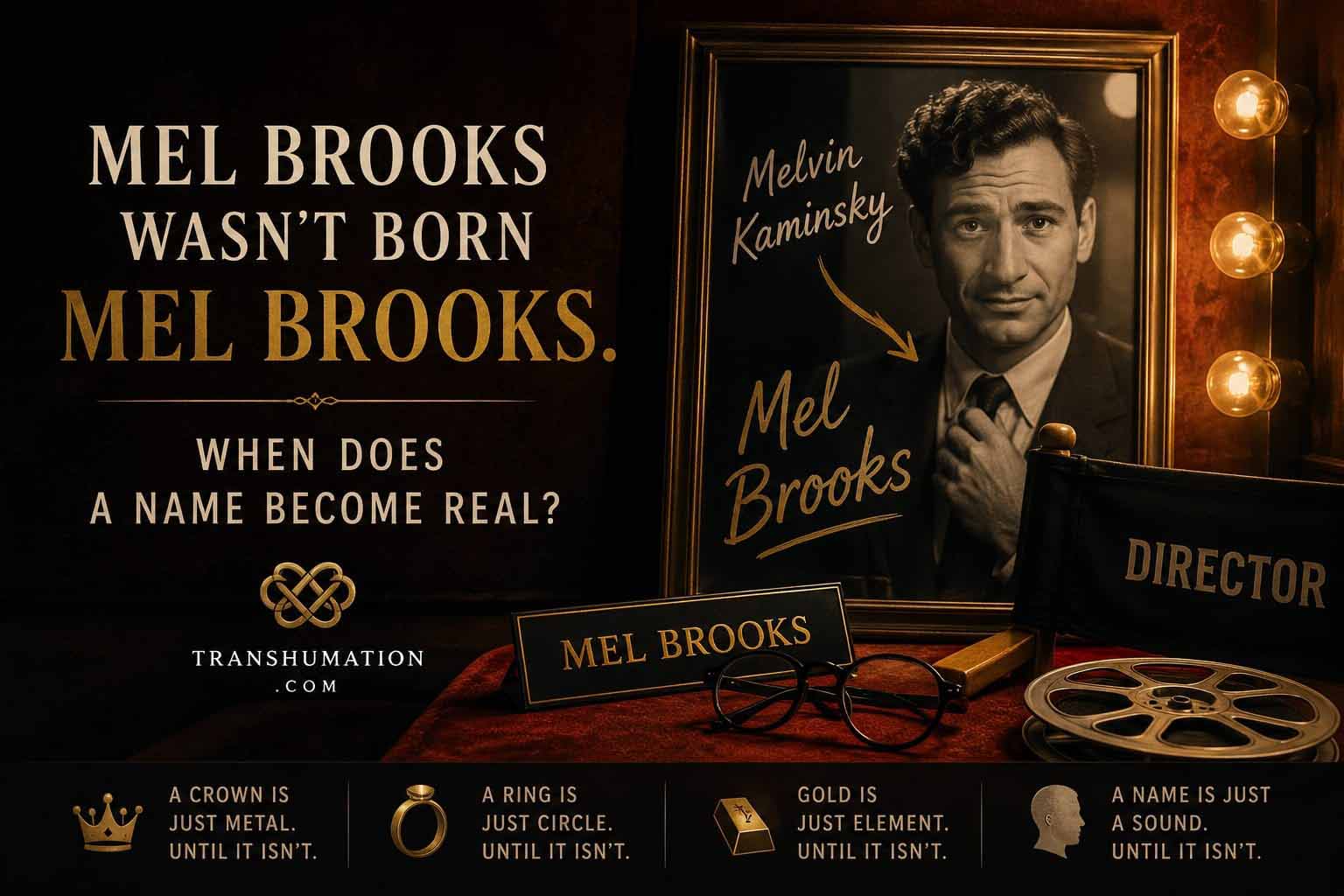
Mel Brooks was born in 1926. By the time he reached one hundred in 2026, his life connected cultural environments that otherwise look almost like separate archaeological layers of modern America.
Childhood before television became the dominant domestic medium.
Military service during the Second World War.
The writers’ rooms of early American television.
Broadway.
Postwar comedy.
The transformation of Hollywood.
Home video.
Cable television.
The internet.
Streaming.
Artificial intelligence.
A timeline can list those transitions.
A living person can remember moving through them.
That difference matters.
Ask an archive when television became culturally important and it can provide statistics, broadcasts and contemporary criticism. Ask someone who lived through the change and they may remember the first household on the street to buy a set, the chairs being moved toward the screen, or the strange feeling that everybody suddenly knew the same joke the next morning.
Such testimony is not necessarily more reliable.
It is differently scaled.
Eventually every living connection becomes archival.
The laugh remains.
The ability to interrupt it does not.
What Happens When the Last Speaker of a Language Dies?
Language makes the distinction even clearer because a language is not merely stored information.
A dictionary can preserve words.
A grammar can preserve rules.
Recordings can preserve pronunciation.
Stories can preserve idiom.
Excellent documentation may allow descendants and linguists to revitalize a language after fluent intergenerational transmission has broken.
So it is too strong to say that a language simply dies in the same instant as its final fluent speaker.
But something can end.
Spontaneous social use.
The ability of speakers to innovate together without consulting an archive.
The joke created tonight.
The affectionate insult invented tomorrow.
The tiny correction one speaker makes because another expression “doesn’t sound right.”
Living languages constantly generate forms nobody planned to preserve.
An archive can record a language.
A community performs it.
The distinction resembles music.
A score can survive after an orchestra disappears.
That does not mean the score is the performance.
What Is Tacit Knowledge?
A skilled craftsperson may know something they cannot state adequately.
They hear a bearing beginning to fail.
Feel that dough contains enough water.
Recognize resistance through a hand tool.
Adjust a machine by a few millimeters without explicitly calculating the correction.
This is often described as tacit knowledge: competence acquired through repeated practice that cannot always be reduced neatly to verbal rules.
Modern technology can preserve more of this than earlier archives could.
High-resolution video can capture hand movement.
Sensors can measure force.
Audio recordings can preserve machine sounds.
Motion capture can record posture.
An apprentice can still learn through demonstration.
Yet recording every measurable movement may not capture the entire structure of expertise, because skilled action often depends upon context-sensitive judgment developed through experience.
The last craftsperson therefore does not necessarily take a secret formula to the grave.
The loss may be subtler.
The chain between instruction and practiced judgment becomes harder to reconstruct.
A manual preserves the rule.
A master shows when to ignore it.
Why Civilization Builds Libraries
Libraries are technologies built against this asymmetry of time.
The dead cannot remain available indefinitely.
So civilization externalizes traces.
Writing preserves statements.
Portraiture preserves appearance selectively.
Photography preserves optical traces.
Audio preserves voices.
Film preserves movement.
Digital archives allow unprecedented quantities of material to be copied, indexed and connected.
Every medium captures something the previous medium struggled to carry.
None captures the entire person.
This is not failure.
It is the condition of preservation.
Every archive is compression.
The decision is always what can survive the transition of carrier.
A letter preserves words but not the exact voice in which they were spoken.
A film preserves movement but not everything outside the frame.
A recording preserves an answer but not every future answer the speaker might have given.
The good archive does not pretend otherwise.
It preserves the trace and, where possible, the boundaries of the trace.
Can AI Reconstruct a Historical Witness?
This is where the old problem becomes genuinely new.
Imagine a person who left behind hundreds of hours of interviews, thousands of letters, diaries, films and conversations. A sufficiently capable AI system could organize this archive and construct plausible responses to questions the person never answered directly.
For education, this could be extraordinary.
A student could ask a historical figure about a theme and receive an answer assembled from relevant primary sources.
A researcher could discover connections scattered across thousands of pages.
A family could interact with a model reflecting the vocabulary and memories of someone they lost.
But the realism of the result creates the central danger.
A generated answer is not testimony.
The model was not present at the event.
It cannot remember what was never preserved.
When it supplies a plausible missing detail, it is reconstructing.
If its reconstruction becomes sufficiently fluent, the difference between archival evidence and synthetic continuation may become psychologically difficult to perceive.
This is why provenance becomes more important as simulation improves.
The future archive should be capable of saying:
This sentence was spoken by the person.
This conclusion is inferred from several sources.
This answer is generated.
This point is unknown.
Those distinctions are not bureaucratic footnotes.
They are the line between history and ventriloquism.
The Witness Becomes the Archive
While a witness lives, information remains attached to a changing biological system.
The person can forget.
Recover a memory.
Change an interpretation.
Encounter evidence.
Refuse an interview.
Remember a name at three in the morning.
After death, the available traces stop expanding through that person’s agency.
The archive may continue expanding because other people discover letters, digitize recordings or connect materials.
But the original source no longer generates new testimony.
This is a transformation of carrier.
Living memory becomes recorded structure.
Something survives magnificently.
Something ends completely.
The mistake would be to confuse either side of that sentence with the whole person.
The Last Answer
Perhaps this is a better way to describe the final witness than speaking of the final death of an event.
An event can remain culturally active for centuries.
Its meaning can change.
Its documentation can grow.
Its victims can be rediscovered.
Its accepted history can be overturned.
But one day, someone asks the last question that will ever receive a direct answer from a participant.
Nobody knows it is the last question.
Perhaps it is banal.
Perhaps the interviewer wastes it.
Perhaps the witness answers badly.
Years later another researcher listens and desperately wishes one obvious follow-up had been asked.
That missed question is the true boundary.
Not between memory and history.
Between a past that can still produce new testimony and a past that can now produce only new interpretations of surviving traces.
That is a smaller claim.
It is also a more haunting one.
Watch the Video
How to Read the World
Current Knowledge
Eyewitness testimony is an important historical source but is not inherently more accurate than documentary evidence. Human memory is reconstructive and can be influenced by time, later information, repeated retelling, emotional context and social pressure. Historians therefore compare testimony with other sources rather than treating memory as direct access to the past.
Living witnesses nevertheless provide a distinctive form of evidence because they can respond to new questions, clarify earlier statements and react to newly discovered material. Recordings preserve past responses but cannot produce genuinely new first-person testimony after the speaker’s death.
Historical knowledge can continue improving after the last eyewitness disappears. New documents may be discovered, archives opened, physical evidence re-examined and earlier interpretations challenged. The end of living memory is therefore not the end of historical discovery.
Languages and practical skills can be documented through writing, audio, film and technical measurement, but documentation does not perfectly reproduce living social use or tacit expertise. Revitalization is possible in some cases, which makes the boundary between a documented and a living tradition more complex than a simple alive/dead distinction.
AI systems can organize archives and generate reconstructions from surviving material, but such outputs are new computational products. They should not be treated as direct testimony unless the content can be traced to authentic statements by the historical person.
Open Questions
One major question is how future archives should distinguish primary evidence from reconstruction. As synthetic voices and historically styled conversational agents become more convincing, visual or linguistic realism will become increasingly useless as evidence of provenance.
Another concerns tacit knowledge. We can record movement, pressure, sound and procedure more precisely than any earlier civilization, yet it remains unclear how much expert judgment can be reconstructed once the community that practiced it continuously has disappeared.
There is also a difficult problem of selection. We cannot know which questions future generations will consider important, which means every archive inevitably preserves some things in extraordinary detail while allowing other dimensions of ordinary life to vanish almost completely.
The deepest question concerns presence itself. If future AI can generate responses so accurately that descendants experience them as conversations, will societies continue to maintain a meaningful distinction between a surviving pattern of a person and the person who once generated that pattern?
Transhumation Interpretation
For Transhumation, the last witness marks the boundary between responsive memory and preserved trace.
A recording can carry voice across time. An archive can carry knowledge. AI may eventually make those traces interactive.
But interactivity must not be confused with continuation.
The original witness could still surprise the archive because they stood partly outside it. A reconstruction can only work from what reached the archive in the first place.
The future librarian therefore has a new duty: not merely to make the dead speak, but to preserve exactly where they fell silent.
FAQ
What is a “last witness”?
It is the final living person with direct experience of a particular event, community, practice or historical environment.
Does history begin when the last witness dies?
No. History already exists while witnesses are alive. What ends is the possibility of obtaining new first-person testimony from a participant.
Are eyewitnesses more reliable than documents?
Not automatically. Memory can be inaccurate or distorted, while documents can preserve details more reliably. Historians compare multiple forms of evidence.
Can recordings replace living witnesses?
They can preserve previous answers, voice and behavior, but they cannot allow the original person to answer a question that was never asked.
Can AI recreate a dead historical figure?
AI may produce useful reconstructions based on authentic archival material. Those reconstructions can be educationally powerful, but generated responses remain interpretations rather than testimony from the deceased person.
What is the deeper Transhumation question?
The deeper question is not whether civilization can preserve more information.
It almost certainly can.
The question is whether preservation can ever preserve the capacity to surprise us in the same way a living person could.
A witness contains more than the answers already given. There are memories nobody requested, corrections nobody provoked, associations nobody knew to trigger. While the person lives, the archive remains partly unwritten.
After death, the relationship reverses.
The surviving material can still answer us, but only through what entered a carrier before the source disappeared. Future technology may make that material searchable, conversational and astonishingly lifelike. It may even produce answers better organized than the witness would have given.
That will make one distinction more important, not less.
The difference between a voice that survived and a person who is still there.
Perhaps this is what a library really preserves.
Not the past itself.
Enough of its structure that the future can continue asking questions, even after the last person capable of answering them has left the room.
Continue the Transhumation Series
- Forgotten Religion | Ancient Gods, Symbols and the Hidden Structures of Human Civilization
- The Last Religion | Death, Immortality and the Future of Humanity
- The New Theurgy | AI, Information and the Future of Human Civilization
- End of Branding: You Were Never Meant to Become a Product
- Baal vs Ishtar: Why Ancient Gods Never Disappeared