
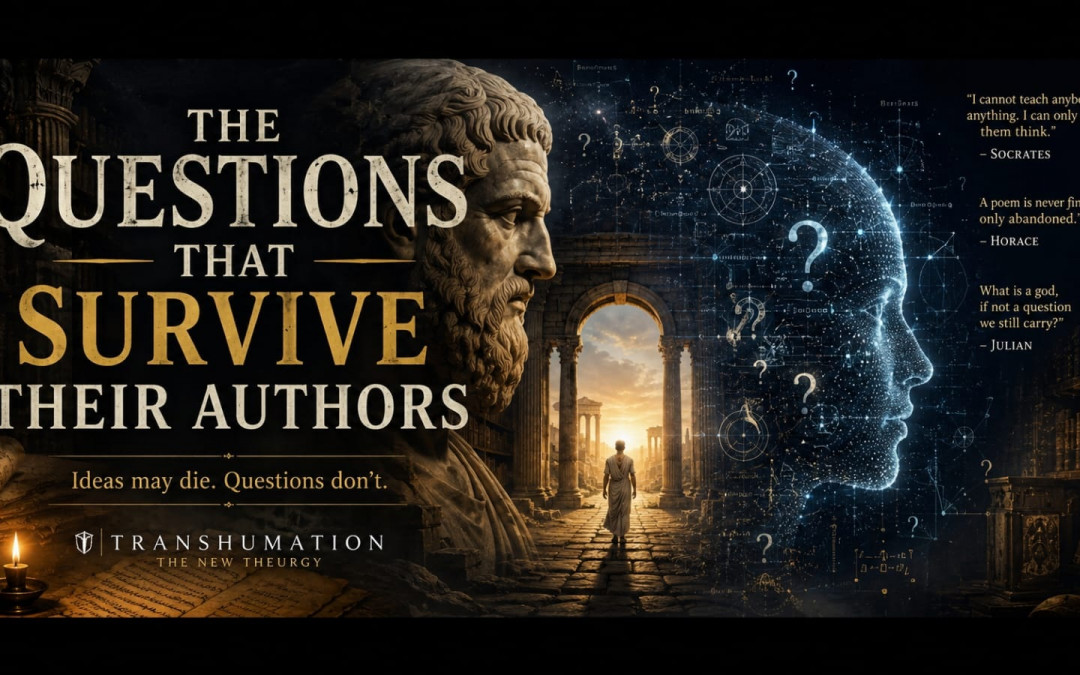
The Moment That I`ve Met Plato
Plato is dead. Rome changed beyond recognition. Julian lost his empire and Horace lost his world. Yet some of their questions have proved harder to kill than the civilizations that carried them.
Plato has been dead for more than twenty-three centuries, which should make conversation with him impossible. His voice is gone, the Athens he knew is buried beneath other cities, the political crises that formed him belong to a world whose assumptions we have to reconstruct before we can even understand some of his arguments. And yet a student can open the Republic tonight and become irritated by Plato before breakfast. A philosopher can still argue with the Theaetetus about knowledge. A political theorist can object to the philosopher-king. A neuroscientist can stumble into an ancient problem concerning perception without accepting a word of Platonic metaphysics. The remarkable thing is not that Plato somehow remained alive. He did not. The remarkable thing is that the death of the person failed to terminate the problem.
We usually teach history through the things that are easiest to date: rulers, wars, inventions, dynasties, borders, treaties. The method is necessary, but it can create the impression that civilization consists primarily of events arranged on a timeline. There is another history running through the same material, much harder to place on a map. It is the history of questions. What is justice? What can we know? Why does anything exist? What makes political authority legitimate? Is consciousness reducible to matter? What, if anything, survives death? These questions pass through cultures whose answers may be completely incompatible. The vocabulary changes, the gods change, the scientific instruments change, and sometimes the question itself is reformulated so radically that its earlier version becomes difficult to recognize. Yet something continues.
Perhaps civilizations do not merely inherit answers.
They inherit unfinished business.
Plato Did Leave — The Question Did Not
There is a romantic temptation to say that opening Plato is equivalent to meeting Plato. It is a beautiful metaphor, but it should remain a metaphor. We do not possess Plato in full. The surviving dialogues are literary constructions rather than transcripts of his private mind, ancient testimony suggests that oral teaching also mattered within his philosophical world, and scholars still disagree about chronology, doctrine and how directly particular speakers represent Plato’s own positions.
This does not diminish the achievement of transmission. It makes it stranger.
We do not need complete preservation of a person for an intellectual structure to survive. A fragmented transmission can be enough to keep a problem active for thousands of years. Plato’s treatment of knowledge does not need to contain the final theory of knowledge to remain useful. His political philosophy does not need to be correct to continue generating objections. In fact, the survival of the question may depend partly on the incompleteness of the answer.
A closed problem becomes an entry in a handbook.
An open problem acquires descendants.
This is why the greatest texts often behave differently from instruction manuals. We return to Newton because some of his discoveries became foundations of science, but we return to Plato in another sense: not simply to retrieve what he knew, but because the architecture of the disagreement remains productive. He creates rooms that later centuries continue furnishing.
The strange continuity is therefore not Plato → Plato → Plato.
It is Plato → Aristotle → later Platonists → theologians → humanists → modern philosophers → people asking questions Plato could never have anticipated.
The person does not travel through time.
The question mutates while remaining recognizable.
Horace Built the Monument Out of the Wrong Material
Near the end of one of his most famous odes, Horace announced that he had built a monument more lasting than bronze. He was speaking about poetry, not architecture, and the boast has survived long enough to become almost comically self-validating. The marble buildings of Augustan Rome were damaged, dismantled, reused and reconstructed. Political institutions mutated. The Western imperial structure eventually disappeared. Latin itself fragmented into other languages while continuing in religion, scholarship and law.
And Horace is still being read.
It would be misleading to say simply that “Rome disappeared while information survived.” Rome did not vanish in one dramatic moment, and information is not automatically durable. Countless Roman poems, letters, jokes, legal documents and private voices were lost permanently. Horace survived because manuscripts were copied, selected, taught, preserved and repeatedly rescued from the ordinary entropy of history.
That makes the lesson better, not weaker.
Information has no magical immunity to destruction.
It survives when it finds another carrier.
A poem moves from voice to manuscript, manuscript to copy, copy to printed edition, printed edition to digital file. The physical object can disappear repeatedly without necessarily destroying the pattern carried by it.
Horace’s monument was therefore not immaterial.
It was serially material.
Its durability came from the ability to inhabit new matter.
That distinction belongs at the center of Transhumation.
Julian and the Questions He Never Asked
Julian is an especially useful case because modern readers can easily make him too modern. The fourth-century emperor did not ask whether artificial intelligence could replace religion. He did not worry about social media, digital memory or technological secularization. To put those questions directly into his mouth would turn history into ventriloquism.
But Julian confronted a problem whose structure remains recognizable.
What happens when a civilization’s inherited religious order loses cultural authority?
Can an older symbolic system be deliberately rebuilt?
Can philosophy provide coherence to ritual?
Can institutions reverse a transformation that has already altered the habits of a population?
Julian’s attempt to revive and reorganize traditional cults within an increasingly Christianized Roman Empire lasted only briefly. His religious program belonged to the fourth century, not the twenty-first. Yet the underlying tension between inherited meaning and civilizational change has not vanished.
We encounter it whenever a society discovers that its technologies, institutions and moral vocabulary are evolving at different speeds.
That does not mean Julian predicted us.
It means we have encountered another version of a problem he encountered.
This distinction is essential. The strongest historical patterns are not prophecies. They are recurrences created when different systems collide with comparable constraints.
History does not repeat the costume.
Sometimes it repeats the difficulty.

Civilization Is an Argument With Missing Participants
Once this becomes visible, a library looks different.
It is easy to think of a library as storage: thousands of individual containers holding statements produced by dead people. But the more interesting object is the network between them. One writer answers another. A later scientist destroys an earlier explanation while preserving the original question. A theologian borrows a philosophical concept and changes its purpose. A political revolution takes an old word such as liberty and gives it new institutional consequences.
The participants rarely occupy the same century.
Civilization therefore contains conversations in which almost everyone arrives late.
Darwin could not answer a modern geneticist. Aristotle could not read Darwin. Plato could not respond to neuroscience. Julian could not examine the modern secular state. Yet later thinkers can place their works beside one another and produce a conversation none of the original participants experienced.
This is one reason civilization does not restart with every generation. We inherit finished discoveries, certainly, but we also inherit disagreements, failed theories, unresolved definitions and questions whose difficulty has increased rather than diminished.
The inheritance is not merely a warehouse of knowledge.
It is an unfinished argument.
And sometimes inheriting the unresolved part is more valuable than inheriting the answer.
Why Answers Age Faster Than Questions
Answers are usually attached tightly to available evidence.
Ask an ancient physician what causes disease and the answer reflects the conceptual tools available to ancient medicine. Ask a nineteenth-century physicist whether the universe is static and the answer may contain assumptions later evidence changes. Ask a twentieth-century computer scientist what a computer can look like and the answer is constrained by technologies existing at the time.
Questions can be more portable.
What causes disease?
What is the universe doing?
What can computation become?
A good question can cross the destruction of its first answer.
This does not mean questions are automatically profound. Humanity has spent enormous amounts of time asking badly formed questions. Some questions disappear because their assumptions collapse. Asking which planet determines someone’s personality may become less interesting once the proposed causal structure fails to survive evidence.
The valuable question is therefore not simply one that lasts.
It is one that remains productive after its original answers have been attacked.
That is a much stricter criterion.
Perhaps one way to judge an intellectual tradition is not by asking whether its founders were correct, but by asking whether the questions they created continue producing discoveries after their authority has disappeared.
The best question does not demand loyalty to its author.
It survives apostasy.
Watch The Video
How to Read the World

Current Knowledge
Plato’s surviving works continue to influence philosophy, political thought, mathematics, theology and theories of knowledge, although the surviving corpus cannot simply be treated as a complete transcript of Plato’s private beliefs. Interpretation of the dialogues remains contested, and philosophical questions associated with Plato have been reformulated repeatedly under intellectual conditions radically different from those of classical Athens.
Horace’s famous claim in Odes 3.30 that he had constructed a monument “more lasting than bronze” concerned the anticipated survival of his poetry. His works did indeed survive through manuscript transmission and later printing, but that survival depended on human institutions of copying, preservation and education rather than on information possessing automatic permanence.
Julian, Roman emperor from 361 to 363 CE, attempted to strengthen and reorganize traditional religious practices in an empire where Christianity had acquired increasing institutional power. Modern questions concerning technological society should not be attributed directly to him, although historians and philosophers can legitimately compare structural problems across periods as long as comparison is distinguished from historical identity.
More generally, cultural information can survive its original physical carrier when it is copied or translated into another one. Such persistence demonstrates continuity of information or structure; it does not by itself demonstrate survival of the consciousness that originally produced it.
Open Questions
One difficult question is whether there are genuinely perennial philosophical problems or whether later civilizations merely reuse old vocabulary for fundamentally different concerns. When a modern philosopher asks about consciousness and Plato asks about the soul, are they participating in one evolving question, or are modern readers constructing continuity after the fact?
There is also the problem of selection. Millions of questions disappeared because the texts carrying them were lost, languages died or institutions decided that other works deserved preservation. What we call the enduring questions of civilization may therefore reflect not only intellectual quality but accidents of transmission and historical power.
Artificial intelligence adds a new complication. If AI systems make the archive increasingly conversational, obscure texts may return to intellectual circulation while famous thinkers become easier than ever to simulate. Will this enlarge civilization’s unfinished conversation, or will generated answers make old questions appear more settled than they really are?
And there is a harder possibility: perhaps the questions we consider eternal survive only because human beings themselves have not changed enough. A radically different intelligence might inherit our mathematics and technology while finding some of our deepest philosophical problems meaningless.
Transhumation Interpretation
Transhumation should be careful with the word immortality.
A surviving question does not keep its author conscious.
Plato does not wake when we read him. Horace does not experience the survival of his poem. Julian is not observing the religious transformations of the modern world.
But something does survive, and dismissing it because it is not personal immortality would miss one of civilization’s most remarkable technologies.
The structure becomes capable of leaving its original carrier.
A question begins in one biological brain, becomes speech, enters writing, passes through copies, translations and institutions, and eventually reorganizes another biological brain centuries later.
The first observer is gone.
The pattern of inquiry continues moving.
This is a cleaner example of carrier independence than speculative mind uploading because we can already observe it. We know that arguments cross media. We know mathematical relationships can cross notation. We know stories migrate between languages. We know questions can remain legible after the political world that generated them has disappeared.
What we do not know is whether the same principle can be extended from a question to the observer who asked it.
That boundary should remain intact.
Perhaps civilization is therefore a strange organism whose continuity works differently from ours. Individuals persist through biological and psychological processes. Civilization persists by repeatedly transferring selected structures between individuals.
No single person contains the whole conversation.
No generation begins it.
No generation finishes it.
The library exists because every reader arrives halfway through.
This gives another meaning to the old dream of leaving something behind. The ambition need not be to create an answer that everyone will repeat. That may be the most fragile legacy of all, because answers are eventually corrected.
A better legacy may be a question sufficiently precise that future people can use it against your own conclusions.
Plato survives intellectually not because civilization became Platonic.
It survives because civilization can still contradict Plato using problems he helped formulate.
That may be a more demanding form of continuity than fame.
The name can eventually disappear while the question continues.
And perhaps somewhere in the distant future, a mind very unlike ours will confront a structure first noticed by humans and ask the problem again without knowing who first gave it words.
At that point the question will have done something its author never could.
It will have entered a future without needing to bring its creator with it.
FAQ
Why do Plato’s questions still matter?
Because questions concerning knowledge, justice, reality and human nature remain unresolved in forms recognizable to modern philosophy, even though our possible answers and conceptual tools have changed dramatically.
Did Horace really predict that his poetry would outlive Rome?
He famously claimed that his poetic monument would prove more durable than physical monuments. The remarkable part is that his poetry did survive, although through repeated copying and preservation rather than some inherent immortality of information.
Are Julian’s problems really modern?
Not literally. Julian belonged to a very different religious and political world. What can survive is a structural resemblance between his problem of cultural and religious transformation and questions later civilizations encounter under different conditions.
Are questions really more durable than answers?
Some are. A good question can remain productive after several generations of answers have failed, but many questions disappear when their assumptions prove mistaken.
How does this connect to Transhumation?
It provides a demonstrable case of continuity across carriers. Human beings die, physical media disappear and languages change, yet some organized structures of thought can continue moving between minds.
The deeper possibility is therefore not that history is populated by people who somehow refused to die.
It is that civilization discovered a way to continue a conversation after losing almost everyone who began it.
Perhaps history is not a cemetery.
But neither is it a museum of immortal minds.
It is a library after closing time, with books left open on the tables and questions waiting for readers who have not yet been born.
Continue the Transhumation Series
- Forgotten Religion | Ancient Gods, Symbols and the Hidden Structures of Human Civilization
- The Last Religion | Death, Immortality and the Future of Humanity
- The New Theurgy | AI, Information and the Future of Human Civilization
- End of Branding: You Were Never Meant to Become a Product
- Baal vs Ishtar: Why Ancient Gods Never Disappeared