
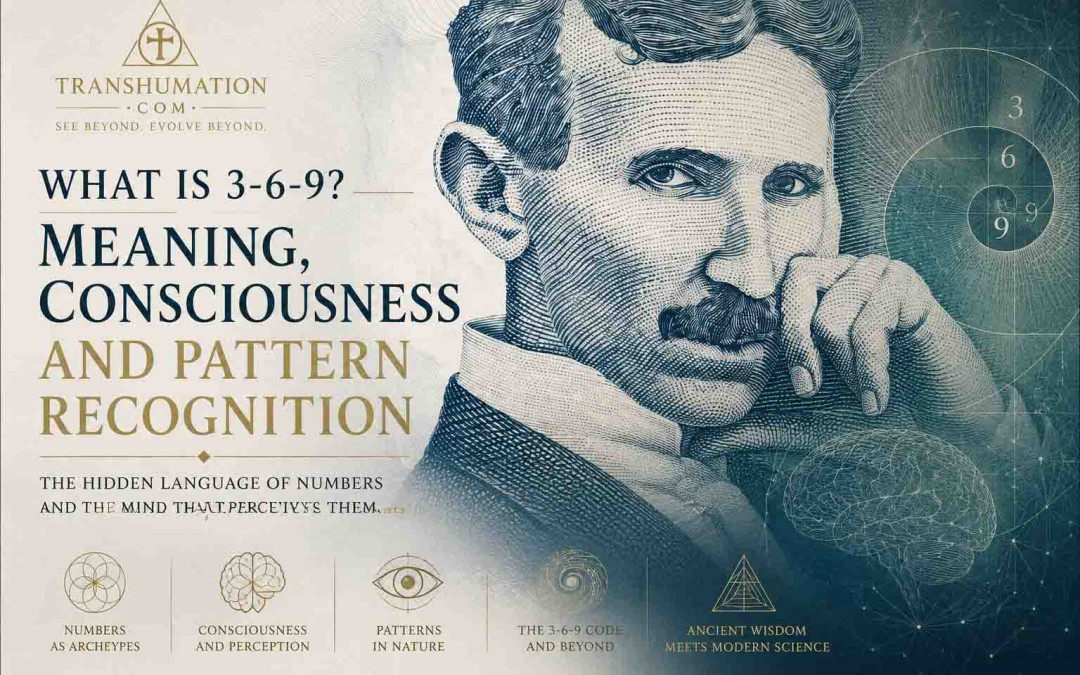
Why Does 3-6-9 Appear Everywhere?
Perhaps the famous sequence is not a code hidden inside the universe. Perhaps it reveals something stranger about the mind looking at it.
You wake during the night and the clock says 3:33. By itself, it means nothing. Two days later your restaurant bill ends in 33.33. A week after that you are given hotel room 306. Then someone sends you a video about Nikola Tesla and the mysterious significance of three, six and nine. The numbers were always there, scattered among thousands of other numbers you ignored, but suddenly they seem to have stepped forward from the background. The next 3 becomes difficult not to notice. The next 6 feels less accidental. By the time 9 appears, you are no longer merely seeing numbers. You are watching a story assemble itself.
This is where discussions of 3-6-9 usually divide into two predictable camps. One announces that the universe is communicating through a secret numerical code. The other laughs and calls the entire thing superstition. Both responses may be too quick. There is a third possibility, less spectacular but considerably more interesting: 3-6-9 matters because the human mind is a machine for detecting relationships, and once relationships become visible they can acquire psychological reality whether or not they correspond to a hidden cosmic design. The mystery, in other words, may not begin with the numbers. It may begin with the observer.
The Key Tesla May Never Have Given Us
Nikola Tesla is almost impossible to resist in a story like this. He worked with electricity invisible to the eye, imagined technologies decades ahead of his time, cultivated eccentric habits and ended his life surrounded by enough mythology to make the boundary between biography and legend unusually porous. There is evidence that Tesla had a fixation on numerical repetition, particularly multiples of three; historical accounts describe him choosing hotel rooms divisible by three and performing repetitive actions according to numerical rules.
Then comes the sentence that transformed eccentricity into cosmology: “If you only knew the magnificence of the 3, 6 and 9, then you would have a key to the universe.” It appears everywhere. It is printed on posters, repeated in videos and attached to elaborate theories of vibration, manifestation and hidden mathematics. There is one inconvenient problem: no reliable primary source for Tesla saying it has been established. Searches of his known writings and contemporary material have failed to locate the quotation, while its identifiable circulation appears to be modern. The safest historical conclusion is therefore not that Tesla certainly never uttered those words in private, which would also be impossible to prove, but that we presently have no documentary basis for attributing the quotation to him.
Strangely, removing Tesla from the quotation does not destroy the story. It improves it. A sentence can acquire authority because millions of people attach it to the right name; repetition can make an unsupported association feel ancient; a pattern can become culturally real without being historically true. The legend of Tesla and 3-6-9 therefore becomes an example of precisely the phenomenon we are trying to understand. We detect a relationship, repeat it, reinforce it and eventually forget where observation ended and interpretation began.
The Mind That Cannot Stop Connecting Things
Pattern recognition is not an embarrassing defect in human intelligence. It is one of the conditions that made human intelligence possible. A face is a pattern. A word is a pattern of sounds or marks. A melody is a relationship between intervals. Tracks in mud become evidence that an animal passed nearby. Dark clouds become a prediction of rain. A child’s expression becomes a warning that something is wrong long before the child explains it. Civilization depends upon the ability to recognize that separate events may belong to the same structure.
The difficulty is that the same machinery capable of discovering genuine structures can also discover structures that are not there. We see animals in clouds, faces in stone, lucky streaks in random sequences and intention in coincidences. Psychology has several terms for related tendencies, including apophenia for perceiving meaningful connections in unrelated or random information. But even that word can be misleading when used as a universal dismissal. The problem is not that humans see patterns. Scientists see patterns. Detectives see patterns. Physicians see patterns. Investors, musicians, linguists and children learning grammar all depend upon them. The problem is deciding which patterns continue to survive when we try to break them.
That distinction matters enormously. One coincidence deserves curiosity. A second may justify attention. A third can suggest structure. But repetition alone is not proof. A genuine pattern should eventually allow us to expect something we did not already know, distinguish signal from noise or survive comparison with alternative explanations. Otherwise we can always draw the target after the arrows have landed.
The sophisticated response to 3-6-9 is therefore neither worship nor ridicule. It is investigation.

Why Three Feels Like More Than Two
There is nevertheless something genuinely interesting about three, though it requires no hidden physics. Two points create a line; a third begins to establish a shape. Two events can easily be coincidence; a third repetition often feels like the beginning of a rule. A binary opposition gives us one thing against another, while a third element can introduce mediation, comparison or resolution. Human stories repeatedly fall into beginnings, middles and endings. Jokes often build through three beats. Religious traditions contain triads. Political systems divide powers. Visual compositions use triangular balance. None of this demonstrates that the universe possesses a mystical preference for the number three. It demonstrates that three is remarkably useful for minds trying to organize complexity.
Six and nine inherit some of their fascination because they preserve and transform that relationship. Six is twice three; nine is three times three. In our base-ten notation, multiples of nine produce familiar digit-sum patterns, and arrangements of 3, 6 and 9 can generate visually satisfying repetitions. These are real mathematical properties, but mathematics also gives remarkable properties to countless other numbers. The leap from interesting arithmetic to secret architecture of existence is an interpretation, not a mathematical conclusion.
And perhaps that leap is the real subject. Human beings rarely leave elegant structures alone. A pattern invites a story. The story invites a cause. The cause invites an intelligence behind it. Eventually a pleasing numerical relationship can become evidence of a hidden order simply because psychological satisfaction has begun to masquerade as external confirmation.
This does not make the experience meaningless. It changes the location of the meaning.
Hekate at the Crossroads
Ancient Hekate offers a better image for this problem than any internet numerology chart. Hekate became strongly associated with crossroads, boundaries, entrances and, in later iconography, triple form. She belongs to places where one path becomes several and where movement requires a choice. That historical symbolism should not be rewritten into a claim that ancient worshippers possessed a doctrine of 3-6-9; they did not leave us such a system. But the crossroads provides an unusually precise metaphor for what happens when consciousness encounters a pattern.
Imagine three roads meeting at night. The roads exist whether anyone stands there or not. Their geometry is physical. But a traveller introduces something that geometry alone does not contain: destination. One road becomes the way home, another the dangerous route, another the road not taken. The junction acquires meaning because an observer arrives with memory, desire, fear and intention.
This gives us a useful Transhumation variation on the old image. Three paths may create the structure, but there is a fourth element that is easy to overlook: the one standing at their intersection. Not a mystical fourth road and not an ancient secret teaching, but the consciousness for whom the distinction between the roads matters.
This may be why coincidences can feel so powerful. The external events are only part of the structure. The observer is another part. A number seen repeatedly during an emotionally empty week may remain irrelevant; the same number appearing during illness, love, bereavement or an important decision may become unforgettable. The sequence has not necessarily changed. The person encountering it has.
When Pattern Recognition Leaves the Brain
For most of history, the search for meaningful structure belonged primarily to living minds. We watched the sky, compared harvests, classified plants, recognized faces, interpreted dreams and constructed theories. Then we began building machines capable of performing their own forms of pattern recognition.
An artificial intelligence system can detect regularities across quantities of information no individual human could inspect. Algorithms identify correlations in purchasing behavior, medical images, language, traffic, financial markets and social networks. They can find patterns too faint, too large or too multidimensional for ordinary conscious perception. This represents a remarkable change. One of humanity’s oldest cognitive abilities is no longer confined to the biological observer.
But machines also reveal the danger built into pattern itself. Correlation is not causation merely because an algorithm discovers it. A model can find relationships generated by bias in its training data, artifacts in measurement or variables that happen to move together. The scale of computation does not abolish the old human problem. It industrializes it. We have created machines capable of seeing patterns everywhere, which makes the question of which patterns deserve meaning more important rather than less.
The future may therefore depend less on our ability to discover patterns than on our ability to test them.
The Pattern and the Trap
This is where 3-6-9 becomes more interesting than numerology. Suppose you begin noticing the sequence everywhere. There are at least three broad possibilities. You may have discovered an objective regularity. You may be selectively noticing occurrences that were always present. Or you may be encountering a combination of both: a genuine mathematical or cultural regularity whose apparent importance has been amplified by attention.
The mature question is not “Is the pattern real?” because patterns can be real at several levels simultaneously. The numbers on the clock are real. Their mathematical relationships are real. Your increased attention to them is real. The cultural mythology surrounding Tesla is real. The emotional significance you attach to the sequence may also be real. None of those facts establishes that an intelligence outside you placed the numbers there.
This is why meaningful coincidences occupy such a difficult territory. Dismissing them can ignore a psychologically significant human experience; treating them as proof of an external mechanism claims more than the evidence allows. There is a space between credulity and cynicism where the coincidence can be examined without deciding in advance what kind of universe produced it.
That space may be considerably more important than 3, 6 or 9.
Watch The Video
How to Read the World
Current Knowledge
Humans possess powerful mechanisms for detecting regularities, and pattern recognition is fundamental to perception, learning, language, prediction and decision-making. The same capacity also permits false positives: relationships can appear significant even when the underlying events are random or when attention has selectively amplified particular examples. Terms such as apophenia, clustering illusion and confirmation bias describe different parts of this phenomenon, although none implies that every perceived pattern is false. The scientific question is whether a proposed relationship produces evidence beyond the observations that originally suggested it.
The mathematical properties associated with 3, 6 and 9 are real but do not constitute evidence for a unique cosmic code. Their apparent behavior in digit sums and digital-root calculations depends partly on the base-ten numeral system humans use to represent numbers. Other numerical bases generate different visual regularities. Mathematics contains extraordinary structures involving many numbers; selecting 3, 6 and 9 after noticing attractive properties does not by itself demonstrate special physical significance.
Tesla’s documented biography does contain accounts of compulsive numerical behavior, particularly involving three and multiples of three. However, the famous quotation claiming that 3, 6 and 9 provide a “key to the universe” has no established primary source in his surviving published writings or reliably documented statements. It should therefore be described as attributed to Tesla, not presented as a verified Tesla quotation.
There is likewise no established scientific evidence that repeated encounters with 3-6-9 constitute messages from an external intelligence, a mechanism of manifestation or a privileged channel through which consciousness alters physical reality. Such claims belong to philosophical, spiritual or personal interpretation unless they produce independently testable evidence.
Open Questions
The interesting questions begin after the easy explanations have been exhausted. How much of what humans call meaning exists in the external structure, and how much emerges only when a conscious observer encounters it? Can a pattern be psychologically meaningful without being a message intentionally placed in the world? Is the distinction between “discovered” and “created” meaning always clear, given that every scientific model also requires an observer to select variables, construct representations and decide which relationships deserve investigation?
There is also a harder methodological problem. Every important scientific discovery begins with somebody noticing that things previously treated as separate may belong together. If we train ourselves to dismiss unusual correlations too quickly, we can miss genuine structures. If we treat every repetition as significant, we drown in coincidence. What intellectual procedure separates Kepler from numerology, diagnosis from superstition, signal from noise?
Artificial intelligence makes the problem still more urgent. Machines can now discover correlations their designers never anticipated. When an AI identifies a pattern no human understands, should we trust the prediction because it works, or require an intelligible causal explanation? At what point does a system stop being a tool for human pattern recognition and become an independent producer of structures that humans subsequently interpret?
And beneath all of this remains a deceptively simple question: if a pattern requires an observer in order to become meaningful, where exactly does the pattern end and the observer begin?
Transhumation Interpretation
Perhaps the greatest mistake surrounding 3-6-9 is assuming that its importance must reside either entirely outside us or entirely inside us. Transhumation is interested in the interface.
A constellation provides a simple example. The stars are real. Their positions are real. The lines connecting them into Orion are not hanging visibly in space. Human beings supplied those lines. Yet Orion is not therefore “nothing.” For thousands of years the pattern became a navigational instrument, a calendar, a mythological figure and a cultural object transmitted between minds. A structure partly created by interpretation acquired genuine causal power in civilization.
Money works similarly. Borders work similarly. Alphabets work similarly. Laws, corporations, calendars and nations depend upon patterns that cannot simply be pointed to as physical objects, yet they organize physical reality with extraordinary force. Human beings do not manufacture the universe merely by thinking about it, but neither do we inhabit reality without interpretation. We inhabit a world continuously filtered, divided, named and connected by minds.
In that sense, the observer at Hekate’s crossroads becomes more interesting than the roads themselves. Three paths create possibilities. The person standing between them creates direction. The fourth element is not another number. It is interpretation.
Artificial intelligence now complicates the picture because civilization is beginning to construct new observers—or at least systems performing a growing portion of the work we once associated with observation. They classify, connect, predict and recognize. They find structures in the ocean of human data and return those structures to us as recommendations, diagnoses, rankings and answers. Increasingly, we then make decisions inside a reality already interpreted by machines.
This may be the more serious meaning hidden behind the childish pleasure of noticing 3-6-9. Not that three numbers secretly control the cosmos, but that civilization itself is built by creatures incapable of encountering repetition without asking what it means.
Sometimes the answer is mathematics. Sometimes psychology. Sometimes culture. Sometimes coincidence. Occasionally, perhaps, it is a structure nobody had noticed before.
The important thing is not to stop seeing patterns.
It is to learn how to test them without destroying the sense of wonder that made us notice them in the first place.
FAQ
What does 3-6-9 mean?
There is no single accepted meaning. The sequence has become associated with numerology, manifestation practices, Nikola Tesla, mathematical curiosities and spiritual interpretations. Those traditions should not be confused with one another: a number can possess interesting mathematical properties without those properties proving a metaphysical claim.
Did Nikola Tesla really say that 3, 6 and 9 are the key to the universe?
The sentence is extremely widely attributed to Tesla, but no reliable primary source has been established for it. Existing investigations have failed to locate it in his known writings or documented interviews, so the accurate wording is that the quotation is attributed to Tesla rather than verified as his.
Was Tesla actually obsessed with the number three?
Accounts of Tesla’s behavior do describe compulsive habits involving three and numbers divisible by three, including preferences concerning hotel-room numbers and repetitive routines. That makes the later 3-6-9 mythology easier to attach to him, but it does not establish that he possessed a secret mathematical theory involving those three numbers.
Is there anything mathematically special about 3, 6 and 9?
Yes, just as there are interesting properties associated with many other numbers. Three is prime; six is both the sum and product of its proper factors 1, 2 and 3; nine is the square of three, and divisibility by nine produces familiar digit-sum properties in base ten. What mathematics does not establish is that these relationships encode a hidden theory of consciousness or the universe.
Why do I start seeing a number everywhere after noticing it once?
Attention changes what reaches conscious awareness. Once a particular number becomes important to you, instances that previously passed unnoticed become salient and memorable. This can create the impression that the number itself has suddenly become more common even when what has changed is primarily your sensitivity to it.
Does that mean synchronicity is imaginary?
Not necessarily in the ordinary psychological sense. The experience of a coincidence can be genuine and personally meaningful even if no external intelligence arranged it. The stronger claim—that meaningful coincidences are produced by an unknown causal mechanism—requires evidence beyond the feeling of significance itself. The experience and the explanation are two different questions.
How can we distinguish a real pattern from coincidence?
A useful pattern should survive attempts to disprove it. It should ideally predict something not used to construct the original theory, remain visible when the data set expands, outperform reasonable alternative explanations and avoid depending on selective examples. The more freedom we have to choose numbers, dates, symbols or transformations after seeing the result, the easier it becomes to manufacture apparently extraordinary patterns.
Can a pattern be meaningful even if it exists only because humans interpret it?
Yes. Language is an obvious example. There is nothing naturally English about the sequence of letters door, yet the pattern can cause a person to move, remember, fear or act. Human-created meanings can produce completely real consequences. “Constructed” does not mean “powerless.”
Does consciousness create reality?
Not in the simplistic sense that thought alone manufactures external physical events. But consciousness does participate in constructing the experienced world by selecting, organizing and interpreting information. We never encounter reality entirely without categories, attention, memory and expectation. The dangerous mistake is moving from that defensible statement to the much stronger claim that consciousness can arbitrarily control physical reality.
What does Hekate have to do with 3-6-9?
Historically, Hekate is associated with boundaries, crossroads and triple-form iconography; there is no established ancient doctrine connecting her to the modern 3-6-9 system. In the Transhumation interpretation she functions instead as a metaphor: at the crossroads there are not merely several paths but also an observer who must recognize their difference and decide how they relate.
What if some coincidences really do point to structures we do not yet understand?
Then the correct response is neither belief nor dismissal. It is curiosity followed by attempted falsification. History contains many phenomena that looked meaningless until somebody discovered the mechanism connecting them. It also contains innumerable beautiful patterns that disappeared the moment somebody tested them properly. We cannot know which kind we have encountered merely from the intensity of the experience.
Perhaps that is the real lesson of 3-6-9. A pattern is an invitation, not a verdict. The moment we notice it, the investigation begins.
Continue the Transhumation Series
- Forgotten Religion | Ancient Gods, Symbols and the Hidden Structures of Human Civilization
- The Last Religion | Death, Immortality and the Future of Humanity
- The New Theurgy | AI, Information and the Future of Human Civilization
- End of Branding: You Were Never Meant to Become a Product
- Baal vs Ishtar: Why Ancient Gods Never Disappeared