The Word to The Universe
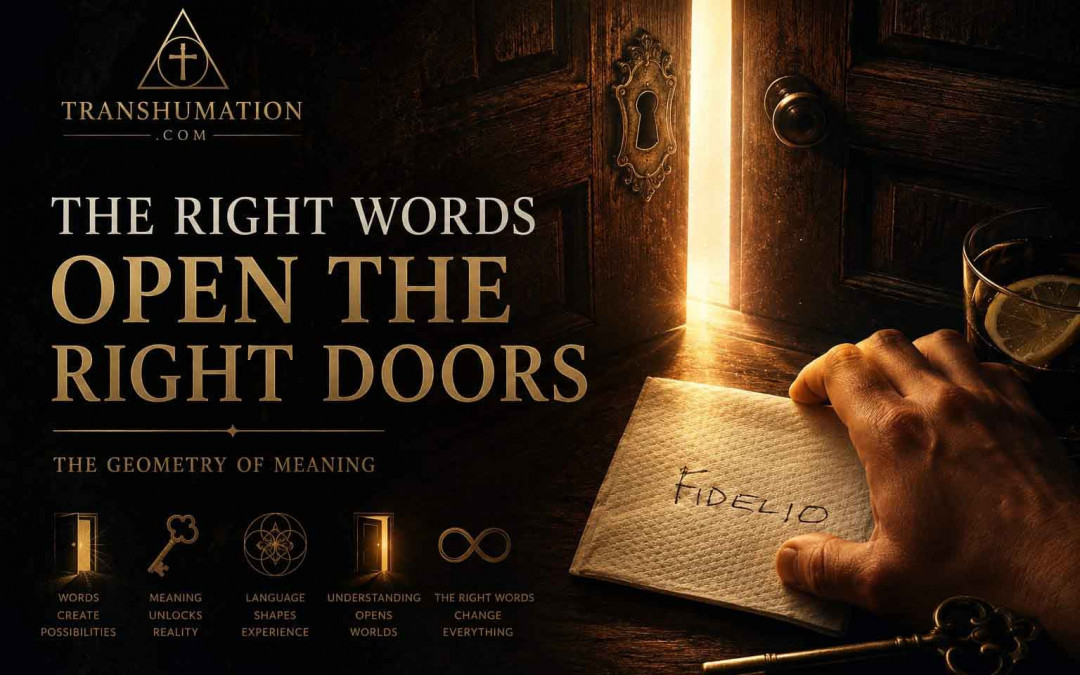
There is a door in Eyes Wide Shut that does not respond to force.
Bill Harford cannot enter because he is wealthy, educated or professionally respectable. None of the ordinary credentials by which he moves through New York are enough. For a moment, the elaborate social identity he carries through the rest of the film becomes useless.
What matters is a word.
Fidelio.
The password works because the world behind the door has agreed that this particular symbolic sequence means admit the bearer. Nothing in the sound itself contains access. Someone shouting Fidelio at a bank vault, airport gate or locked apartment would accomplish very little. The word becomes powerful only inside a structure prepared to recognize it.
That distinction is the beginning of the article.
Language is usually treated as something placed after reality. The object exists; we name it. The event happens; we describe it. The thought occurs; we put it into words. Language appears to be a label attached to a world that was already complete.
But civilization contains another class of words.
Words that do things.
A judge pronounces a sentence and someone’s legal status changes. Two people make a contractual declaration and obligations come into existence. A password grants access. A line of software changes the state of a machine. A mathematical expression allows an engineer to manipulate relations that would otherwise be difficult to control. A carefully chosen scientific concept can suddenly make several apparently unrelated observations intelligible together.
The sound does not possess magic.
The symbol becomes powerful because it enters the right structure.
The right words open the right doors because some doors are made of meaning.
What Does “The Right Words Open the Right Doors” Mean?
There are at least two very different kinds of door.
The first is literal and operational.
A computer receives a command according to a defined syntax. A secure system checks a password. A legal institution recognizes a specified declaration. A machine responds because rules connecting symbol and consequence have already been established.
The second door exists in understanding.
A phenomenon can remain visible for years without becoming conceptually legible because nobody possesses a useful category for describing it. Once the distinction appears, previously disconnected observations can suddenly become part of one structure.
This is why vocabulary matters in science and philosophy.
A good concept compresses.
It tells us which differences deserve attention and which can temporarily be ignored. Words such as gravity, gene, algorithm, trauma, ecosystem or feedback did not create the phenomena they describe, but useful conceptual language allowed people to organize observations into relationships that could be studied, criticized and extended.
The word does not manufacture reality.
It changes what becomes available to thought.
That is a very different kind of power.
Why Is “Fidelio” the Password in Eyes Wide Shut?
Within Kubrick’s film, Fidelio functions first as practical access information.
Without it, Bill remains outside.
With it, he crosses a threshold into a social world whose codes he does not truly understand.
That difference is important because possessing the symbol is not equivalent to possessing the system.
Bill knows the password.
He does not know the rules.
He has linguistic access without social comprehension.
In fact, much of the tension comes from precisely that mismatch. The word carries him farther than his actual knowledge should permit. He can reproduce the correct sign while remaining profoundly ignorant of what the sign belongs to.
This gives Fidelio a richer metaphorical role.
A password can open a door without making the person who knows it an insider.
A formula can be memorized without being understood.
A sacred phrase can be repeated without sharing the worldview that gives it meaning.
An AI prompt can produce an impressive output while the user misunderstands the system generating it.
Symbolic competence and structural understanding are not the same thing.
Sometimes the correct word opens the door only to reveal how little we know about the room.
“In the Beginning Was the Word”
Few phrases in Western culture have acquired a longer intellectual afterlife than the opening of the Gospel of John: In the beginning was the Word.
But Word translates Logos, and Logos should not be casually reduced to vocabulary, speech or command syntax.
The term carries philosophical and theological associations involving reason, order, expression and the relationship between divine reality and creation. John’s use belongs to a specific religious and intellectual context, not to an ancient prediction of programming languages.
The comparison with modern information systems therefore has to remain structural.
What makes Logos interesting here is the ancient intuition that intelligibility and order are not trivial additions to reality. The world is not merely matter occupying space; human beings encounter relationships, regularities, distinctions and forms that can become expressible.
Modern technology makes another version of symbolic order unusually visible.
Software works because physical machines can be organized to respond systematically to formal representations.
But the computer does not demonstrate that John’s Logos was code.
It demonstrates something narrower and more defensible:
symbols can become operational when they belong to systems capable of interpreting them.
That is enough.
Do Words Actually Change Reality?
Some do, but not in one universal way.
A command spoken to an empty room changes very little. The same command spoken by an authorized controller inside a functioning institution may move people, money or machinery.
A wedding vow can alter social and legal relationships because institutions recognize the act.
A declaration of war can reorganize millions of lives because states respond to words as political actions.
A false rumor can change a market because human behavior changes in response to information.
A scientific term can alter research by providing a stable category around which measurements can be organized.
Language therefore participates in causal chains.
But it does not possess unlimited causal power.
Saying rain does not produce rain.
Describing a bridge does not make it stand.
Calling a weak argument true does not make reality cooperate with it.
The world retains its veto.
This is the boundary that keeps symbolic thinking from becoming magical thinking.
Language can change reality when there is a mechanism connecting symbol to consequence.
The mature question is always:
What is interpreting the word?
Plato and the Problem of the Correct Concept
Plato is tempting here because his philosophy invites the language of hidden structure.
But we should avoid saying that Plato believed Forms could be accessed simply through correct words. His philosophy is far more complicated, and language itself can mislead.
What makes Plato relevant is his insistence that appearances do not exhaust intelligibility.
Several physical triangles can be imperfect while sharing relationships that allow us to understand them mathematically as triangles. Different acts of justice can prompt arguments about what justice itself means. Philosophy attempts to move from examples toward more stable distinctions.
Language participates in that movement because concepts allow us to group, compare and separate.
A poor distinction can trap thought.
A better distinction can release it.
This is one reason philosophical history repeatedly contains moments in which changing vocabulary changes the available problem.
The world does not physically rearrange.
The intellectual map does.
And once the map changes, new actions can become possible.
The Word That Creates a New Object
Sometimes naming does something even stranger.
Before a useful category exists, several phenomena may appear unrelated. After the category becomes established, people begin noticing relationships among them, measuring them together and designing institutions around them.
The concept becomes socially real because people coordinate around it.
Money is an obvious example at another level. A banknote possesses comparatively little value as paper, yet institutions and people coordinate around the symbolic relationships it represents.
Borders are similar. A line on a map can become politically powerful because legal and institutional systems make the symbolic distinction operational.
This does not mean reality is merely linguistic.
A border can be crossed physically.
A bank can fail physically.
A law can encounter a body that refuses to obey.
Material constraint remains.
But human civilization adds layers of symbolic causation on top of the physical world.
Much of modern life therefore occurs inside systems where knowing the correct symbol changes what actions become available.
That makes Fidelio less unusual than it first appears.
We spend our lives surrounded by passwords.
Why Do Prompts Change AI Outputs?
Generative AI makes the relationship between language and system behavior unusually visible because ordinary language itself becomes a control surface.
Change the request and the output can change.
Specify an audience and the response may reorganize.
Add constraints and possible answers narrow.
Provide context and a different interpretation becomes relevant.
This feels almost magical because older software usually required users to translate intention into menus, commands or formal syntax.
Generative systems can respond to much less rigid linguistic instructions.
But the prompt does not contain the answer in miniature.
Nor does the model simply obey language like an enchanted servant.
The system processes the prompt through learned statistical and computational structures shaped by training, architecture, context and system constraints. Small changes can matter greatly in some cases and very little in others.
Prompting therefore illustrates the power of symbolic interfaces without proving anything metaphysical about language.
The machine responds because it has been constructed and trained to respond to patterns in language.
Still, culturally, something important has happened.
For perhaps the first time at enormous scale, ordinary people can operate extremely complicated computational systems largely by describing what they want.
The distance between intention and instruction has become smaller.
That is an interface revolution.
Sacred Names and Operational Symbols
Many religious and magical traditions have attributed special significance to names, formulae, chants, inscriptions or correctly performed ritual language.
These traditions differ enormously.
There is no single ancient doctrine according to which reality behaves like software.
Nor should modern code be treated as proof that ritual language secretly described information theory.
But the structural comparison can still reveal something useful.
A ritual formula functions within a symbolic system whose participants believe that correctness matters.
A password functions inside a technical system where correctness demonstrably matters.
The reasons are entirely different.
One may depend upon theology or sacred tradition.
The other depends upon engineering.
The resemblance lies in the architecture of access:
symbol → recognition → change of permitted state.
The mistake would be turning resemblance into genealogy.
The opportunity is using the resemblance to ask why humans repeatedly build worlds in which correct symbolic alignment matters.
Symbols as Interfaces
A symbol is valuable because it can compress more structure than its physical size suggests.
A red light at an intersection is physically trivial.
Its social meaning is not.
A national flag is cloth arranged in a pattern.
Its historical and political meanings cannot be found by analyzing the fibers alone.
A mathematical sign may occupy a few millimeters while representing a relation applicable across enormous classes of problems.
Symbols therefore belong naturally to interfaces.
They take relationships too complex to hold in full and present them in forms suitable for recognition and action.
But compression always removes information.
A symbol becomes dangerous when people forget what was removed.
A flag is not a country.
A diagnosis is not a patient.
A statistical category is not a person.
A map is not territory.
A prompt is not the model.
The symbol gives access precisely because it does not reproduce the whole system.
Its power depends upon reduction.
Its danger does too.
When Civilization Needs a New Vocabulary
Technological revolutions often create conceptual confusion before they create conceptual clarity.
We inherit words from older systems and stretch them.
Memory once referred primarily to biological or human recollection; now machines have memory.
Friend becomes a category inside a social platform.
Cloud becomes infrastructure.
Agent moves from human action into software.
Hallucination acquires a technical metaphorical meaning in AI.
Intelligence itself becomes contested because machines can perform tasks previously treated as indicators of uniquely human capability.
The vocabulary struggles because the relationships changed faster than ordinary language.
This is where better terminology becomes intellectually important.
Not because reality waits for us to discover a secret name.
Because poor language can hide distinctions that increasingly matter.
Does a model remember in the same sense as a person?
Does a synthetic voice preserve someone?
Does an AI agent possess agency?
Does a digital copy constitute continuity?
The wrong word can make different structures look identical.
The right distinction can keep them apart long enough to think.
The Word and the Door
This returns us to Fidelio.
The password is elegant because it reduces a complicated social structure into one tiny act of recognition.
Say the right word.
Enter.
But Bill’s experience reveals the limitation of all interfaces.
Access is not mastery.
The password can pass authentication while the person remains conceptually outside.
Modern civilization is filling with similar doors.
Search engines give access to information without guaranteeing understanding.
AI gives access to complex operations without requiring mastery of the systems underneath.
Scientific vocabulary gives access to models without eliminating the need to test them.
Symbols allow us to move through complexity faster than biological cognition could manage alone.
That is their triumph.
The danger comes when speed of access produces the illusion that the room has been understood.
Perhaps the best intellectual password therefore does not simply open the door.
It reminds us that there is still a building behind it.
Watch The Video
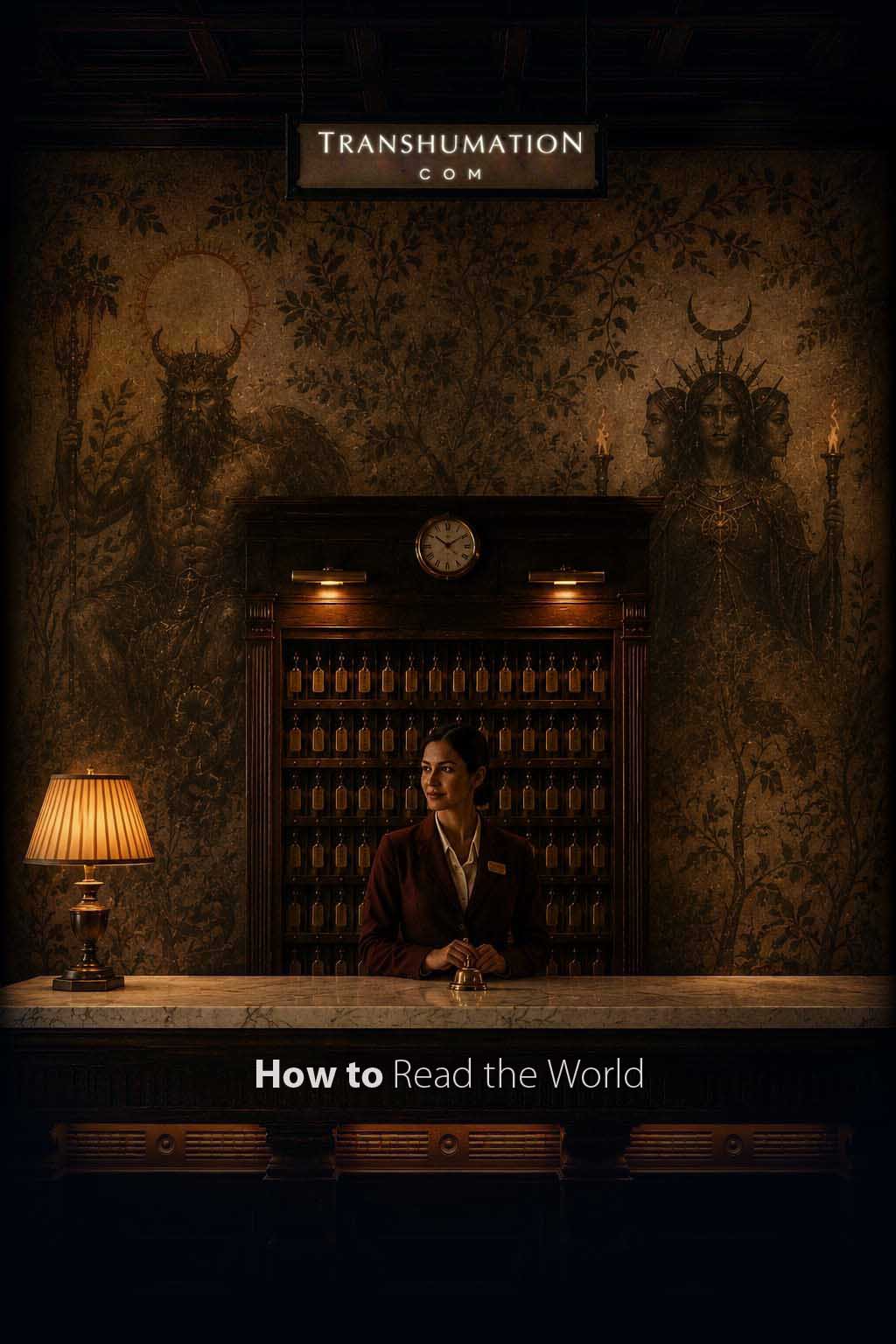
How to Read the World
Current Knowledge
Human language does more than label objects. Linguistic communication can influence attention, classification, memory, coordination and behavior, while certain social utterances can perform actions within established institutional contexts. Promises, contracts, commands and legal declarations can alter social reality because communities and institutions recognize their consequences.
Formal symbolic systems such as mathematics and programming languages operate differently from ordinary language. Their power depends upon defined relationships and interpretation within mathematical, computational or institutional systems. Code does not change the world through symbolic force alone; physical machines and social infrastructures execute or act upon it.
The Logos in the opening of the Gospel of John should not be equated directly with modern notions of code, information or prompts. Historical comparison can identify structural similarities concerning order, intelligibility and expression, but this does not establish that ancient theology anticipated computation.
Generative AI systems can respond differently to changes in prompts because language is part of the computational input shaping their output. Prompt sensitivity demonstrates the importance of context and symbolic instruction inside these systems, not a general metaphysical power of words over reality.
Symbolic systems can compress complicated relationships into manageable forms. Their usefulness depends partly upon what they preserve and what they omit, which is why symbols, categories and interfaces can both improve understanding and introduce distortion.
Open Questions
One unresolved question is how deeply language shapes thought. Humans clearly use language to classify and communicate experience, but it remains difficult to determine which forms of conceptual thought depend upon linguistic categories and which can exist independently of them.
Another question concerns the growing role of natural language as a technological interface. If people increasingly operate software, machines and institutions by describing intentions rather than learning formal commands, will language become the dominant interface to computation, or will other forms of interaction eventually replace it?
AI also raises a problem of conceptual inflation. Words such as reasoning, memory, agent and understanding are increasingly applied to machines, yet the same word can conceal important differences between human and computational processes. The future may require more precise vocabulary rather than broader metaphors.
The deepest question is whether language merely organizes structures humans already encounter or sometimes creates genuinely new social structures by making previously unavailable forms of coordination possible. Human civilization suggests that the boundary between describing a world and participating in its construction is not always clean.
Transhumation Interpretation
For Transhumation, Fidelio represents the moment when a symbol becomes an interface.
The word itself has no universal power. Its power appears because a larger structure is prepared to recognize it. That is true of passwords, laws, code, mathematical notation and, in a different way, cultural symbols.
The important question is therefore not whether language is magic.
It is what kind of system becomes accessible once the correct distinction, symbol or vocabulary exists.
Transhumation needs new language for exactly this reason. Not to invent a mystical reality, but to keep emerging structures separate: pattern from person, memory from storage, intelligence from consciousness, representation from continuity, interface from world.
Sometimes the right word opens a door because somebody built the lock.
Sometimes it opens a door because, until the word existed, we had not realized there was a door at all.
FAQ
What does “the right words open the right doors” mean?
It means that language can sometimes function operationally rather than merely descriptively. A word, command, category or symbol can change what actions or interpretations become available inside a system capable of recognizing it.
Why is Fidelio important in Eyes Wide Shut?
It functions as the password that gives Bill access to a hidden social environment. The article uses it as a metaphor for the difference between possessing the correct symbol and actually understanding the structure behind it.
Do words really change reality?
Sometimes, through identifiable mechanisms. Legal declarations, contracts, commands, code and public information can change social or technological states, but words do not possess unlimited physical power.
Does “In the beginning was the Word” mean reality is made of information?
Not necessarily. John’s Logos belongs to a theological and philosophical context and should not be treated as an ancient prediction of modern information theory.
Why do prompts change AI responses?
Because the prompt becomes part of the input from which the model generates its response. Changes in wording, context and constraints can alter which learned patterns become relevant to the output.
What is the deeper Transhumation question?
The important question is not whether civilization can discover a magical language capable of commanding reality.
It is whether better words can reveal distinctions that bad words had been hiding.
A civilization can possess enormous technical power and still misunderstand what it has created because it continues describing new structures with categories inherited from an older world.
Perhaps the next important vocabulary will not make machines more powerful at all.
It will make us more precise about what the machines have already changed.
And sometimes that is what the correct password does best: it does not reveal the answer.
It reveals which door we should have been trying to open.
Continue the Transhumation Series
- Forgotten Religion | Ancient Gods, Symbols and the Hidden Structures of Human Civilization
- The Last Religion | Death, Immortality and the Future of Humanity
- The New Theurgy | AI, Information and the Future of Human Civilization
- End of Branding: You Were Never Meant to Become a Product
- Baal vs Ishtar: Why Ancient Gods Never Disappeared