
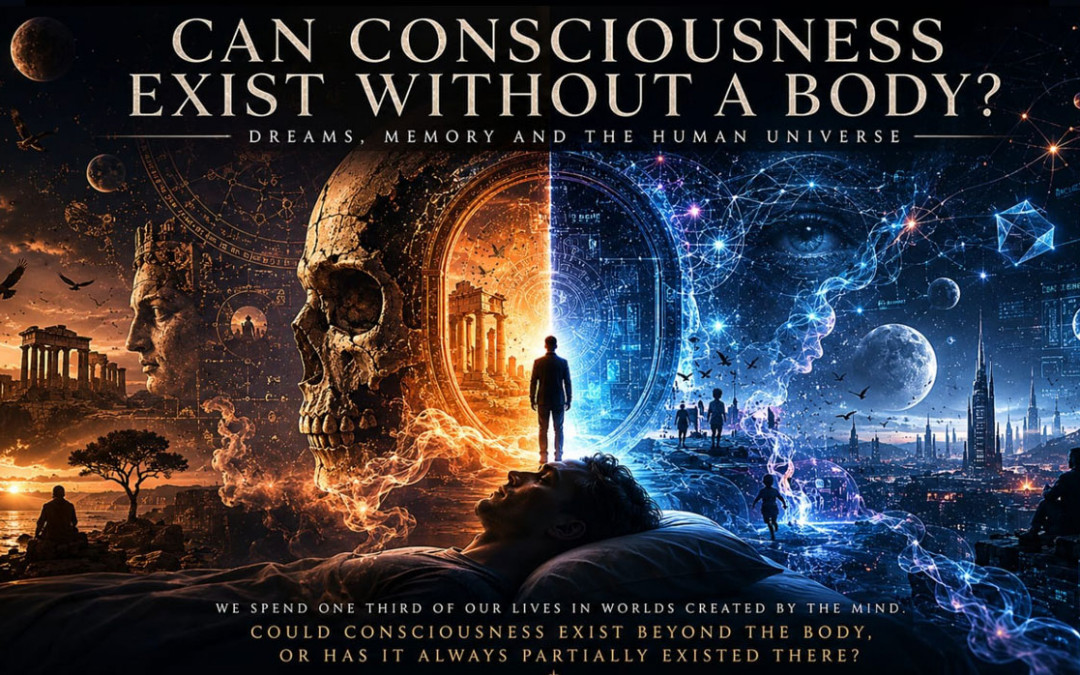
The Universe Behind the Skull
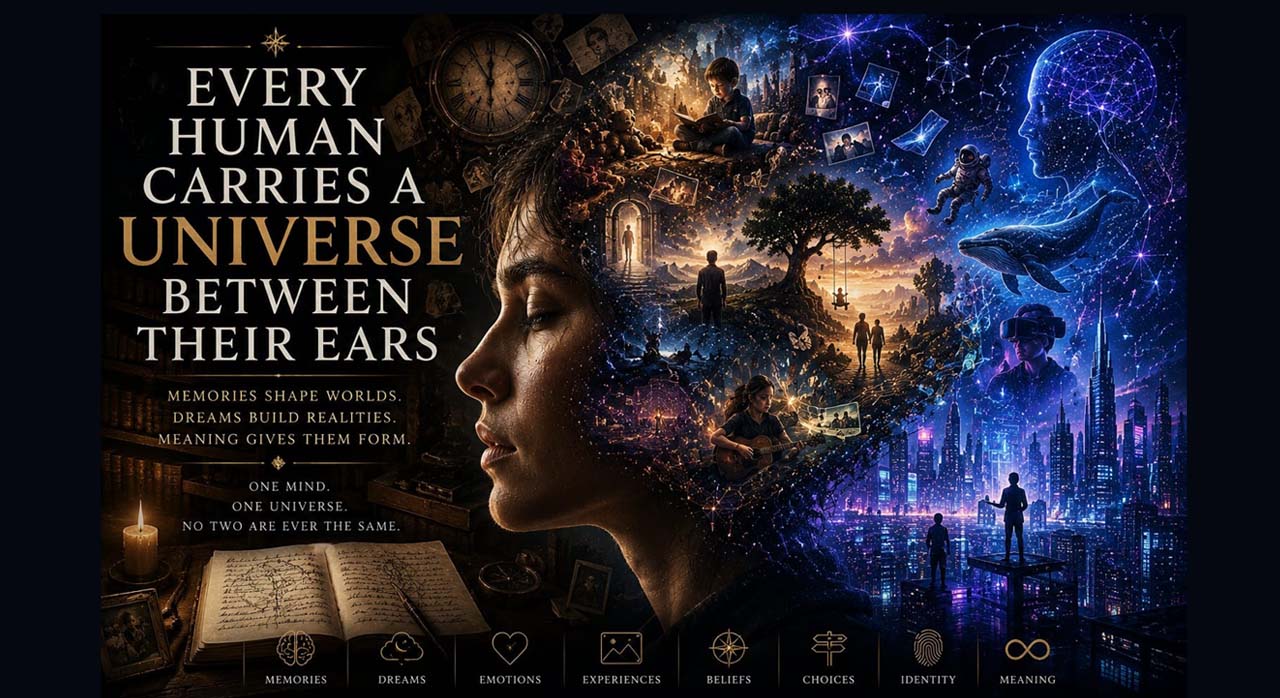
Every human being carries a world that no one else can enter completely. One day the body remains, for a while. The world does not.
Tonight, somewhere between the last conscious thought and morning, an ordinary event will occur that is so familiar we almost never treat it as strange. The bedroom will remain where it is. The walls will not move. Gravity will continue working. Outside, cars will pass, satellites will cross the sky and the physical universe will proceed without interruption. Yet for a few minutes or perhaps much longer, another environment may appear. A street that never existed. A childhood house reconstructed incorrectly. A conversation with someone dead for twenty years. A city assembled from fragments of several cities. Fear without danger, desire without possibility, movement without muscles carrying the body anywhere at all.
Then the eyes open.
The second world disappears almost instantly.
We call it a dream and continue with breakfast.
Dreams do not demonstrate that consciousness can survive without a brain. On the contrary, everything we presently know gives us strong reasons to connect dreaming with biological activity inside the sleeping brain. But dreams reveal something less spectacular and perhaps more important: human experience has never been a transparent window through which an objective universe simply pours into us. The brain constructs. It selects. It predicts, edits, combines and interprets. Even while awake, what we call reality is partly the result of an encounter between whatever exists outside us and the extraordinary machinery through which that existence becomes experience.
The mystery is therefore not that another universe is secretly hidden inside the skull.
The mystery is that there is a universe for someone at all.
The Private World
Two people can sit at the same table, hear the same sentence and leave carrying completely different events.
One remembers an insult. The other remembers a joke. A piece of music that means almost nothing to one listener can return another to a room occupied forty years earlier. A smell can recover a grandmother, a hospital corridor or a summer afternoon with a precision no photograph manages. The physical stimulus may be shared. The experienced world is not.
This distinction is so ordinary that its philosophical strangeness disappears.
Human beings inhabit an external environment of matter, bodies, weather, buildings and other organisms, but they also inhabit an interpreted environment composed of memory, expectation, fear, attachment, symbolism and meaning. The second world is not separate from the first in the sense of existing in another supernatural dimension. It depends on the body and brain. Yet it cannot be described simply by listing the external objects surrounding the person.
A wedding ring has a measurable mass.
Its meaning does not.
A childhood house can be described architecturally, photographed and sold. None of those descriptions contains what the house feels like to the person who grew up there.
This does not make meaning unreal. A nation can go to war over meaning. A person can cross an ocean because of memory. Someone can spend an entire life pursuing an idea that occupies no measurable volume in physical space.
The internal world is not less consequential because it is experienced.
It is often the reason the external world changes.
The Border We Carry With Us
The skull makes an irresistible metaphor because it looks so much like a container. Bone outside, brain inside. The world beyond it; consciousness behind it.
But a border may be a more useful image than a box.
Borders separate territories, but they are also places of exchange. Light reflected from another person’s face reaches the eyes and becomes neural activity. Vibrations in air reach the ear and eventually become a familiar voice. Molecules become smell, pressure becomes touch, electrical and chemical events become the experience of warmth, embarrassment, beauty or pain.
We should be careful with the phrase matter becomes consciousness. Neuroscience can describe increasingly detailed chains between sensory input, brain processing and reportable experience, but the relationship between those physical processes and subjective experience remains philosophically contested. The skull does not contain a little theater where an invisible spectator watches the world arrive.
Still, something remarkable occurs at this boundary.
The universe that enters us as photons does not remain photons.
It becomes sunset.
Sound waves do not remain pressure variations.
They become Bach, an alarm, a lover’s voice or a sentence we wish had never been spoken.
External structure enters a nervous system and becomes part of a life.
Perhaps this is the most interesting frontier humanity has ever encountered, and it has been travelling with us from the beginning.
The Archaeology of a Missing World
There is a peculiar sadness in an ancient skull.
Archaeology can extract astonishing amounts of information from human remains. Bone can reveal approximate age, biological sex, trauma, diet, disease, migration and sometimes ancestry. Teeth can preserve chemical traces of childhood environments. DNA can reconnect people separated from us by thousands of years.
We can know what someone ate.
We may discover where they were born.
We can sometimes see the injury that killed them.
What we cannot recover is what rain sounded like to that particular person.
The skull once belonged to somebody for whom the landscape was not archaeological evidence. It was simply Tuesday morning. Someone knew which path led home. Someone disliked another person in the village. Someone had a private memory associated with a tree that disappeared three thousand years before anyone thought to excavate the settlement. Someone dreamed.
This is where the artifact changes character.
The skull is not merely evidence that a human organism existed. It is evidence that there was once a point of view from which the universe was encountered.
The distinction is enormous.
Billions of human beings have lived and died, and almost all of their internal worlds have disappeared without leaving enough information for another person even to guess at their shape. History preserves rulers disproportionately because rulers commissioned stone. Ordinary consciousness usually vanished almost completely.
We know that someone existed because we find the bone.
The universe behind it is inaccessible.
What Actually Disappears When Someone Dies?
Death destroys a living biological system. That fact is measurable. Yet the human experience of loss has never been exhausted by the disappearance of biological function.
We lose access to a particular observer.
Nobody else remembers precisely the same childhood. Nobody else has exactly the same network of associations between people, places, fears, embarrassments, tastes and private jokes. Even identical twins do not accumulate identical perspectives. The death of one person therefore removes something that cannot simply be substituted by another member of the species.
Calling this an entire universe can sound poetic, but the metaphor contains a precise point. A conscious life is an enormous field of relationships available only from one perspective. Remove that perspective and the physical universe continues, but one way in which that universe was being experienced no longer does.
Whether this should be called the greatest loss in the cosmos is impossible to know. We do not know how common consciousness is beyond Earth. We do not know whether subjective experience exists in forms radically unlike ours. Even among terrestrial organisms, consciousness almost certainly should not be treated as an exclusively human possession.
But we do know something extraordinary.
Matter appears plentiful.
Stars are plentiful.
Planets appear to be plentiful.
A particular first-person life happens once.
The Sculptor and the Sculpture
There is another complication. The internal world is not simply delivered to us finished.
We build part of it while it builds us.
A childhood experience alters future expectations. Expectations alter what receives attention. Attention affects memory. Memory influences decisions. Decisions create new experiences, which modify the person who will make the next decision.
Identity is therefore neither an immovable object hidden somewhere inside the body nor a fiction without continuity. It resembles a process maintaining recognizable form while continuously changing its own components.
A person at seventy is materially and psychologically different from the child they were at seven, yet the adult ordinarily experiences some continuity between the two. The sculpture has changed dramatically while the sculptor has changed with it.
This is one reason the future technological problem of identity is more difficult than simply preserving data.
A photograph freezes appearance.
A diary preserves selected memories.
A recording preserves voice.
A database may preserve preferences.
Even an extraordinarily sophisticated artificial model could preserve patterns of language and behavior.
But a living consciousness does something archives do not obviously do: it continues to be altered by what happens next.
The self is not merely information already accumulated.
It is an ongoing relationship with time.
Why Dreams Matter Now
This brings us back to the sleeping person.
Dreams matter not because they prove that we possess detachable souls travelling outside the body, but because they make one feature of consciousness unusually visible: experience does not require the external world to be present in the form we experience it.
The sleeping brain can construct people who are not in the room, architecture that does not exist and events that violate ordinary physics. During many dreams, the strangeness is accepted without protest. The experiential environment temporarily becomes sufficient.
Virtual reality and artificial intelligence make this fact technologically relevant.
If the brain can treat internally generated or mediated signals as meaningful environments, increasingly sophisticated artificial environments may someday occupy a much larger share of ordinary human experience. The philosophical question will not necessarily be whether those environments are “real.” Their physical causes will be perfectly real.
The more interesting question will be what happens when experienced reality becomes increasingly independent of immediate physical surroundings.
Humanity has already begun moving in that direction through books, cinema, telephones, networks and virtual worlds.
Dreaming reminds us that the nervous system had the basic architecture for it long before Silicon Valley arrived.
Watch The Video
How to Read the World

Current Knowledge
Human consciousness, including dreaming, is strongly associated with activity in the living brain. Sleep is not a period in which the brain simply switches off. Different stages of sleep involve characteristic patterns of neural activity, and vivid dreaming is particularly associated with REM sleep, although dreams can also occur during other sleep stages. Changes to brain function through injury, anesthesia, drugs, disease or stimulation can profoundly change conscious experience.
Perception is also not understood as passive recording. Contemporary neuroscience treats perception as an active process involving sensory information, prior expectations, attention and multiple levels of neural processing. The experienced world is therefore not a photographic copy of external reality, although this does not imply that external reality is created arbitrarily by consciousness.
Dreams provide evidence that brains can generate complex experiences with greatly reduced dependence on immediate external sensory input. They do not provide evidence that consciousness exists independently of biological brains.
Human autobiographical memory is reconstructive rather than a perfect archive. Memories can change during recall, acquire new associations and incorporate errors. Personal identity therefore cannot be reduced straightforwardly to a collection of perfectly stored historical records.
There is currently no demonstrated technology capable of preserving or transferring a deceased person’s subjective consciousness. Digital archives and AI systems can preserve or reproduce aspects of behavior, language, appearance and recorded memory, but preservation of information is not established preservation of the experiencing subject.
Open Questions
The most obvious unresolved question is why brain activity is accompanied by subjective experience at all. Science can increasingly describe which processes accompany perception, memory, wakefulness and dreaming, but there remains significant philosophical disagreement over whether such descriptions fully explain what consciousness is.
A second question concerns the boundaries of the self. If memories can be stored externally, sensory experience can be technologically mediated and cognitive functions can increasingly be supported by artificial systems, how much of personal existence must remain biologically internal for us to describe the resulting system as one individual?
Dreaming introduces another puzzle. If the brain can produce a convincing experienced environment without receiving corresponding information from the external world, what criteria does consciousness use to distinguish reality from internally generated models? Why does this distinction usually become obvious after waking but often remain invisible while dreaming?
Then comes the problem of preservation. Suppose a future system could record extraordinary amounts of a person’s memories, speech, preferences, relationships and neural organization. How much would have to survive before we stopped describing the result as an archive and began asking whether something closer to the person had survived?
And there is an even harder version: if the reconstructed system possessed memories of being the original individual and sincerely claimed continuity, what evidence could distinguish genuine continuation from an extraordinarily successful new observer inheriting an old life’s information?
Transhumation Interpretation
Transhumation begins here with a modest observation.
Every human being is already an interface.
Outside is a world that does not arrive inside us untouched. Inside is not an independent universe floating free from matter. Between them lies a continuous process of translation: wavelength into colour, vibration into sound, event into memory, memory into meaning.
The mistake would be to choose too quickly between two extremes.
One says that only external physical reality is important and subjective experience is merely decorative output.
The other says that consciousness creates reality and therefore the physical world is somehow secondary.
Neither is necessary.
A better model is the border.
Human existence occurs where a physical universe becomes an experienced universe.
This is why the ancient skull matters so much. The bone survives as carrier evidence. The structure of an individual life mostly does not. Archaeology can reconstruct pieces of the environment, but the interface through which that environment once became meaningful has closed.
A library creates a partial solution.
Writing allows one consciousness to leave structures another consciousness can later reconstruct. Music does the same. Painting does the same. Photography, cinema and digital archives dramatically increase the bandwidth. Artificial intelligence may increase it further by allowing preserved information to become interactive rather than merely static.
But the Library of Mirrors has a limit.
It can preserve what reached the mirror.
It does not automatically preserve the observer.
This distinction may eventually become one of the central problems of Transhumation. Perhaps human civilization will become extraordinarily successful at preserving the traces of conscious worlds while remaining completely incapable of preserving consciousness itself. We may build perfect museums of people who are gone.
Or perhaps future neuroscience will discover forms of continuity we currently cannot imagine.
Both possibilities must remain open.
The interesting question is not whether the inner world is supernatural.
It is whether civilization should treat a conscious perspective as something uniquely valuable precisely because it may be fragile, temporary and impossible to reconstruct after the process stops.
A skull can survive for ten thousand years.
The world behind it can disappear in seconds.
Perhaps that is the inversion modern civilization still has not fully understood.
We have become very good at preserving objects.
The next question is whether we can preserve viewpoints.
FAQ
Why do we dream?
There is no single complete explanation of dreaming. Dreams are associated with normal brain activity during sleep and may relate to memory processing, emotion, learning and other neural functions. Researchers continue to debate why dreams take the particular narrative and experiential forms they do.
Are dreams another reality?
They are real experiences generated by a sleeping brain, but there is no evidence that ordinary dreams occur in an independent external universe. Their importance lies in demonstrating how convincingly the brain can generate an experienced environment without corresponding events occurring around the sleeping body.
Why does a dream feel real while it is happening?
During dreaming, brain systems involved in perception, emotion and memory can generate vivid experiences, while processes associated with critical evaluation and awareness of contradiction may function differently from ordinary wakefulness. This can allow bizarre events to feel temporarily normal.
What does the skull symbolize in this article?
The skull represents the boundary at which external physical processes participate in producing an individual experienced world. It also becomes an archaeological symbol of asymmetry: the biological structure may remain long after the subjective world associated with it has become inaccessible.
Do humans really live in two realities?
Not necessarily in the sense of two separate universes. The distinction is between external physical reality and subjective experienced reality. The second depends on biological processes but includes meanings, memories and perspectives that cannot be identified simply by describing the external environment.
Is subjective experience less real than physical reality?
It is real in a different sense. Fear, love, pain and memory are experienced states with physical correlates and real consequences, even though they are not independent physical objects such as stones or tables. Confusing different categories of reality creates unnecessary philosophical problems.
Is consciousness simply information?
We do not know. Conscious brains process information, but it has not been demonstrated that information processing alone is sufficient for subjective experience. This distinction becomes crucial when discussing AI and hypothetical mind uploading.
Could AI preserve someone’s inner world after death?
AI may preserve and reconstruct increasingly sophisticated traces of a person: language patterns, photographs, recordings, preferences, correspondence and perhaps eventually aspects of neural information. This could create an extraordinarily convincing interactive representation. It would not by itself establish that the original person’s consciousness survived.
If everything about me were recorded, would that record become me?
Not necessarily. A complete description and the thing described may remain different. Even an exact behavioral duplicate raises the continuity problem: if you and the duplicate could exist simultaneously, there would immediately be two different points of view sharing one remembered past.
Why is consciousness important if it is entirely produced by the brain?
Because dependence on biology does not make experience insignificant. Music depends on physical vibration without becoming merely vibration. A living conscious perspective could be entirely physical and still remain one of the most complex and irreproducible phenomena we know.
What exactly is lost when a conscious person dies?
Biologically, an organism ceases functioning. Personally and culturally, relationships, knowledge and influence may continue through other people and records. What appears to disappear is the ongoing first-person perspective itself: the particular place from which the world was being experienced.
Could that perspective ever be preserved?
We currently have no evidence that it can. Future technologies may preserve vastly more information about individuals and may possibly reproduce aspects of their cognitive organization. The harder question is whether continuity of information can ever become continuity of experience.
That distinction is where the technological problem ends and the philosophical problem begins.
We may eventually know how to reconstruct every room inside the vanished city.
We still will not know whether anyone came home.
Continue the Transhumation Series
- Forgotten Religion | Ancient Gods, Symbols and the Hidden Structures of Human Civilization
- The Last Religion | Death, Immortality and the Future of Humanity
- The New Theurgy | AI, Information and the Future of Human Civilization
- End of Branding: You Were Never Meant to Become a Product
- Baal vs Ishtar: Why Ancient Gods Never Disappeared