
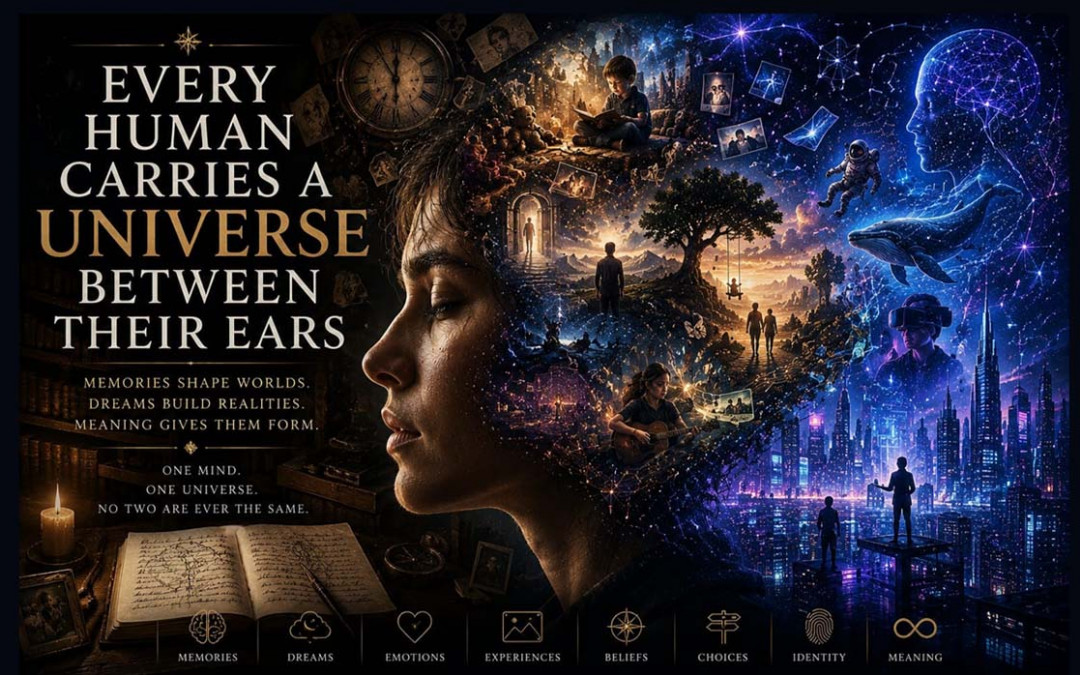
The Worlds Behind Other People’s Eyes
We spend our lives surrounded by people whose inner worlds we can never enter directly. Civilization may be the elaborate system we invented to cross that distance.
Across the table sits another person. You can see the movement of their hands, the small delay before they answer, the way their eyes return to the window while you are speaking. You know the color of their coat and the sound of their voice. Perhaps you have known them for thirty years. Perhaps you met them ten minutes ago. In either case, almost everything that matters about their existence remains invisible.
You cannot see the room they are remembering.
You cannot hear the sentence repeating privately in their head. You do not know whether the song playing softly in the background means nothing to them or whether it has just returned them, without warning, to a summer twenty years earlier. You can ask. They can answer. But even the answer arrives translated into language, compressed from an experience that belonged to them before it became words available to you.
This is one of the strangest facts of ordinary human life, and familiarity has made it almost disappear. We live among billions of conscious beings while encountering only the surfaces of their consciousness. Faces, gestures, speech, photographs, choices and stories become evidence from which we infer the world behind them.
Every person is therefore both extraordinarily visible and fundamentally hidden.
The human face may be the most familiar border in existence.
The World We Share Is Not the World We Experience
Imagine ten people standing in the same railway station when an announcement suddenly reports that every train has been cancelled. Physically, the event is almost identical for all of them. The loudspeaker produces the same vibrations. The departures board displays the same information. The architecture does not change.
Yet almost immediately ten different worlds emerge.
One traveller worries about missing a funeral. Another sees an excuse to remain in the city for another night. Someone becomes angry because this is the third cancellation that month. A child is delighted by the disruption. A railway employee hears not an inconvenience but the beginning of several difficult hours at work. Another passenger barely reacts because a message received thirty seconds earlier has made the railway irrelevant.
There is one station and several realities of significance.
This does not mean that everyone literally occupies a separate physical universe. The rails remain where they are regardless of interpretation. A cancelled train does not reappear because someone thinks positively about it. But conscious creatures do not respond to physical reality in its entirety. They respond to what physical reality means within a model shaped by memory, attention, expectation, emotion and previous experience.
The difference is crucial.
The external world can be shared.
Meaning cannot be transferred so easily.
Memory Is Not a Warehouse
We often speak about memory using architectural metaphors. We store memories. We retrieve them. We place things in the back of the mind. The brain begins to sound like a badly organized archive in which childhood sits somewhere near old passwords and forgotten telephone numbers.
But human memory does not behave like a perfect collection of recordings.
Remember your childhood kitchen. Perhaps the table appears first. Perhaps light through a particular window. A smell. The position of a door. Someone standing with their back turned. You may feel certain that you are retrieving the scene exactly as it was.
You probably are not.
Memory is reconstructive. Each act of remembering can involve rebuilding an event from surviving fragments, later knowledge, emotion and expectation. Details can shift without the person becoming aware of the shift. Two siblings can sincerely remember the same afternoon differently, not because one is lying but because neither possesses a neutral recording from outside themselves.
This makes memory more interesting, not less.
It means the past continues to exist inside consciousness partly as reconstruction. The childhood house carried by the adult is no longer simply the building that once stood at a particular address. It has accumulated later losses, later understanding, nostalgia and perhaps resentment. The physical room belonged to history. The remembered room belongs to a living person.
A photograph can preserve the wallpaper.
It cannot preserve what entering the room meant.

The Impossible Distance Between Two People
Human beings developed extraordinary mechanisms for crossing this gap.
Language is perhaps the greatest of them.
One nervous system produces sounds or marks that allow another nervous system to reconstruct part of an experience it never directly possessed. Literature does something even stranger. A person dead for centuries can arrange symbols in such a way that someone not yet born will eventually experience fear, amusement, recognition or grief.
Music performs another version of the crossing. Painting another. Cinema, ritual, architecture, letters, photographs and now digital communication all attempt the same impossible operation: move something from one private world into another without ever making the two worlds identical.
This may be one of the deeper functions of culture.
Civilization is not only a system for organizing bodies in physical space.
It is a technology for reducing the isolation of consciousness.
A book cannot give you the author’s exact experience. But it can build a temporary bridge strong enough for two minds separated by language, geography or death to share a structure.
Perhaps this is why the destruction of libraries has always seemed more serious than the destruction of storage facilities.
What disappears is not merely information.
Possible bridges disappear.
Dreams Show How Little the World Needs to Cooperate
Dreams make the constructive power of consciousness unusually obvious.
During ordinary waking life, perception is constrained by continuous sensory information. The walls resist us. Gravity remains dependable. Other people contradict our expectations. The external world forces corrections upon the internal model.
Dreaming loosens that relationship.
A person dead for ten years can enter a room without explanation. A city can contain streets borrowed from three different countries. Time can collapse. A childhood friend can possess the face of a stranger. The impossible often passes unnoticed until waking.
None of this demonstrates that dreams occur outside the brain. There is no need to smuggle metaphysics into sleep physiology.
What dreams reveal is enough.
The nervous system is capable of generating an experienced environment from internally produced activity with remarkably little cooperation from the immediate physical surroundings.
And the experience can matter after it ends.
A nightmare can alter the mood of an entire morning. A dream of someone lost can produce real grief. The dreamed event did not occur in the external world, but the emotional consequence belongs perfectly well to waking reality.
The border between “real” and “unreal” becomes less useful once we ask which kind of reality we mean.
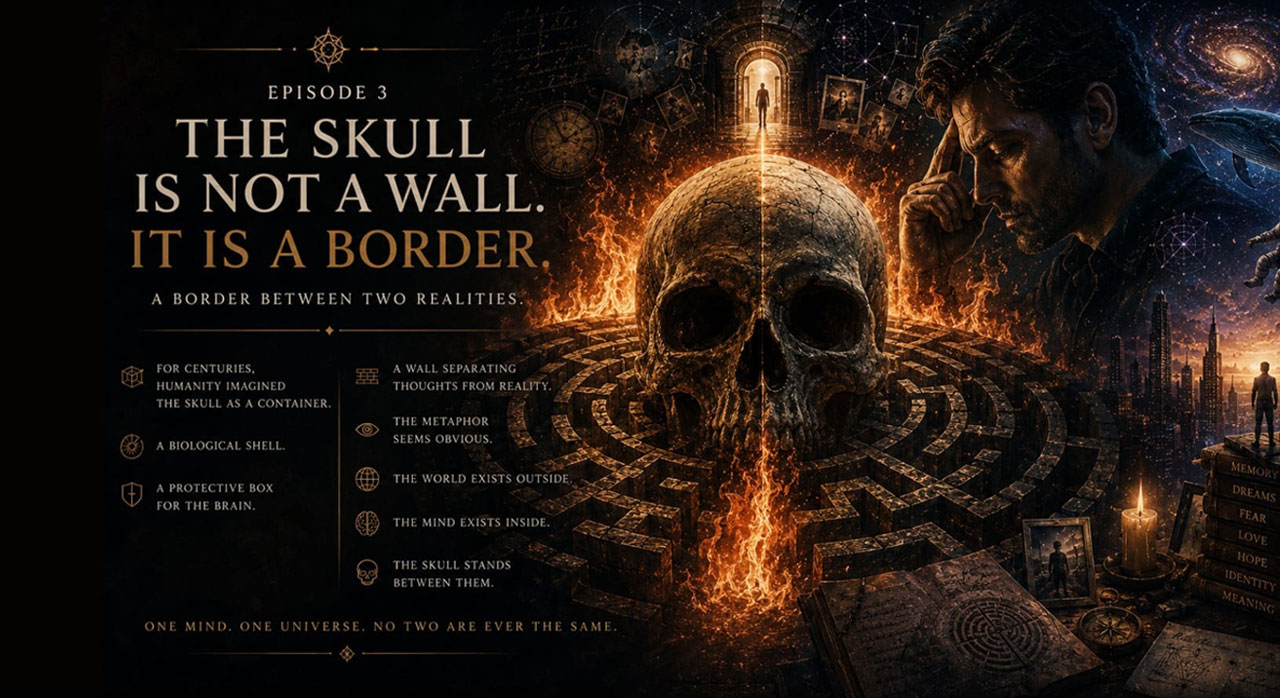
The Sculptor Is Made of Stone Too
There is another reason every inner world differs.
We do not merely receive experience.
Experience changes the system doing the receiving.
A humiliation at sixteen can alter the interpretation of conversations at forty. A successful risk can change a person’s estimate of future danger. Love modifies attention. Grief changes the significance of ordinary places. Education creates distinctions the untrained eye could not previously see.
At the same time, human beings participate in shaping themselves. We choose which environments to enter, which relationships to maintain, which memories to rehearse, which disciplines to practice and which stories about ourselves to repeat.
The division between sculptor and sculpture therefore breaks down.
The person interpreting the world has been shaped by earlier interpretations of the world.
Identity emerges from this recursive process.
This is one reason a human being cannot be reduced easily to a list of traits. Personality is not simply a collection of settings waiting behind the eyes. It is a history still operating in the present.
Plato’s Cave Was Never Only About Shadows
Plato’s allegory of the cave survives because it captures something more durable than its original philosophical argument. Human beings do not simply encounter reality in a complete, uninterpreted form. What reaches conscious awareness is mediated.
Modern neuroscience gives the problem a different vocabulary. Sensory systems extract limited information. Attention selects. The brain integrates signals with prior knowledge. Expectations affect perception. Memory reconstructs.
None of this proves Platonic metaphysics.
It does demonstrate that perception is not the same thing as possessing reality in its totality.
We inhabit models sufficiently reliable to let us cross streets, recognize friends and build spacecraft. Those models are not arbitrary fantasies. They remain constrained by a world capable of punishing bad predictions very efficiently.
But they are models nonetheless.
And each model contains a history.
The color red may be physiologically similar for two people while carrying entirely different associations. A church can be architecture to one observer, home to another, oppression to a third and beauty to a fourth. The stones do not change.
The worlds around them do.
Humanity’s Hidden Wealth
Civilizations are remarkably good at counting objects.
Population.
Land.
Energy reserves.
GDP.
Buildings.
Machines.
Weapons.
Data.
It is much harder to count perspectives.
Yet every human consciousness contains a configuration that has never previously existed in precisely the same form. Not because every person is equally wise, creative or virtuous, but because no two lives occupy exactly the same position within the network of experience.
This gives ordinary people a kind of value that statistics handle poorly.
The elderly woman sitting quietly on a bus may contain the last living memory of a particular family story. A migrant may carry two cultures inside one biography in a combination no archive records. A child may notice a relationship between things that adults have learned to ignore. A dying person may possess thousands of associations that disappear without ever becoming language.
Humanity’s invisible wealth is not simply information contained in brains.
It is perspective.
A library can preserve knowledge.
A civilization also needs viewpoints from which knowledge can become meaningful.
Watch The Video
How to Read the World

Current Knowledge
Human perception is not understood as a passive recording of the external environment. Contemporary neuroscience describes perception as an active process involving sensory input, attention, previous experience, expectation and multiple stages of neural processing. Human beings therefore experience internally constructed representations constrained by the physical world rather than an unmediated copy of every feature of that world.
Autobiographical memory is also reconstructive. Research has repeatedly shown that memories can change over time, incorporate later information and differ between people who experienced the same event. Confidence in a memory does not guarantee perfect accuracy.
Dreaming demonstrates that the sleeping brain can generate complex perceptual and emotional experiences without corresponding events occurring in the immediate environment. This does not imply that dreams exist in another external reality or that consciousness functions independently of the brain.
Humans also possess sophisticated capacities for inferring the mental states of others, often discussed under concepts such as theory of mind. We use facial expression, language, behavior and context to infer what another person may believe, intend or feel. Those inferences can be highly successful, but they remain indirect. No known mechanism allows one person direct access to another person’s subjective experience.
Open Questions
The first problem is the oldest: why is there subjective experience at all? Neuroscience can increasingly describe how sensory information is processed and how brain states correlate with reported experiences, yet philosophers and scientists continue to disagree about whether such descriptions completely explain the existence of a first-person point of view.
There is also the problem of similarity. When two people say they see red, how much can we know about whether their experiences are actually alike? Shared biology and behavior give us strong reasons to assume broad similarities, but subjective experience is not directly available for comparison in the way two physical measurements are.
Memory creates a different uncertainty. If personal identity depends partly on memories that are continually reconstructed, how much alteration can occur while the person remains recognizably the same individual? Is continuity based on accurate preservation of the past, or on an ongoing process capable of reorganizing the past while maintaining a coherent present?
Technology introduces the newest version of the problem. If neural interfaces eventually transmit richer sensory or emotional information between people, could the privacy of consciousness begin to shrink? Could one person ever genuinely experience another person’s remembered event, or would the recipient simply construct a new experience triggered by transmitted signals?
And if perfect sharing proved impossible, would that limitation reveal something fundamental about consciousness itself?
Transhumation Interpretation
Transhumation treats the private world of consciousness as an interface problem.
There is reality outside the observer.
There is experience within the observer.
Between them lies translation.
Light becomes color. Vibration becomes voice. Events become memories. Memories become stories. Stories enter other people and become something slightly different again.
Civilization can be understood as an enormous machinery built around this chain of translation.
Language translates thought.
Art translates experience.
Science translates observation into models.
Religion translates encounters with mortality and mystery into symbols.
Law translates moral expectations into institutions.
Libraries translate dead minds into structures available to living readers.
Artificial intelligence now enters the same chain as a new kind of intermediary. It can compress, reorganize and reproduce enormous quantities of human symbolic material. It can imitate styles, connect texts and generate new combinations.
But an interpreter is not automatically an experiencer.
That distinction matters.
A perfect archive of a person might preserve almost everything others could observe about them while still failing to preserve what it was like to be them.
This is the boundary Transhumation should resist pretending to have crossed.
The phrase “a universe inside every person” is therefore useful only if we keep it disciplined. It does not require a miniature physical cosmos hidden behind the eyes. It describes the extraordinary fact that every conscious organism possesses a point of view from which the shared universe acquires a configuration unavailable from anywhere else.
The external world may be one.
Its perspectives are many.
Perhaps civilization has always been an attempt to connect those perspectives without eliminating their difference.
This changes the meaning of preservation.
Saving every photograph is not enough.
Saving every message is not enough.
Even preserving every memory, if such a thing became technologically possible, might not be enough.
The deepest question is whether perspective itself can survive a change of carrier, or whether the unique world behind another person’s eyes exists only while that particular conscious process continues.
We do not know.
But until we do, perhaps another person deserves to be approached with a slightly greater sense of mystery.
Not because there is something supernatural hidden behind their face.
Because there is something inaccessible.
FAQ
Does everyone experience the world differently?
Yes, although not completely differently. Shared human biology gives our perception substantial common structure, but memory, culture, attention, emotion and personal history influence how events are interpreted and remembered.
What does it mean to say that every person carries a universe inside them?
It is a metaphor for a unique subjective world: the network of memories, associations, emotions, expectations and meanings through which a person experiences external reality. It does not imply that a separate physical universe literally exists inside the brain.
Is perception just imagination?
No. Perception is constrained by sensory information coming from the external world. The brain actively interprets that information, but this does not mean it can arbitrarily create external reality.
Why can two people remember the same event differently?
Memory is reconstructive rather than a perfect recording. People notice different details, interpret events through different expectations and later reconstruct memories using information accumulated afterward.
Are dreams real?
Dreams are real experiences produced by a sleeping brain, but their events generally do not correspond to events occurring in the immediate external environment. Their emotional and psychological consequences, however, can remain after waking.
Can we ever know exactly what another person feels?
Probably not in the strictest sense. Language, empathy and observation allow remarkably sophisticated inference, but the subjective experience itself remains available directly only to the person having it.
Is that why art matters?
It may be one reason. Art allows structures from one person’s private experience to generate related experiences in other minds. The transfer is never exact, but complete accuracy may not be necessary for a meaningful bridge to form.
Could technology eventually let us share memories directly?
Future neural interfaces may conceivably transmit increasingly complex patterns of sensory or neural information. Whether this would amount to sharing the original experience or creating a new experience based on transmitted information remains unresolved.
Could artificial intelligence reconstruct someone’s inner world?
AI could potentially reconstruct aspects of a person’s language, preferences, history and behavior from sufficient data. That would provide a model of observable patterns. It would not demonstrate access to the original person’s subjective experience.
Is a person’s inner world more important than their body?
The distinction may be misleading. Human subjective experience, as currently understood, depends on the functioning biological organism. The inner world is not an object living separately inside the body; it is something the living system does.
What happens to a private world when someone dies?
As far as current evidence shows, the ongoing conscious perspective ends when the biological processes supporting it irreversibly cease. Memories of the person can persist in others, and records can preserve parts of their history, but there is no demonstrated method for preserving the original first-person experience.
If every consciousness is private, are humans fundamentally alone?
Only in one sense. No one appears able to occupy another person’s exact first-person perspective. Yet much of civilization consists of mechanisms for crossing part of that distance: language, touch, music, literature, ritual, friendship, science and shared work.
Perhaps complete access was never required.
A bridge does not have to turn two shores into one shore.
It only has to make crossing possible.
What is the deeper Transhumation question?
Not whether billions of miniature universes literally inhabit human skulls.
The more serious question is what kind of civilization we would build if we treated every conscious perspective as an irreducible form of information and experience rather than merely another interchangeable biological unit.
We have spent thousands of years trying to explore what lies beyond the horizon.
The stranger frontier may always have been sitting opposite us at the table.
Continue the Transhumation Series
- Forgotten Religion | Ancient Gods, Symbols and the Hidden Structures of Human Civilization
- The Last Religion | Death, Immortality and the Future of Humanity
- The New Theurgy | AI, Information and the Future of Human Civilization
- End of Branding: You Were Never Meant to Become a Product
- Baal vs Ishtar: Why Ancient Gods Never Disappeared