
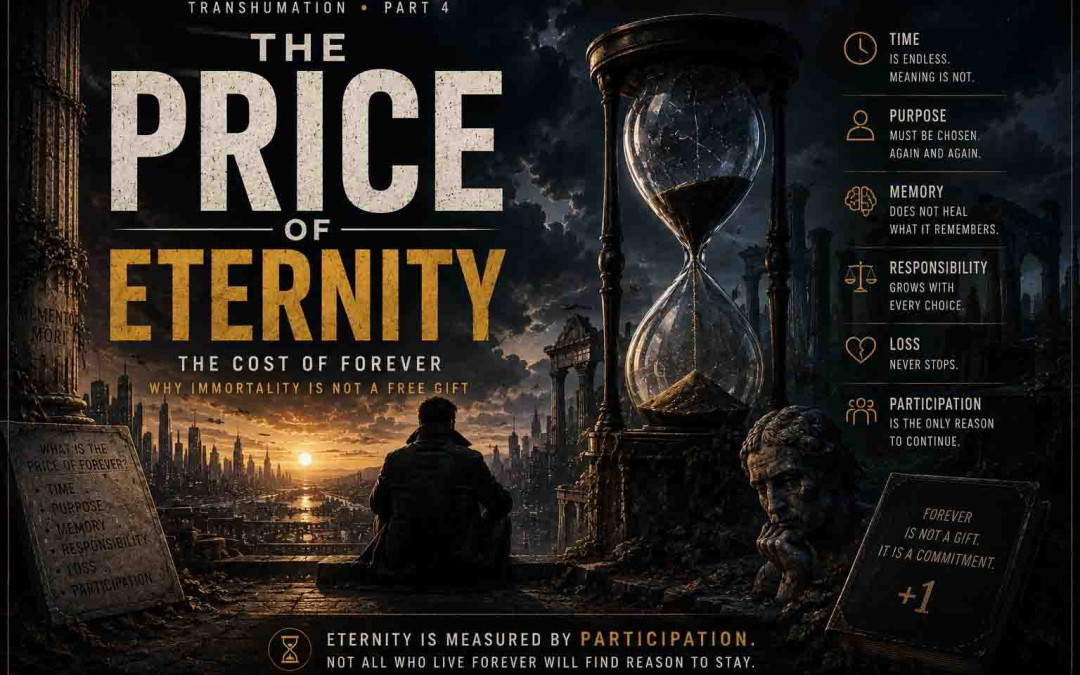
Eternity Does Not Remove Limits
In stories, immortality usually arrives at the wrong moment.
The hero discovers the secret when someone they love is already dying. The vampire has youth but has lost the century that made youth meaningful. The king survives his enemies and eventually discovers that survival has become another kind of prison. Literature has spent centuries imagining the immortal person as melancholy, detached or exhausted.
This tells us something interesting, although perhaps not what it first appears to tell us.
It does not prove that endless life would become unbearable.
It reveals that human beings have difficulty imagining eternity without importing the psychology of mortality into it.
We imagine living forever while keeping the same memory, the same desires, the same emotional architecture, the same relationships and roughly the same idea of a meaningful life. Then we extend that person across ten thousand years and are surprised when the result looks exhausted.
But perhaps the problem is not eternity.
Perhaps it is the assumption that nothing except duration changes.
If human life were radically extended, time would not simply become more abundant. Memory, identity, obligation, power, love, ownership, politics and responsibility would all acquire new scales.
The real cost of forever might not be boredom.
It might be the weight of everything that has had time to accumulate.
Would Immortality Become Boring?
This is probably the first objection people make.
Eventually you would have seen everything. Read everything. Loved everyone. Visited every country. Learned every instrument. Nothing would remain new.
It sounds plausible until we remember that the world does not stop changing while the immortal person is living in it.
New people are born.
New art is produced.
New sciences appear.
New technologies alter what can be experienced.
Cultures change.
Entire environments could emerge that do not currently exist.
A person living in 1026 could not have exhausted the internet by 1526 because the internet was not waiting somewhere on a list of experiences to be completed. The space of possible experience expands with civilization itself.
Boredom therefore cannot be treated as the inevitable mathematical conclusion of longevity.
But another problem survives.
Even if reality keeps generating novelty, can one individual continue caring about novelty indefinitely?
Human motivation depends not only on the availability of new things but on the capacity to assign significance to them.
After twelve careers, does a thirteenth feel liberating or merely repetitive?
After losing five generations of friends, does forming another attachment become easier because one has learned resilience or harder because intimacy has become associated with eventual loss?
We do not know.
The interesting question is therefore not whether eternity eventually runs out of content.
It is whether a mind can continue generating investment in content over radically extended time.
The Vampire Problem
This is why vampires remain useful even if they tell us little about actual future psychology.
The literary vampire is rarely tormented because the night lacks entertainment.
The deeper problem is temporal asymmetry.
Everyone else moves through one human lifespan.
The vampire remains.
Relationships become temporary from their perspective.
Cities transform.
Languages change.
Political orders vanish.
The individual carries memories into worlds in which those memories no longer belong naturally.
The vampire is therefore less a prediction about biological immortality than a thought experiment about outliving context.
That may become one of the genuine costs of extreme longevity.
Identity is partly relational.
We know who we are because there are people who remember earlier versions of us, places containing our history and institutions whose timelines overlap with our own.
A person who lives for one thousand years may repeatedly outlive these mirrors.
At some point, the question is no longer merely “Who am I?”
It becomes:
Who remembers who I used to be?
Could Memory Become a Burden?
A hundred-year life already contains forgetting.
Most people cannot recall every breakfast, conversation or ordinary Tuesday they have experienced. Memory selects, compresses and reconstructs. Entire years can eventually be represented by a few scenes.
This is often frustrating, but an immortal mind might discover that forgetting is not simply a defect.
It may be maintenance.
Imagine a thousand years of autobiographical experience preserved with high fidelity.
Hundreds of thousands of conversations.
Thousands of friendships.
Multiple marriages.
Entire cities known intimately and later demolished.
Languages once spoken fluently.
Political convictions held passionately and later rejected.
The problem is not merely storage capacity.
A future technology might solve storage relatively easily.
The harder problem is salience.
Which memories should remain emotionally close?
Which should become archival?
How many versions of oneself can remain equally present before the current self becomes difficult to locate among them?
An immortal person might eventually require the equivalent of a personal librarian.
Not someone who remembers everything.
Someone who knows what needs to be near the reading room.
Would Immortality Change Personal Identity?
Almost certainly, although ordinary life already does.
The child and the elderly adult can differ in body, beliefs, vocabulary, desires and relationships while remaining parts of one continuous biography. We accept enormous transformation because the change occurs through an ongoing process rather than an obvious replacement.
Extend that process for one thousand years and the intuition becomes harder to maintain.
Suppose you change profession twenty times.
Replace much of your body medically.
Store large portions of memory externally.
Adopt beliefs your present self would find incomprehensible.
Forget most of the emotional texture of your first century.
Would the person living in year nine hundred still be you in the sense that matters now?
Perhaps yes.
The causal chain remains.
But extreme longevity exposes an uncomfortable possibility: survival may eventually preserve the organism while transforming the person so profoundly that the original desire for immortality has become philosophically ambiguous.
The twenty-first-century self says, “I want to live forever.”
The thirty-first-century successor may answer, “You did. But almost nothing you cared about survived unchanged.”
The price of eternity may therefore include accepting that continuation is not preservation.
To live forever may require becoming someone your present self cannot imagine.
The Human Clock Does Not Simply Disappear
Mortality creates deadlines.
That much is obvious.
But it does not follow that an indefinitely long life abolishes them.
Even an immortal person can be late for dinner.
A friend can leave.
A political opportunity can pass.
A child can grow up.
A civilization can collapse.
A particular sunset will still occur once.
Eternity changes one type of scarcity — the expected scarcity of remaining lifespan — without eliminating local scarcity.
This distinction matters enormously.
An immortal individual may possess endless future time while possessing only one present.
Attention remains finite.
You cannot give complete attention to two incompatible experiences simultaneously.
You cannot maintain unlimited intimate relationships merely because your lifespan is large.
You cannot postpone every decision without affecting the world that continues changing around you.
Infinite duration does not create infinite immediacy.
The immortal person still has to choose what happens now.
Perhaps this saves eternity from meaninglessness.
Choice survives because simultaneity remains impossible.
The Accumulation Problem
A longer life does not merely add experiences.
It adds unfinished structures.
Property.
Promises.
Friendships.
Enemies.
Professional obligations.
Debts.
Rights.
Reputations.
Organizations.
Projects begun centuries earlier.
A hundred-year life allows many of these structures to disappear when the person does.
A thousand-year life does not.
Imagine signing a long-term agreement at age sixty and still being alive five hundred years later.
Imagine founding a company and personally controlling it when the institution is four centuries old.
Imagine owning land bought before the surrounding country existed in its present political form.
Imagine remembering the original purpose of a law that everyone else treats as ancient tradition.
Longevity could create extraordinary continuity.
It could also produce extraordinary inertia.
The mortal world receives a crude form of renewal through succession.
People leave.
Positions open.
Property transfers.
New generations inherit institutions without the same emotional investment in preserving them.
An immortal civilization would have to learn to manufacture forms of renewal that biology currently supplies without asking permission.
Would Immortal People Accumulate Too Much Power?
This may become a more serious problem than boredom.
Wealth compounds.
Networks compound.
Reputation compounds.
Expertise compounds.
Political influence compounds.
A person who has spent three hundred years accumulating property, relationships and institutional knowledge could possess advantages impossible for a thirty-year-old competitor to overcome.
Mortality presently imposes an imperfect ceiling on accumulation.
Fortunes can pass to descendants and dynasties can persist, but the original individual eventually disappears.
Radical longevity weakens that reset.
A founder might personally control a corporation for centuries.
A politician could remain influential longer than entire current constitutional traditions.
An investor could compound wealth over timescales that make present inequality look modest.
This does not make longevity undesirable.
It means that biological innovation would require institutional innovation.
Term limits might matter more.
Ownership structures might need redesign.
Political systems might deliberately prevent longevity from becoming permanent incumbency.
The future could discover that defeating biological death is easier than preventing the birth of immortal aristocracy.
The Mortgage of Eternity
A house provides a useful metaphor because ownership begins with a photograph and continues with maintenance.
People celebrate the keys.
They rarely frame the invoice for the roof.
Extreme longevity would work similarly.
The breakthrough receives the headline.
The next five hundred years receive the maintenance schedule.
Bodies require repair.
Memories require organization.
Institutions require reform.
Relationships require renewal.
Technological dependencies require upgrades.
A person extending cognition into external systems acquires security risks that biological ancestors did not have.
A civilization increasing its lifespan accumulates infrastructure whose failure could affect lives that now span centuries.
The mortgage is not punishment.
It is the consequence of persistence.
Anything valuable enough to preserve becomes something capable of deteriorating.
This is one of the deepest lessons of the Balance Problem: organization creates new failure modes.
Immortality would not defeat that principle.
It would give it more time to operate.
Mortality Lets Us Escape Our Consequences
There is another side of longevity that receives less attention.
It could make responsibility more immediate.
Modern societies regularly make decisions whose major consequences will occur after the decision-makers are dead.
National debt.
Environmental degradation.
Nuclear waste.
Urban planning.
Long-lived infrastructure.
Climate policy.
A seventy-year-old politician can influence conditions in 2100 while knowing they will almost certainly never experience that year.
Imagine instead that they expect to be alive in 2180.
The psychological structure changes.
The future stops belonging exclusively to descendants.
You may personally meet your consequences.
This would not automatically make people wiser.
Humans are quite capable of harming their own future selves.
But extreme longevity could weaken one of mortality’s most convenient moral loopholes:
someone else will deal with it.
The immortal citizen inherits the world they helped create.
Repeatedly.
The Strange Politics of Forgiveness
Long life also changes moral memory.
Modern societies partly depend upon generations forgetting.
Enemies die.
Participants disappear.
Children inherit stories but not always the intensity of the original hatred.
Time can cool conflicts partly because the people who experienced them leave the stage.
What happens when they do not?
A person wronged in 2150 might still confront the offender in 2450.
A dictator could still be alive when historians reinterpret the regime.
Victims and perpetrators could share centuries of public life.
Forgiveness would become less abstract.
So would resentment.
An immortal society might need institutions designed not only to preserve memory but to prevent memory from becoming permanent political paralysis.
Again the problem is accumulation.
Perfect memory sounds morally attractive until every insult, betrayal and injustice remains psychologically contemporary.
Civilization may require the ability to remember accurately while allowing emotional distance to grow.
Eternity may discover that mercy is partly an information-management problem.
What Happens to Love Over Centuries?
Science fiction often gives us only two options.
Eternal love.
Or unbearable loss.
Human reality would probably be stranger.
Relationships already change across decades. People grow together, grow apart, renegotiate commitments, forgive, become bored, rediscover one another or separate.
Extend the lifespan by an order of magnitude and the meaning of lifelong commitment changes because life changes.
A promise designed for seventy years is not automatically identical to a promise extending seven hundred.
Cultures might develop renewable commitments.
Century marriages.
Periods of independence.
Entirely new forms of family.
None of this would make love weaker.
It would expose something mortality currently hides: duration and devotion are related but not identical.
A relationship can be real without being endless.
An endless relationship can become empty.
Extreme longevity would force societies to separate the value of commitment from the simple fact of never leaving.
That could be painful.
It could also make commitment more deliberate.
The Future of Responsibility
The popular image of immortality is freedom without expiration.
No final illness.
No countdown.
No last goodbye.
But a very long life could produce another definition of freedom: the ability to participate in consequences across scales currently beyond one biography.
Plant a forest and see it mature.
Build an institution and remain long enough to repair its founding mistakes.
Begin a scientific project expected to take two hundred years.
Travel to another star without requiring the traveler to sacrifice an entire human lifespan.
Extreme longevity could create responsibilities impossible for mortal humans precisely because projects could remain personally continuous.
The immortal person may therefore not become a spectator.
They may become the ultimate caretaker.
The danger lies in confusing stewardship with possession.
Living long enough to remember the beginning does not grant the right to control everything that followed.
Eternity would require learning how to remain responsible without becoming immovable.
What Is the Real Price of Eternity?
Perhaps the answer is not one thing.
The cost could be memory without forgetting, power without succession, relationships without inherited endpoints, identity stretched across transformations and responsibility expanded across centuries.
None of these makes immortality undesirable.
They simply remove it from the category of free miracles.
Every increase in capability creates new maintenance.
Every extension of time creates new accumulated structure.
Every preserved relationship generates something else that can eventually require repair.
The naïve dream says:
I will have more life.
The mature question asks:
What will more life require me to carry?
That is where immortality ceases to be fantasy and becomes civilization.
Watch The Video
How to Read the World
Current Knowledge
Human beings have not achieved immortality or indefinite healthy lifespan, and current biomedical research into aging does not establish that such an outcome is technically possible. Radical longevity should therefore be treated as a thought experiment when discussing lives lasting centuries or millennia.
There is no evidence that extreme longevity would inevitably produce boredom. Human motivation depends upon personality, environment, novelty, relationships, goals and many other factors, while the environment itself continues producing new possibilities.
Memory is selective and reconstructive rather than a perfect recording. A radically longer life could create new challenges for autobiographical organization, but specific psychological consequences remain speculative because no human population has experienced lifespans remotely approaching the scales discussed here.
Modern institutions are deeply shaped by mortality through inheritance, succession, retirement, generational turnover and limited political tenure. Large increases in lifespan would therefore have effects extending far beyond medicine.
Cultural depictions of vampires, gods and immortal figures are valuable expressions of human concerns about longevity, loss and identity, but they should not be treated as evidence of how real radically long-lived humans would behave.
Open Questions
One major uncertainty is whether human psychology would remain recognizable over extreme timescales. Desire, attachment and identity might adapt to longevity rather than simply stretching current psychology across centuries.
A second problem concerns memory. Would long-lived people forget naturally, rely on external archives or deliberately compress earlier periods of life? The answer could determine whether an immortal person experiences one continuous biography or something closer to a sequence of partially connected selves.
Political inequality may be even more consequential. If longevity arrived unevenly or allowed individuals to compound wealth and influence for centuries, biological life extension could transform class structure before it transformed philosophy.
The deepest question concerns responsibility. Mortality limits how many consequences one person can personally encounter. Radical longevity could make individuals participants in futures that current generations can only imagine, changing the moral relationship between action and consequence.
Transhumation Interpretation
For Transhumation, eternity should not be understood as the removal of limits.
It is the movement of limits from duration to maintenance, attention, identity and responsibility.
An immortal person would still have one present moment, one history to organize and consequences that continue accumulating.
That is why the useful test is not simply whether something can survive.
It is whether the structure can continue changing without becoming a prison built from everything it once refused to let go.
Forever may require one ability more than any other:
knowing what deserves another century.
FAQ
What is “The Cost of Forever”?
It is the idea that radical longevity would solve some problems while creating others involving memory, identity, relationships, power and long-term responsibility.
Would living forever necessarily become boring?
No. New experiences and knowledge could continue appearing indefinitely. The harder question is whether human motivation would adapt to extremely long duration.
Why are vampires often portrayed as unhappy?
They are literary tools for exploring loneliness, memory and outliving one’s social world. Their unhappiness tells us more about human anxieties than about the actual psychology of future long-lived people.
Could immortality create political problems?
Yes. Very long-lived individuals could potentially accumulate unusual amounts of wealth, expertise and influence, making succession and institutional renewal increasingly important.
Would immortality remove urgency?
It could reduce the urgency created by limited lifespan, but attention and local opportunities would remain finite. Even an immortal person can only inhabit one present moment at a time.
What is the deeper Transhumation question?
The deepest question is not whether forever would become boring.
It is whether anything can remain healthy while accumulating indefinitely.
A thousand-year-old person would contain more than additional memories. They would carry abandoned identities, old promises, inherited power, unresolved losses, institutions they helped create and consequences whose beginnings they personally remember.
Mortality currently removes much of that weight through succession.
Eternity does not.
That may be its greatest opportunity and its greatest danger. An immortal civilization could become extraordinarily wise because it remembers what happened. It could also become extraordinarily rigid because nobody ever leaves the room.
The real price of forever may therefore be neither boredom nor time.
It may be learning the difference between what deserves to survive and what deserves permission to end.
Because the art of eternity would not consist only in keeping things alive.
It would consist in knowing what not to carry forever.
Continue the Transhumation Series
- Forgotten Religion | Ancient Gods, Symbols and the Hidden Structures of Human Civilization
- The Last Religion | Death, Immortality and the Future of Humanity
- The New Theurgy | AI, Information and the Future of Human Civilization
- End of Branding: You Were Never Meant to Become a Product
- Baal vs Ishtar: Why Ancient Gods Never Disappeared