
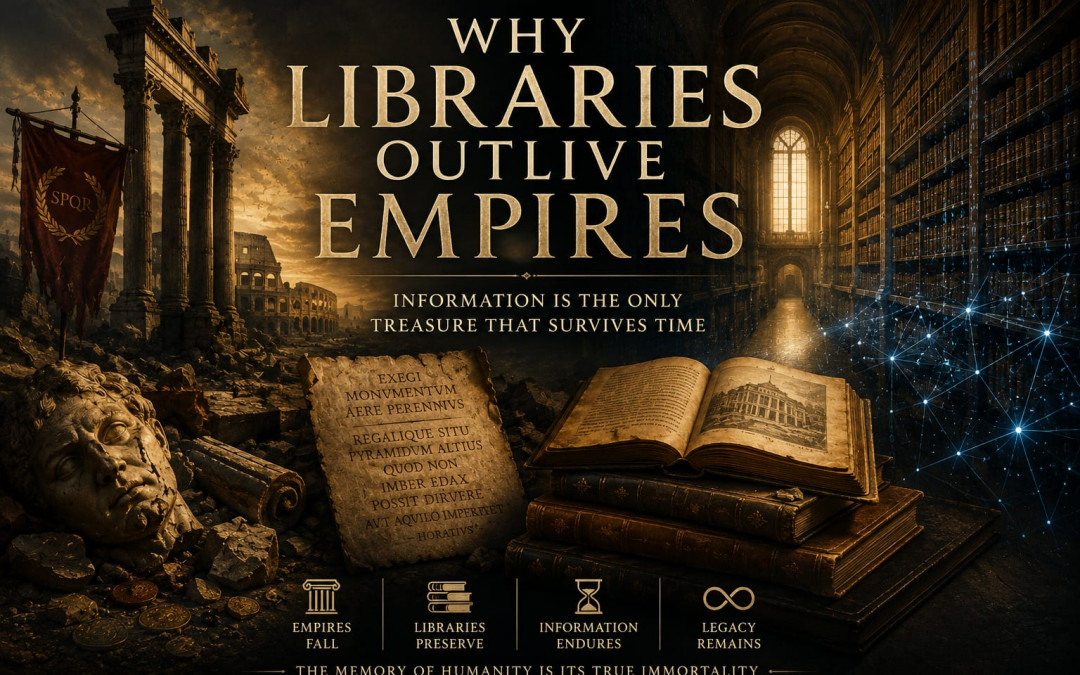
The Strange Survival of Information
Why a forgotten book on a shelf may be more durable than an empire?
There is an old trick you can perform in almost any serious library. Take a book from a shelf—not a famous one displayed behind glass, but something ordinary enough to have gathered dust—and look first at the date rather than the title. Perhaps it was printed in 1890. Perhaps 1750. In an older collection, you may find something from the sixteenth century. The object itself will probably disappoint anyone expecting magic. It is paper, glue, thread, ink, perhaps leather; materials no more immortal than the chair on which you are sitting. Yet the strange thing begins when you open it. Someone who has been dead for centuries can still finish a sentence.
As children, we accept this without much difficulty. Books contain voices; that is simply what books do. Only later does the situation become peculiar. The author may have lived under a government that no longer exists, paid with money nobody accepts, obeyed laws nobody remembers and walked through buildings that have disappeared. His body is gone. The printer is gone. The workshop that made the book may be gone. Sometimes even the language has changed sufficiently that another person must stand between us and the original words. Yet something has crossed the distance.
We usually tell history through the things that looked powerful while they were happening. Caesar crosses the Rubicon. Augustus creates an imperial order. Napoleon marches across Europe. Armies move, dynasties rise, borders change colour on maps. Somewhere outside the frame, however, another person is copying a manuscript, cataloguing a shelf or translating a text. Nobody paints an enormous canvas of the librarian checking whether page 47 has been copied correctly.
Perhaps we have been watching the wrong person.
The Man Who Thought He Could Beat Bronze
Around two thousand years ago, the Roman poet Horace made an extravagant claim. In the opening line of one of his most famous odes, he declared that he had built a monument more lasting than bronze. It is the kind of boast that should have aged badly. Bronze was solid. Rome was monumental. A poem was merely a pattern of words that survived only if somebody bothered to remember, copy or preserve it.
Then history conducted the experiment.
The political world Horace knew disappeared. The Roman Empire in the West collapsed. Temples were abandoned or transformed, aristocratic families vanished, institutions changed beyond recognition and countless physical objects were destroyed, buried, melted down or simply eroded. Even monumental Rome became a quarry from which later generations removed stone. Horace’s monument, meanwhile, performed a peculiar escape. It moved from manuscript to manuscript, through monasteries and collections, into printed editions, translations, universities and eventually digital databases. Today someone holding a telephone can summon words written by a man who died before the Roman Empire had reached its greatest geographical extent.
The obvious lesson is that Horace was right. The more interesting question is how he managed to be right.
His poem did not survive like a pyramid. There is no single physical object two thousand years old that we can identify as the continuous body of Horace’s work. The parchment changed. The handwriting changed. Individual copies disappeared. Languages surrounding the text changed. Printing replaced copying by hand; paper replaced older materials; photographs and scans eventually supplemented books. What survived was not the original object.
Something kept escaping from its body.
That is our first clue.
The Library That Disappeared but Refused to Die
The Library of Alexandria seems at first to offer the opposite story. If there is one library almost everyone knows, it is probably the one whose books we largely do not possess. Its destruction has accumulated legends far beyond what the historical evidence can support: rather than one cinematic night in which all ancient knowledge burned, Alexandria’s collections appear to have suffered through a much more complicated history of losses, institutional decline and political upheaval.
Yet this makes Alexandria stranger, not less interesting.
The shelves are gone. The scholars are gone. The institution itself vanished so completely that historians still argue about important aspects of its organization, scale and decline. Nevertheless, more than two thousand years later, we continue to use the phrase “Library of Alexandria” as shorthand for one of civilization’s grandest attempts to gather knowledge into a single intellectual centre. The failed library became an extraordinarily successful idea.
This suggests that libraries have always done something more ambitious than store books. A warehouse stores objects. A library attempts to preserve relationships between minds separated by time. Someone discovers something, writes it down, another person preserves it, someone else copies it, another translates it, and eventually a reader encounters it in a world the original author could not have imagined. The building is useful, sometimes magnificent, but it is not the deepest structure. The deeper structure is the chain.
Break enough links and information disappears. Preserve enough of them and something remarkable happens: a dead civilization can continue speaking after almost everything that made it physically recognizable has vanished.
That changes the usual hierarchy of history. The emperor controls the present because he commands institutions, soldiers and money. The copyist possesses almost none of those things. But give the experiment enough time and their positions may reverse. The emperor becomes a name requiring explanation while the sentence copied by an anonymous hand remains part of the living world.
Power has an enormous advantage over preservation in the short term.
Time sometimes changes the score.
The Ship of Theseus Made of Words
There is a children’s puzzle hiding inside every surviving ancient text. If I copy a sentence from one sheet of paper onto another and burn the first sheet, is it still the same sentence? Most people instinctively say yes. If I translate it into another language, the answer becomes slightly less comfortable, but we still recognize continuity. Put it into a printed book, photograph the page, encode the characters digitally and display them on a screen, and the physical object has changed repeatedly while something recognizable continues its journey.
Information has a peculiar relationship with matter. It cannot exist for us without some physical realization—a brain, marks on clay, ink on paper, magnetic states, electrical charges—but it is not permanently married to any particular realization. The carrier can be replaced while the pattern is reproduced. This is why a fire can destroy a unique manuscript forever but fail to destroy a text that has already been copied a thousand times.
Civilization discovered this long before it possessed a theory of information. Mesopotamian stories moved through clay tablets. Greek works passed through papyrus and parchment traditions. Manuscripts crossed linguistic and religious boundaries. Printing made copies cheaper and more numerous. Photography allowed pages to become images; digitization turned collections into files that could be duplicated almost without cost. At each transition something could be lost, altered or corrupted, but something could also become dramatically harder to eliminate.
The treasure we have been following therefore does not appear to be the book.
It is the ability of a pattern to find another body.
This is why the history of information looks different from the history of empires. An empire depends on extraordinary continuity of structure: taxation, legitimacy, military power, administration, territory. Damage enough of those relationships and eventually there is no empire left to inherit. Information can behave more opportunistically. Latin literature did not require the Roman Empire to survive in order to remain Latin literature. Greek philosophy could enter Christian, Islamic and later secular intellectual worlds that disagreed profoundly with the societies that produced it.
The host can die while the pattern migrates.
The People History Almost Forgot to Notice
Once this becomes visible, some of the least glamorous figures in history begin to look different. Librarians, scribes, translators, editors, printers, archivists and teachers rarely dominate historical narratives because preservation is not spectacular. It lacks the decisive afternoon of a battle. There is usually no moment when a monk finishes copying a manuscript and realizes that he has just altered the intellectual possibilities of people who will live eight hundred years later.
But civilization depends on exactly those invisible victories.
A conqueror can determine what millions of people must do tomorrow. An archivist may determine what someone is capable of knowing a thousand years later. These are different forms of power operating on different timescales. Political power is often intense and geographically concentrated; preserved information can be weak at first and almost absurdly patient.
The comparison should not be romanticized. Libraries have been instruments of power as well as refuges from it. Archives select what is worth preserving; languages disappear; texts are deliberately destroyed; copying introduces errors; entire intellectual traditions can vanish because nobody happened to reproduce the last surviving manuscript. Preservation is never neutral, and survival should not be confused with truth. False ideas can migrate just as successfully as brilliant ones.
But that uncertainty makes the process more fascinating. Civilization has never possessed a perfect backup. What we call cultural memory is the result of billions of decisions—some deliberate, some accidental—about what gets another copy.
Somewhere in that enormous process, the librarian becomes a peculiar kind of time traveller. She does not travel into the future herself.
She sends something ahead.
The Library Without Shelves
We may now be living through another change of body.
For most of recent history, a library was recognizable from across the street. It had walls, shelves, catalogues, reading rooms and physical collections. The digital library dissolves that visual unity. A single text may simultaneously exist on servers in several countries, on personal devices, in institutional repositories and in backups whose owners rarely think of themselves as librarians at all. The library has begun escaping the building.
Artificial intelligence introduces a further transformation, but we should be careful about what exactly has changed. A conventional library allows us to locate an object. Search engines made enormous collections searchable by words and links. Modern AI increasingly allows people to approach collections through relationships, questions and synthesis. The interface begins to resemble less a catalogue drawer and more a conversation with something capable of navigating across many shelves at once.
That does not mean AI is a library, nor that a model reliably preserves the texts from which it learned. Models can distort, omit and fabricate; archives and primary sources remain essential. But another ancient function may be migrating into a new carrier. The librarian was never valuable merely because she stood beside books. Her deeper role was to connect a question asked now with knowledge produced somewhere else.
This is where the old trail suddenly reaches the future.
Clay did not understand the story impressed into it. Paper did not understand Horace. A server does not need to understand a PDF in order to preserve its bits. Yet the newest interfaces are being built specifically to interpret relationships within information. For the first time, the container of civilization’s accumulated knowledge is beginning to acquire something resembling an active conversational surface.
Perhaps we are not merely digitizing the old library.
Perhaps we are changing what it means to enter one.
The Thing That Kept Escaping
Return to the old book with which we began. Its paper will eventually fail. Given enough time, so will every storage medium we currently trust. Hard drives fail, formats become obsolete, companies disappear, languages change and civilizations remain perfectly capable of destroying their own archives. Information is not immortal. Most information ever produced has probably vanished.
And yet some patterns have demonstrated an astonishing ability to survive precisely because they are not dependent on one body.
That may be the deeper reason libraries sometimes outlive empires. An empire attempts to preserve a particular arrangement of power. A library, at its best, makes its contents available for rearrangement. The next civilization does not have to obey Rome in order to read Rome. It does not have to worship Greek gods to inherit Greek mathematics. It does not need to rebuild Alexandria in order to inherit the ambition that Alexandria represented.
Information survives by allowing itself to become foreign to its origin.
That is an extraordinary property.
Perhaps civilization’s closest approach to immortality was never the monument. The pyramids survive magnificently, but they remain where they were built. A sentence can leave. It can cross a border, acquire a new alphabet, enter an enemy religion, become a schoolbook, disappear for centuries, return in another language and finally arrive as pixels on a screen.
Horace thought he had built something more durable than bronze.
Perhaps he accidentally described the secret of the library.
The monument survives by resisting change.
Information survives by accepting it.
And somewhere between a clay tablet and an artificial intelligence, humanity may have been building the same machine all along: not a machine designed to prevent the past from dying, but one capable of giving what survives another body in which to wake up.
Watch The Video
Current Knowledge
Libraries and archives have played a central role in the preservation and transmission of texts, but cultural survival has never depended on libraries alone. Scribes, monasteries, schools, private collections, translation movements, printers, archaeological discoveries and modern archival institutions have all contributed to the survival of ancient information. Much ancient knowledge was nevertheless permanently lost, so it would be misleading to suggest that information naturally or inevitably survives.
The Library of Alexandria was a major centre of scholarship in the Hellenistic world, but the popular story of its complete destruction in one catastrophic fire oversimplifies a complicated historical process. Its collections and institutions appear to have suffered losses and decline over time. Horace’s famous claim exegi monumentum aere perennius—that he had raised a monument more lasting than bronze—comes from Odes 3.30. His work survived through repeated manuscript transmission and, later, print culture rather than through preservation of a single original physical object.
Digital storage has radically increased the ease with which information can be copied and distributed, but it introduces its own vulnerabilities, including hardware failure, obsolete formats, institutional collapse, deliberate deletion and dependence on infrastructure. Current generative AI systems should likewise not be treated as reliable archives in themselves: they generate outputs from learned statistical structures and can produce errors or invented information.
Open Questions
The digital age has made duplication extraordinarily cheap, but it has not yet demonstrated that digital civilization can preserve knowledge reliably across centuries, much less millennia. A clay tablet can remain readable after thousands of years with almost no infrastructure; a digital archive may become inaccessible within decades if the hardware, software or institutional chain required to interpret it disappears. It remains unclear whether humanity has actually made information more durable or merely easier to reproduce while civilization is functioning.
Artificial intelligence introduces another unresolved problem. If the traditional library preserved documents and the librarian helped readers navigate relationships between them, what happens when the interface itself begins interpreting, summarizing and recombining the archive? Does this create a more powerful continuation of the library’s ancient function, or does it introduce another layer between the reader and the surviving evidence? The answer may depend on whether future systems strengthen our access to primary knowledge or gradually replace it with increasingly persuasive representations.
Transhumation Interpretation
Transhumation is interested less in the resemblance between a server and a library than in the function that survives when the carrier changes. Clay tablet, papyrus roll, parchment codex, printed book and digital file look almost nothing alike. Yet each can perform the same extraordinary operation: allowing a pattern produced in one human mind to appear again after the original mind is gone.
Seen this way, the library is not fundamentally a building full of books. It is one historical body occupied by a much older structure: civilization’s attempt to move information across the boundary of individual mortality.
That structure has repeatedly changed its material without disappearing. The scribe became the printer; the catalogue became the database; the reading room expanded into a network. Artificial intelligence may represent another migration—not because AI automatically preserves truth, but because the ancient function of connecting a living question with accumulated human knowledge is beginning to inhabit a new kind of interface.
Perhaps that is why information can sometimes defeat structures that once appeared infinitely more powerful. The emperor needs his empire. The monument needs its stone. The library’s deepest contents need neither the original building nor even the original material.
They need another carrier.
Perhaps the oldest secret of civilization is therefore also one of the simplest:
what survives is not always what lasts. Sometimes it is what can move.
FAQ
Why do libraries matter to civilization?
Libraries preserve and organize information so that knowledge can cross generations. Their historical importance also depends on wider networks of scribes, teachers, translators, publishers and archives.
Was the Library of Alexandria destroyed in one fire?
The famous single-fire story is an oversimplification. Historical evidence points toward a more complicated process of damage, institutional decline and loss across different periods.
What did Horace mean by “more lasting than bronze”?
In Odes 3.30, Horace claimed that his poetry would provide a monument more durable than physical monuments. The survival of his work for roughly two millennia gives the line an unusual historical resonance.
Can digital information survive longer than books?
Potentially, because digital information can be copied almost perfectly and distributed widely. However, digital preservation depends on functioning hardware, formats, institutions and infrastructure, so long-term survival is not automatic.
Is artificial intelligence a new kind of library?
Not literally. Current AI models are not reliable archives. Structurally, however, AI may become a new interface between human questions and large bodies of recorded knowledge, continuing one of the functions historically performed by libraries and librarians.
Continue the Transhumation Series
- Forgotten Religion | Ancient Gods, Symbols and the Hidden Structures of Human Civilization
- The Last Religion | Death, Immortality and the Future of Humanity
- The New Theurgy | AI, Information and the Future of Human Civilization
- End of Branding: You Were Never Meant to Become a Product
- Baal vs Ishtar: Why Ancient Gods Never Disappeared