

The Moment the Machine Began Competing for the Human Mind
A spear is easy to understand.
Its purpose sits almost entirely in the physical world. It extends the arm, concentrates force and makes possible an action the unaided body performs less effectively. The same clarity belongs to the wall, the plough, the bridge, the pump and the engine. Each confronts an obstacle that can be pointed to: distance, hunger, cold, weight, disease, physical danger.
Now place a pair of headphones beside them.
The object is technologically sophisticated, but the problem it solves is strangely difficult to locate. It does not make the body stronger. It does not reduce the distance to food. It does not shelter the user from rain. What it alters is something less tangible: the relationship between a person and the moment they are already inhabiting.
The street remains the same.
The journey remains the same length.
The body continues walking through the same weather.
Yet the experience has changed.
That change marks one of the most important movements in modern technological culture. It did not begin with the Walkman, and it did not replace technology’s older concern with survival. Agriculture, medicine, energy, sanitation and transport remain foundational to civilization. But in societies where many physical necessities became sufficiently reliable to disappear into infrastructure, another technological frontier expanded rapidly.
The machine increasingly entered the space between the world and the person experiencing it.
It began to work on attention.
Memory.
Mood.
Identity.
Orientation.
Interpretation.
The ancient question of technology was often: How do we survive this world?
The modern question increasingly became: What kind of world will this machine allow us to experience?
Technology Was Never Only About Staying Alive
The clean historical story is seductive.
First humanity invented tools because it was hungry.
Then it invented civilization.
Finally, after material problems were sufficiently controlled, it turned toward entertainment, psychology and meaning.
Actual human history refuses to cooperate.
Some of the earliest surviving artifacts are practical. Others are decorative, symbolic or ceremonial. Music is ancient. Jewelry is ancient. Pigments are ancient. Monumental architecture frequently exceeded immediate survival requirements by astonishing margins. Human beings devoted enormous labor to graves, temples, sculpture, games and ritual while still living in environments where food security could hardly be taken for granted.
Technology has therefore always served at least two overlapping worlds.
One is the world in which bodies must survive.
The other is the world in which human beings need those bodies to belong to a meaningful existence.
A flute does not feed anyone.
A cathedral is an inefficient shelter.
A crown does not improve the thermodynamics of the skull.
Yet civilizations repeatedly invest tremendous resources in such objects because human needs cannot be reduced to metabolism.
What changes in modernity is not the appearance of non-survival technology.
It is the scale, intimacy and persistence with which technology begins entering the psychological environment of ordinary people.
The ceremonial object once occupied a particular place and time.
The modern interface travels with you.
When Necessity Becomes Invisible
A successful civilization has a strange habit of hiding its greatest technologies.
Clean water may require reservoirs, purification systems, pipes, pumps, regulation and constant maintenance, yet to the user it appears as a tap.
Food arrives through agriculture, refrigeration, logistics, transport and global supply chains, yet to the consumer it may appear as a shelf.
Electricity depends upon enormous physical infrastructure, yet it presents itself as a socket in a wall.
The better the system works, the less the individual needs to think about it.
This produces an important psychological shift.
When a survival technology becomes dependable, it stops feeling technological.
People do not wake every morning astonished that municipal engineering has reduced their probability of dying from contaminated water. They notice the system mainly when it fails.
Innovation does not stop serving survival.
Survival simply becomes less visible as a category of daily attention.
This helps explain why late-twentieth- and early-twenty-first-century consumer technology can appear increasingly psychological. The physical foundations remain enormous, but many users encounter them only through interfaces built on top of already-stable systems.
Once transport, electricity, food distribution and basic communications become sufficiently dependable, technological competition can move toward a subtler scarcity.
Not merely calories.
Not merely horsepower.
Not merely distance.
Human time.

The Walkman and the Editable Afternoon
Sony introduced the Walkman in 1979, and its historical importance can easily be exaggerated. Portable music existed before it, headphones existed before it, and people had always used music to modify atmosphere.
What the Walkman helped normalize was something more specific: continuous individualized sound layered over shared public space.
That distinction matters.
A person could walk through a city while inhabiting an acoustic environment unavailable to the people walking beside them. The physical street remained collective. The emotional soundtrack became private.
A train platform could acquire melancholy.
A walk home could become cinematic.
A dull suburban road could suddenly carry the emotional weight of a film scene.
Nothing outside the listener needed to change.
The technology altered significance rather than geography.
That is a remarkable technological act because it reveals that a human environment is never merely the collection of objects physically present around us. It is also what the nervous system selects, emphasizes and interprets.
Change the interpretation and you can change the experienced world while leaving the measurable environment almost untouched.
The Walkman did not create this ability.
Human beings had always sung, remembered, prayed, daydreamed and told themselves stories while moving through space.
What the device did was mechanize one layer of that interior editing.
The Phone That Began Organizing the Person
The smartphone extends this logic much further.
Calling it simply a portable computer misses what it has become culturally. It is simultaneously camera, diary, map, archive, communication system, entertainment system, payment device, navigation assistant, music player, social mirror and increasingly an access point to artificial intelligence.
Its importance therefore lies not only in computation.
It occupies a privileged position between intention and action.
You are lost; it tells you where you are.
You remember a person; it retrieves the conversation.
You want to know something; it offers a search field.
You are bored; it offers stimulation.
You want to present yourself; it offers a camera and an audience.
You cannot remember the restaurant; the device remembers for you.
You do not know which road to take; the software chooses.
This is a different kind of technological extension from the shovel or engine.
The smartphone does not primarily enlarge muscle.
It increasingly extends and reorganizes cognitive access.
It participates in remembering, finding, choosing, orienting and presenting.
The boundary between tool and environment becomes harder to locate because the device is not used for one isolated task. It accompanies a large fraction of ordinary consciousness throughout the day.
The machine does not need to enter the skull to become psychologically intimate.
It only needs to be the place a person repeatedly turns before deciding what happens next.
The New Scarcity
Industrial civilization became extraordinarily good at producing abundance in certain domains.
More food.
More objects.
More information.
More entertainment.
More communication.
More available choices.
Abundance, however, does not abolish scarcity.
It relocates it.
A person with access to ten books lacks books.
A person with access to ten million books lacks time.
When there are three television channels, programming is scarce.
When there are millions of videos, attention becomes scarce.
When communication is slow, connection is valuable.
When everyone can contact everyone continuously, silence becomes valuable.
This transformation helps explain much of modern technology more effectively than the claim that humanity simply moved from the body to the mind.
The underlying economic problem changed.
The bottleneck moved.
An information-rich civilization discovers that human cognition has severe limits.
A day remains twenty-four hours.
Working memory remains finite.
Attention cannot be allocated infinitely.
Emotional bandwidth is limited.
The information supply can grow exponentially while the biological reader remains stubbornly human-sized.
Modern technological systems therefore compete increasingly over selection.
What should you look at?
What should you remember?
What matters now?
What deserves interruption?
Which person, product, story or warning reaches consciousness before everything else?
The problem is no longer only producing information.
It is controlling the doorway through which information becomes experience.
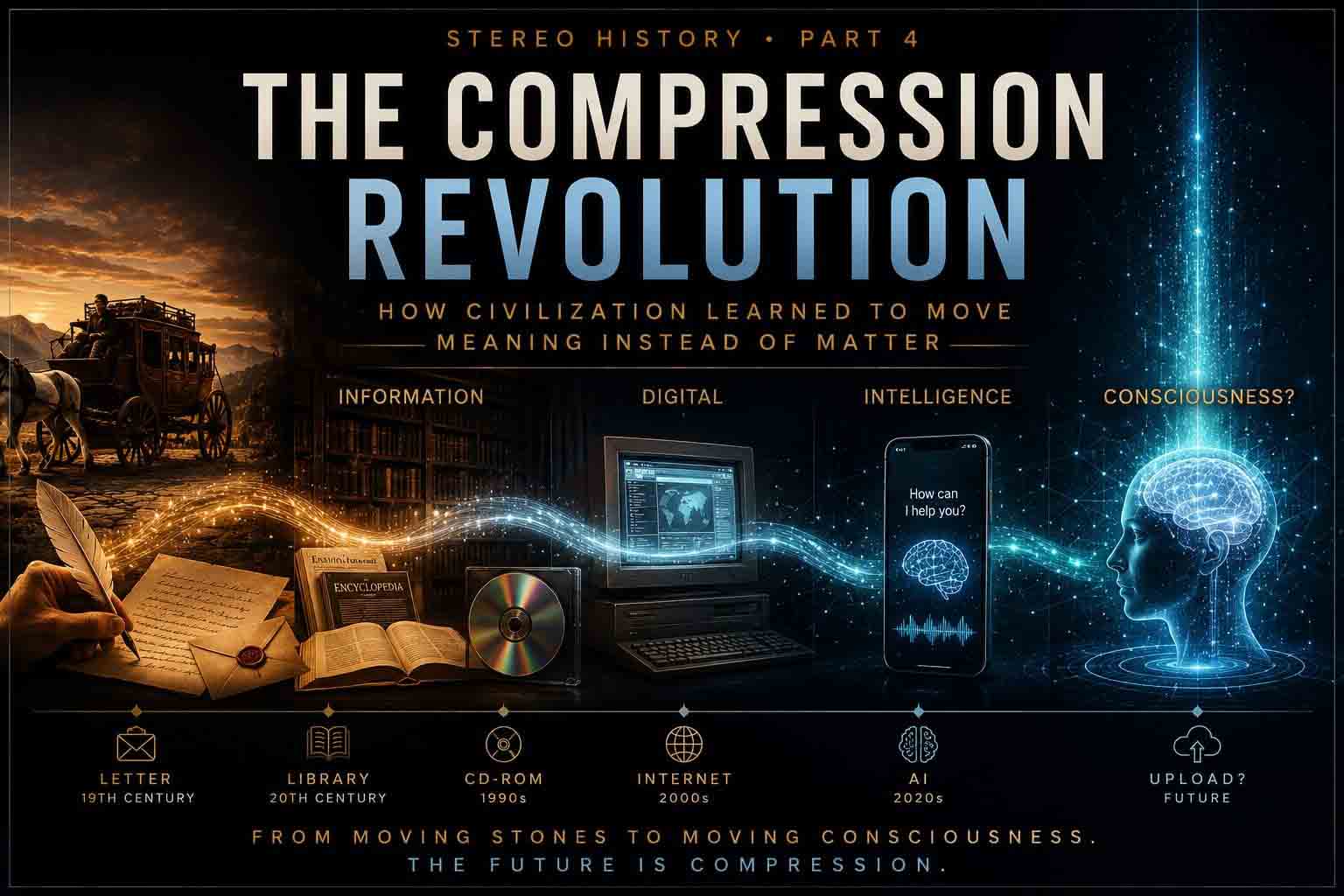
The Consciousness Economy
This is where the phrase consciousness economy becomes useful, provided we use it carefully.
Consciousness itself is not literally a commodity exchanged like wheat. But large parts of the contemporary economy depend upon capturing, directing and predicting human attention.
Advertising has always understood this.
The modern difference is measurement and persistence.
A billboard can attempt to attract the eye.
A digital platform can observe what happens afterward.
Did you stop?
Did you click?
Did you return?
What did you watch next?
Which notification caused re-entry?
Which image held attention?
How long did the hesitation last?
Once behavioral traces become measurable at enormous scale, the interface can adapt.
The competition is no longer only to place a message before a human being.
It is to learn which message this particular human being is most likely to notice.
That changes the cultural role of technology.
The machine becomes partly an instrument for organizing salience.
It participates in deciding what rises from the background of existence and becomes psychologically foregrounded.
This power is subtle because nothing needs to be censored or physically removed.
A thing can remain technically available while becoming practically invisible through ranking.
The interface does not have to destroy the library.
It can simply choose which shelves the reader encounters first.
More Information, Less Orientation
This creates one of the central paradoxes of digital civilization.
Access increases.
Orientation may decrease.
A person can know more while finding it harder to know what deserves belief.
One can communicate with more people while becoming less certain which relationships are substantial.
One can access endless entertainment while experiencing chronic boredom.
One can possess more choices while becoming less confident in choosing.
The old fantasy imagined that information scarcity was the problem.
Give humanity more information and intelligence would naturally expand.
The modern environment demonstrates that information abundance produces a second problem.
Selection.
Context.
Trust.
Interpretation.
This is one reason artificial intelligence arrives at such an interesting moment. Its appeal is not simply that it can generate more information.
Civilization already has too much.
Its more important promise is that it may help navigate information that exceeds human capacity to inspect directly.
The search engine asks for keywords.
The conversational interface allows the user to begin with uncertainty.
That may be a much more consequential shift than producing another trillion pages of text.
AI and the Return of the Librarian
Artificial intelligence is often described as another productivity technology.
That is certainly part of the story.
But conversational AI also belongs to the longer history of interfaces moving closer to the structure of human intention.
A command line asks the user to understand the machine’s grammar.
A graphical interface offers icons.
Search allows natural keywords.
Conversation allows the person to begin closer to the question itself.
The distance between thought and operation shrinks.
This creates enormous opportunity.
A good AI system can help a person move through unfamiliar knowledge, compare explanations, translate technical language, locate contradictions and change scale without manually traversing every layer underneath.
In that sense, AI may become less like an encyclopedia and more like a librarian standing between the reader and an impossibly large library.
But that power also creates a new risk.
The easier the interface becomes, the easier it is to forget that the interface is interpreting.
A librarian can point toward the relevant shelf.
An oracle pretends the shelf no longer matters.
That distinction is crucial.
If AI becomes one of the principal systems through which people encounter knowledge, its role will not merely be informational.
It will help shape orientation.
Which evidence appears?
Which uncertainty is visible?
Which interpretation sounds central?
Which disagreement is compressed into a sentence?
The technology does not need consciousness of its own to have profound effects on human consciousness.
From Tool to Atmosphere
The deepest technological transition may therefore have less to do with individual devices than with ubiquity.
A hammer can be put down.
A television can be switched off.
A smartphone can theoretically be put away too, but the system behind it continues: messages accumulate, markets move, social networks update, navigation data changes and work waits.
The technological environment becomes continuous even when the individual interface is temporarily absent.
This is different from earlier tools because the tool begins resembling atmosphere.
You live inside a network whether you are looking at the network or not.
Its rules influence employment, friendship, commerce, travel and reputation.
Increasingly, the important question is not simply what a technology allows you to do while using it.
It is what kind of society becomes normal once enough people use it continuously.
The automobile changed more than transportation.
It altered cities.
The smartphone changed more than communication.
It altered expectations about availability, memory, navigation, photography and social presence.
AI may similarly matter less as a separate application than through the institutions that reorganize themselves around its presence.
The tool succeeds.
Then society redesigns itself around the tool.
At that point, technology has stopped merely solving a problem.
It has begun defining the environment in which future problems will appear.
Watch The Video
How to Read the World
Current Knowledge
Technology has never served only survival. Archaeological and historical evidence shows extensive human investment in symbolic, artistic, ceremonial and recreational technologies across very early societies. Instruments, ornamentation, architecture and image-making demonstrate that practical and expressive needs have long developed together.
Modern industrial and public-health technologies nevertheless transformed survival conditions dramatically in many societies through sanitation, vaccination, agriculture, transport, energy systems and medicine. These achievements remain unevenly distributed, and survival-related technological problems are far from solved globally.
Late-twentieth-century consumer electronics increasingly emphasized communication, entertainment, personal media and information management. The Walkman, introduced in 1979, became especially influential as a mass-market form of portable individualized listening, although portable audio and headphone culture had earlier histories.
Digital platforms operate within environments of severe information abundance and limited human attention. Many online business models rely partly upon engagement, advertising and behavioral measurement, creating economic incentives to capture and retain attention.
Smartphones and networked digital systems increasingly externalize or support functions associated with memory, navigation, communication and information retrieval. This does not mean cognition has literally moved out of the brain, but it does mean that ordinary cognitive tasks are increasingly performed through coupled human-technological systems.
Open Questions
One important question is whether attention should be understood as the defining scarcity of digital civilization or merely one among several new bottlenecks. Trust, legitimacy, context and the ability to distinguish signal from noise may become equally important as informational abundance grows.
Another concerns psychological dependence. When external systems become extremely good at remembering, navigating and selecting on our behalf, do they simply release human capacity for more important tasks, or can unused cognitive skills weaken through disuse? The answer is likely to differ by function and context rather than obey one general rule.
AI creates a related uncertainty. If conversational systems increasingly mediate access to knowledge, will they broaden intellectual autonomy by making difficult material navigable, or narrow it by hiding disagreement and provenance behind convenient synthesized answers?
There is also a deeper political question about control of salience. In an environment too large for any individual to inspect directly, whoever organizes ranking, recommendation and summarization acquires substantial influence over what becomes visible. How should such systems be designed when attention itself is a scarce resource?
Finally, technological history leaves open the question of whether the distinction between survival and experience can remain meaningful. Mental health, social belonging, information access and orientation can influence physical well-being profoundly. The boundary between technologies of the body and technologies of the mind may therefore be less stable than the title initially suggests.
Transhumation Interpretation
The central Transhumation question here is not whether technology abandoned the body.
It did not.
The modern digital world still rests on mines, factories, cables, power grids, data centers, shipping, food systems and biological users who need sleep and oxygen. Nothing about the informational layer cancels the physical one.
What changed is that some of civilization’s most intimate technologies increasingly operate before the moment when a human being decides what something means.
That is a different degree of mediation.
A road changes where the body can travel.
A search engine changes which information the mind can reach.
A recommendation system changes which possibilities are presented before choice.
An AI assistant may change the scale at which a person can enter an unfamiliar field.
These technologies therefore participate not merely in action but in the architecture preceding action.
They organize the field from which decisions emerge.
This is why the idea of interface becomes so important.
An interface is never merely decoration placed between user and system. It determines which possibilities are legible, which operations are easy and which complexities remain hidden.
A map allows navigation because it removes most of the territory.
A search result allows access because it refuses to show most available pages.
An AI answer may make knowledge usable because it compresses an enormous informational field into a human-scale response.
Each operation helps.
Each also chooses.
The danger begins when successful mediation becomes invisible enough that the user forgets any selection occurred.
This is where the transition from survival technology to consciousness technology becomes philosophically serious.
A spear changes what the hand can do while remaining clearly external to the person.
A mature informational interface may change what the user notices without appearing as an intervention at all.
The medium becomes transparent.
The selected world begins to feel like the world itself.
That distinction is central to the New Theurgy as well.
The interface should never be confused with the underlying system.
A navigation app is not the city.
A model is not reality.
A summary is not the archive.
A recommendation feed is not culture.
And an AI librarian is not civilization’s total knowledge simply because conversation makes access feel immediate.
The better the interface becomes, the more important this discipline becomes.
There is another implication.
For most of technological history, increasing human capability often meant applying more force to the environment.
Lift more.
Move faster.
Build higher.
Travel farther.
Informational technology creates another kind of extension.
It can enlarge the radius of meaningful attention.
A human being cannot personally read every archive, learn every language or inspect every argument relevant to a complex question. An intelligent interface may help navigate that scale without pretending that the biological reader has become infinitely knowledgeable.
That is a genuinely new kind of technological power.
But it does not remove the human bottleneck.
It relocates it.
The limiting factor becomes judgment.
What should I trust?
Which question matters?
What was omitted?
Where should I look closer?
When should I stop delegating and examine the source?
The more machines become capable of supplying answers, the more valuable the quality of human questions may become.
This changes the meaning of progress.
Perhaps the mature technological civilization is not the one that eliminates difficulty.
It is the one that understands which difficulties should not be eliminated.
We want medicine to remove unnecessary suffering.
We want navigation to remove pointless confusion.
We want information systems to remove needless friction.
But uncertainty, attention, judgment and responsibility cannot always be engineered away without removing something essential from human agency.
A system that chooses everything for us might be perfectly efficient and philosophically catastrophic.
Technology therefore did not simply move beyond survival.
It entered a more ambiguous territory.
A furnace can be evaluated partly by whether the room becomes warm.
A system shaping attention is harder to judge because success depends upon what kind of person emerges from prolonged use.
Does the interface enlarge awareness or narrow it?
Does it preserve agency or replace it with convenience?
Does it help the reader enter the library, or does it quietly convince the reader that the interface itself is the library?
Those are not engineering questions alone.
They are civilizational questions.
The first technological revolutions taught humanity how to survive more reliably inside the physical world.
The next may determine how much of the world remains visible once machines become increasingly skilled at deciding what deserves our attention.
That is the threshold.
Not the moment technology stopped caring about survival.
The moment survival ceased to be the only scarce thing worth engineering around.
FAQ
Did technology really stop solving survival problems?
No. Medicine, food systems, energy, sanitation and transport remain central to human survival. The title describes a shift in emphasis within parts of modern consumer technology, not the disappearance of survival technology.
Why is the Walkman important in this argument?
Because portable individualized audio made it easy to alter the emotional experience of public space without changing the physical environment itself.
What is the “consciousness economy”?
It is a useful description for economic systems in which access to human attention, engagement and behavioral response becomes highly valuable.
Why does more information make attention more important?
Because human cognitive capacity remains limited even when the supply of information becomes enormous. Abundance therefore transfers scarcity from information itself toward selection, time and orientation.
Where does AI fit into this transition?
AI may increasingly help people navigate complexity rather than simply produce more information. That gives it potential power over orientation, interpretation and the visibility of evidence.
What is the deeper Transhumation question?
Earlier tools primarily helped us act upon the world. Increasingly sophisticated interfaces can also help determine which version of the world reaches us before we act.
That makes the central question no longer only what technology can do for a human being, but what kind of human being emerges after living long enough inside the interface.
Continue the Transhumation Series
- Forgotten Religion | Ancient Gods, Symbols and the Hidden Structures of Human Civilization
- The Last Religion | Death, Immortality and the Future of Humanity
- The New Theurgy | AI, Information and the Future of Human Civilization
- End of Branding: You Were Never Meant to Become a Product
- Baal vs Ishtar: Why Ancient Gods Never Disappeared