
What Happens When Survival Stops
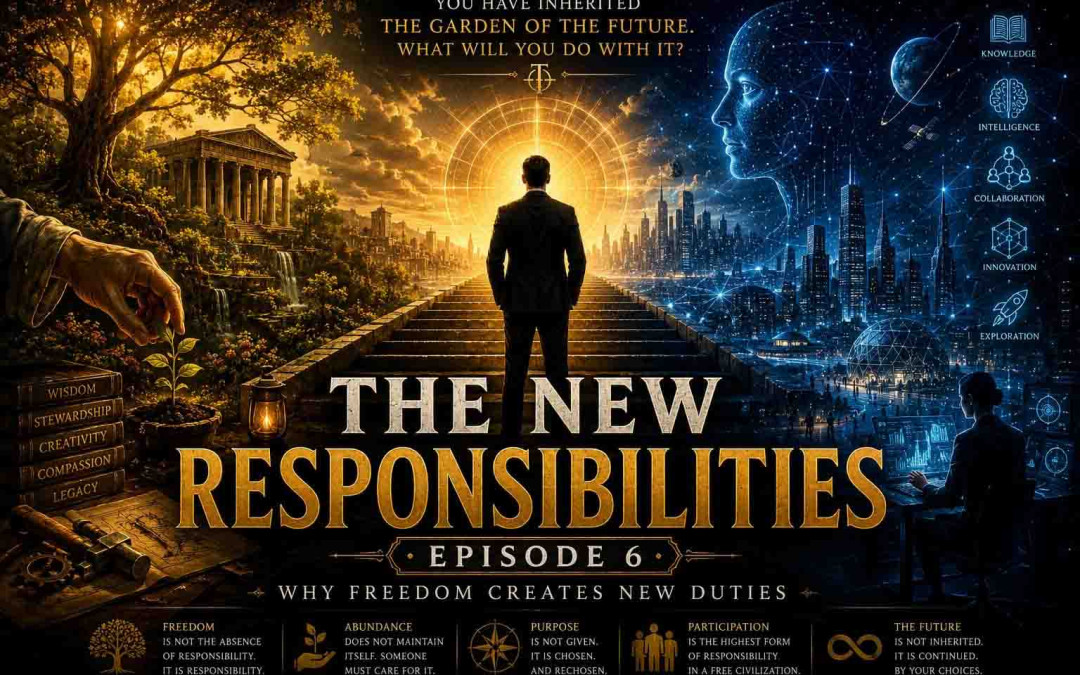
Imagine inheriting a garden so old that nobody alive remembers who planted the first trees.
The walls are already there. The irrigation system works. Someone before you chose the paths, planted the fruit trees, built the greenhouse and learned which corner floods after heavy rain. You arrive into abundance rather than wilderness.
At first, inheritance feels like freedom.
You do not need to begin from bare ground.
Then spring arrives.
Branches need pruning. Pipes leak. Invasive plants spread. A tree that stood for eighty years begins to rot beside a path used by children. Some parts of the garden deserve preservation. Others were mistakes from the beginning.
The garden does not become maintenance-free because you did not create it.
Civilization works much the same way.
Every generation inherits systems built by people it never met: roads, hospitals, electrical grids, laws, languages, archives, scientific knowledge, political compromises, environmental damage, cultural assumptions and technologies whose inner workings most citizens will never understand.
For much of history, necessity absorbed enormous amounts of human effort. Food had to be produced. Fuel gathered. Goods moved. Children protected. Illness endured. Physical labor consumed bodies.
Technology has repeatedly reduced some of these burdens.
Artificial intelligence may reduce more.
But reducing necessity does not eliminate responsibility.
It changes its address.
Does More Freedom Create More Responsibility?
Freedom is often imagined negatively.
No boss.
No schedule.
No compulsory task.
No one telling you what to do.
Yet the disappearance of instruction does not automatically produce direction.
It creates a space in which direction must be chosen.
A child can follow a timetable created by someone else. An adult with complete control over the day must decide what deserves the morning, what can wait until evening and which possibility will never happen because another was chosen instead.
This is why freedom can be psychologically demanding.
Choice creates authorship.
When there is only one available road, the traveler may dislike it, but responsibility for choosing the route is limited. When there are twenty roads, possibility increases and so does the burden of selection.
Modern abundance already exposes this problem.
An individual with access to millions of books cannot read all of them. Someone with thousands of available films still chooses one. A person with extraordinary mobility cannot live in every city.
More options do not remove limits.
They relocate the limit from availability to attention.
A technologically advanced civilization may encounter the same principle on a much larger scale.
As more activities become technically possible, the decisive question becomes less Can we? and more Which possibilities deserve realization?
What Happens When Survival Takes Less Human Labor?
The original fantasy of automation is simple.
Machines perform the unpleasant tasks and humans become free.
History has never been that clean.
Agricultural technology reduced the proportion of people required to produce food in many societies, but it also changed land ownership, cities, employment and political power. Industrialization created extraordinary productive capacity while producing new forms of dependence and inequality. Digital technology eliminated some frictions while creating new ones involving attention, surveillance and informational overload.
Every solved problem changes the landscape in which the next problem appears.
Artificial intelligence is likely to do the same.
If software can prepare documents, coordinate logistics, analyze large datasets, generate media and automate administrative routines, some human effort may indeed be released from tasks previously treated as unavoidable.
But released effort does not arrive with instructions attached.
A society can convert technological abundance into shorter working lives, education, care, science and culture.
It can also convert the same abundance into concentrated wealth, passive consumption and increasingly elaborate systems designed to capture attention.
Technology expands the menu.
It does not choose dinner.

The End of Automatic Direction
There is a useful distinction between meaning and direction.
Meaning was never supplied automatically by survival.
A medieval farmer could love music. A nineteenth-century factory worker could care passionately about politics. People living under severe material pressure still produced poetry, religion, jokes, friendship and philosophy.
But necessity did provide direction.
Certain things had to happen today.
Animals needed feeding.
Wood had to be cut.
Goods had to reach market.
A factory shift began at six.
A household could not simply decide to ignore winter.
As technology absorbs more routine necessity, the space not governed by immediate survival may grow.
That does not create a meaningless society.
It creates one that must become better at self-direction.
The challenge changes from fulfilling obvious obligations to establishing worthwhile ones.
This may turn out to be a profound cultural transition.
Human beings spent millennia learning how to cooperate when scarcity told them what had to be done.
We may now have to learn how to cooperate when there are several plausible futures and no natural force selects one for us.
Will AI Remove Responsibility or Move It?
Imagine a hospital in which an AI system can diagnose certain conditions more accurately than an individual physician.
At first glance, responsibility seems to have moved to the machine.
But new questions immediately appear.
Who selected the training data?
Who approved the system?
Who decides when the AI should be trusted and when a human should intervene?
Who is accountable when its recommendation is wrong?
Which errors are acceptable?
Does the model treat all populations equally well?
What happens when efficiency conflicts with dignity?
Automation therefore tends to remove execution before it removes governance.
A machine may perform the task.
Someone still has to define the task.
A system may optimize a target.
Someone still has to decide whether the target is worth optimizing.
This becomes more important as interfaces improve.
Poor automation constantly reminds us that it is there.
Excellent automation disappears.
The danger is that responsibility becomes least visible precisely when the system becomes easiest to use.
A civilization surrounded by intelligent systems may therefore require less routine intervention and more capacity to inspect hidden choices.
The future citizen may spend less time pressing buttons.
That does not mean fewer decisions are being made.
It may mean the decisions have moved behind the interface.
The Garden Problem
The garden is useful because it contains a lesson technology often hides.
Abundance is not self-maintaining.
A forest can recover without human stewardship, but a designed garden cannot simply be abandoned and expected to preserve the intentions built into it.
Civilization is far closer to the garden.
Electrical grids require maintenance.
Software requires updates.
Medical knowledge requires training.
Archives require context.
Democratic institutions require participation.
Language requires speakers.
Infrastructure does not care whether the generation inheriting it feels motivated.
It deteriorates anyway.
A sufficiently advanced society might automate much of this maintenance.
Robots repair roads.
AI systems monitor bridges.
Autonomous infrastructure manages energy.
But even then, another layer of stewardship remains.
Which infrastructure should still exist?
Which system should be dismantled?
When does preservation become waste?
Which historical institution is a load-bearing wall, and which is simply old?
Stewardship is not keeping everything.
It is deciding what deserves another generation.
What Is Stewardship in an Advanced Civilization?
Stewardship is responsibility toward something one did not create and does not fully own.
That may be one of the defining moral problems of technologically mature societies.
We inherit the climate without having designed it.
Languages we did not invent.
Cities shaped before our birth.
Scientific knowledge accumulated across thousands of lives.
Species whose future depends partly on human behavior.
Institutions that existed long before the people currently running them.
The steward occupies an unusual position.
They are temporary.
The structure may outlive them.
This creates an ethic very different from consumption.
A consumer asks what something can provide now.
A steward asks what condition it should be in when control passes onward.
Radical longevity would complicate this further. If people live for centuries, stewardship becomes less easily separated from self-interest because the future being protected may be one they personally inhabit.
But even without immortality, technology already extends the scale of consequence far beyond the natural horizon of individual attention.
A decision made today can affect systems functioning decades later.
The new responsibility is partly the ability to care beyond the range in which consequences remain emotionally immediate.
Can Abundance Create New Duties?
Yes, although abundance does not automatically make people virtuous.
Consider information.
Humanity once struggled to preserve enough knowledge.
Now many people struggle to decide what deserves attention.
The scarcity moved.
Or consider food in affluent societies.
For some populations, the primary nutritional problem shifted from obtaining enough calories to navigating abundance intelligently.
Capability creates secondary responsibilities.
When travel becomes easier, environmental consequences matter more.
When communication becomes instant, restraint becomes valuable.
When information becomes abundant, verification becomes more important.
When creative tools become powerful, selection becomes harder.
Artificial intelligence may reproduce this pattern.
A person capable of producing a hundred designs in seconds has not eliminated the design problem.
They have moved part of it from production to judgment.
The scarce resource becomes the ability to distinguish the interesting result from the merely possible one.
This is a recurring feature of civilization.
Every time technology removes one bottleneck, another becomes visible.
What Replaces Purpose When Necessity Declines?
Nothing has to replace it because purpose was never identical to necessity.
But societies may need to become much more deliberate about the environments in which purpose can develop.
Meaning often grows from participation in structures larger than immediate preference.
Raising children.
Learning a discipline.
Caring for a place.
Building an institution.
Teaching someone.
Maintaining a tradition.
Investigating a question whose answer may not arrive quickly.
These activities are not valuable simply because they are difficult.
They are valuable because they establish relationships between the self and something outside the self.
A civilization with greater material freedom may therefore need fewer compulsory routines while needing more opportunities for meaningful commitment.
This is a different model from permanent leisure.
Leisure is valuable partly because it exists beside obligation.
If almost everything becomes optional, societies may need to cultivate forms of voluntary seriousness.
Projects people choose and then allow to make demands upon them.
This is already familiar.
A musician chooses the instrument and then submits to practice.
A scientist chooses the question and then accepts the discipline of evidence.
A parent chooses responsibility and discovers that responsibility quickly ceases to feel optional.
Freedom can create obligations without destroying freedom.
The Civilization of Participants
A society built only around consumers would be technologically advanced and culturally fragile.
Consumption requires very little explanation.
Something appears.
It entertains.
It disappears.
Participation works differently.
To participate is to accept some responsibility for the condition of the system one inhabits.
A citizen does not merely use a democracy.
A reader participates in a culture of books.
A scientist enters a chain of knowledge maintained by correction and criticism.
A member of a community receives benefits produced by people they may never meet.
This is why mature civilization cannot be measured only by output.
Wealth tells us what a society can produce.
Technology tells us what it can do.
Participation tells us whether enough people still regard the shared structure as partly their responsibility.
The danger of extreme automation is not simply unemployment.
It is spectatorship.
A person can be materially comfortable while feeling no ownership of the world producing that comfort.
If that condition spreads widely enough, civilization becomes something delivered rather than something inhabited.
The lights remain on.
Few people remember why.
The New Responsibilities
Future responsibility may therefore contain several shifts.
The first is from production toward selection. When machines can generate enormous quantities of options, humans may spend more effort deciding which options deserve reality.
The second is from execution toward governance. As systems become more autonomous, responsibility moves toward rules, goals, oversight and accountability.
The third is from ownership toward stewardship. An increasingly powerful civilization inherits systems too large and consequential to treat merely as private possessions.
And the fourth is from compulsory participation toward chosen commitment. If basic survival eventually requires less human labor, societies may need to become better at creating structures people enter voluntarily and then take seriously.
None of this means necessity disappears.
Someone will still become ill.
Infrastructure will still fail.
Conflicts will remain.
Physical reality will continue imposing vetoes on fantasy.
The future beyond necessity is therefore not a world in which nothing must be done.
It is a world in which a larger proportion of human effort may be spent deciding what is worth maintaining, changing and creating.
That is a more demanding freedom than simple escape.
The Responsibility of Direction
Technological civilization has become extraordinarily good at answering instrumental questions.
How can we move faster?
Store more?
Predict better?
Automate this process?
Generate this object?
Reduce this cost?
AI accelerates this ability because one system can increasingly assist across many domains.
But instrumental intelligence always eventually reaches a boundary.
Faster toward where?
More of what?
Optimized according to whose objective?
Preserved for whom?
The most advanced system imaginable cannot make these questions disappear merely by being powerful.
Power increases their importance.
A civilization unable to choose direction intelligently becomes more dangerous as its ability to travel increases.
This is why the final responsibility may not be creation.
It may be orientation.
Knowing not only what civilization can build, but what kind of civilization its tools are building in return.
Watch The Video
How to Read the World
Current Knowledge
Human history cannot be reduced to survival alone. Even under severe material constraints, people have consistently devoted effort to social life, art, ritual, play, prestige, knowledge and other activities not explainable solely as immediate survival behavior.
Technological development has reduced the human labor required for many tasks while creating new forms of work, complexity and dependency. Automation often shifts human activity rather than simply eliminating it.
AI systems can increasingly perform or assist with cognitive tasks such as classification, language production, analysis and planning, but deploying these systems introduces questions of governance, accountability, values and distribution. Automation does not remove the need to decide which objectives should be pursued.
Greater material abundance can change rather than eliminate scarcity. When information is abundant, attention becomes scarce. When production becomes cheap, selection and verification can become more important.
Meaningful human activity has never depended exclusively on paid employment or survival pressure. Relationships, care, learning, creativity, community and voluntary projects can provide purpose independently of economic necessity.
Open Questions
One major question is whether societies can successfully separate material security from employment without weakening social participation. If jobs become less central, new institutions may be required to provide structure, recognition and opportunities for contribution.
Another concerns governance. As AI systems become more autonomous and less visible in everyday interaction, how can responsibility remain traceable rather than disappearing behind technical complexity?
A third problem is distribution. Technological abundance does not guarantee equal access to its benefits. A civilization can become extraordinarily productive while allowing power and wealth to concentrate in fewer hands.
The deepest question concerns voluntary commitment. If people face fewer obligations imposed by survival, will they reliably create demanding purposes of their own, or will societies need new cultural structures that make participation attractive without making it compulsory?
Transhumation Interpretation
For Transhumation, freedom is not the disappearance of structure.
It is the ability to choose which structures deserve participation.
As technology removes some forms of compulsory labor, responsibility may move upward: from performing tasks toward choosing goals, preserving systems and deciding what should be allowed to end.
That is why the future citizen may resemble a caretaker more than a worker.
The new question is not simply:
What must I do to survive?
It is:
What is worth taking responsibility for when survival no longer answers enough of the question?
FAQ
What are “the New Responsibilities”?
They are responsibilities that become more visible when technology reduces some forms of routine necessity, including stewardship, governance, selection and long-term participation.
Does more freedom mean less responsibility?
Not necessarily. More freedom often means more decisions must be made without external instructions, increasing responsibility for consequences.
How can AI create new responsibilities?
By automating execution while leaving humans and institutions responsible for choosing goals, setting rules, monitoring outcomes and deciding how benefits are distributed.
What is the Garden Problem?
It is the idea that inherited abundance still requires care. Civilization, like a garden, can deteriorate even when the current generation did not build it.
What replaces work if survival requires less labor?
Not one thing. People may invest more time in care, learning, creativity, community, exploration and projects chosen for value rather than necessity.
What is the deeper Transhumation question?
The deeper question is not whether technology will eventually free humanity from responsibility.
It almost certainly will not.
The more interesting possibility is that technology frees us from enough compulsory activity that the quality of what we choose becomes more important than the quantity of what we are forced to do.
A machine can keep the irrigation system running.
It cannot make the garden worth preserving merely by maintaining it.
A model can generate thousands of possible futures.
It cannot make one of them desirable simply because it is possible.
A civilization can inherit extraordinary abundance and still fail if nobody feels responsible for what happens next.
That may be the new responsibility.
Not carrying civilization because death stands behind us.
Carrying it because, for once, we are free enough to decide that it deserves to continue.
Continue the Transhumation Series
- Forgotten Religion | Ancient Gods, Symbols and the Hidden Structures of Human Civilization
- The Last Religion | Death, Immortality and the Future of Humanity
- The New Theurgy | AI, Information and the Future of Human Civilization
- End of Branding: You Were Never Meant to Become a Product
- Baal vs Ishtar: Why Ancient Gods Never Disappeared