
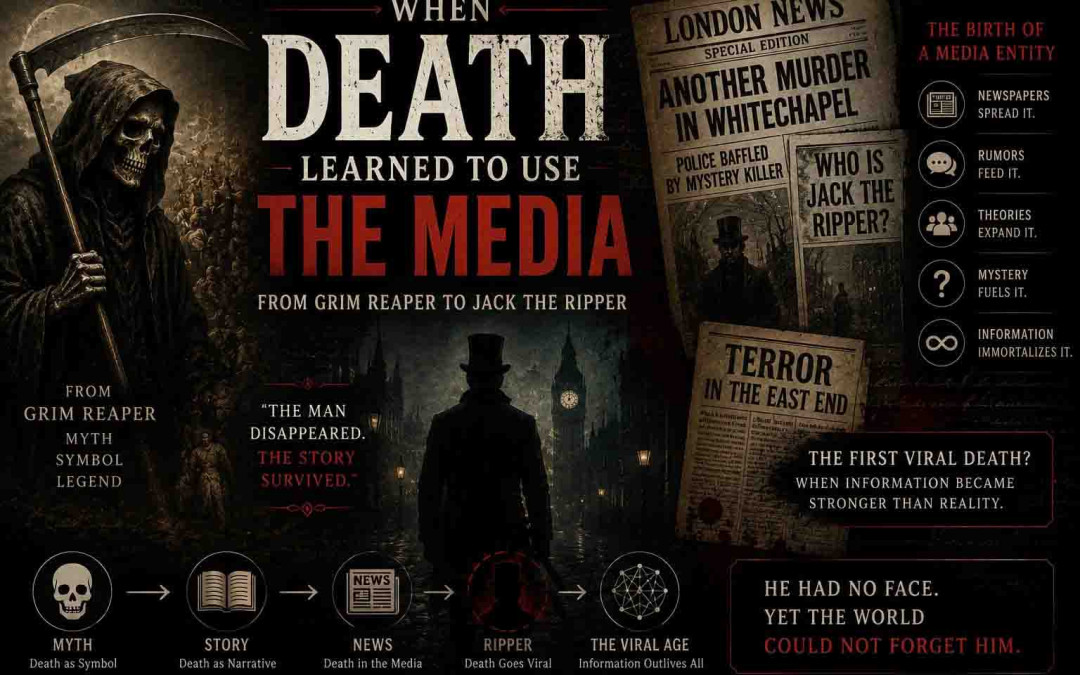
„The Grim Ripper”
Death has always presented civilization with a representational problem.
A dead body is visible. Death itself is not. It has no face, no voice and no stable physical form that can be pointed to independently of the organism in which it occurs. Cultures therefore gave it bodies. Skeletons danced through medieval imagery. Saints, demons, angels and psychopomps escorted souls across thresholds. During the later Middle Ages, particularly in a Europe repeatedly confronted by plague and mass mortality, the familiar skeletal harvester with the scythe became one of the durable Western personifications of death.
The image solved a psychological problem by turning an abstraction into a character.
Centuries later, Victorian London produced a very different figure.
No confirmed skeleton. No scythe. No supernatural mythology. Most importantly, no verified face.
And yet almost everyone knows the name.
Jack the Ripper.
The historical murderer remains inaccessible, but the public figure assembled around him became one of the most recognizable representations of violent death in modern culture. Newspapers gave the mystery circulation. Letters of uncertain authenticity supplied a name and apparent voice. Illustrators supplied imagined bodies. Later literature and cinema supplied atmosphere. Each medium added another layer until the figure could survive almost independently of the man who committed the crimes.
Death had not literally learned to use the media.
Something more interesting had happened.
Media had learned how to give an absence a personality.
Death Had Faces Before It Had Headlines
The comparison between the Grim Reaper and Jack the Ripper works only if we resist turning resemblance into genealogy.
There is no need to claim that the latter evolved directly from the former. The cultural histories are different. Nor should the similarity between Reaper and Ripper be treated as evidence that whoever coined the Ripper name consciously intended an ancient symbolic transformation. Linguistic attraction is not historical proof.
What the comparison gives us is a change in mechanism.
The Reaper belongs to symbolic culture. The figure condenses a universal process into an image that can be painted, carved, narrated and recognized. Nobody needs to believe that an actual skeleton walks through fields harvesting human lives for the symbol to function. Its power comes from compression.
Jack the Ripper is stranger because the cultural figure begins with real physical events but becomes increasingly detached from the unknown person responsible for them.
The murderer existed.
The persona was assembled.
That distinction is crucial.
The Reaper gives a fictional body to death.
The Ripper case gives a cultural identity to a body we cannot identify.
One begins with an abstraction and manufactures a figure.
The other begins with a figure who existed and ends with an abstraction.
Did Newspapers Create Jack the Ripper?
Not exactly.
They did not create the murders, and it would be grotesque to reduce the deaths of real women to a media experiment. The physical crimes came first. Police investigations, witnesses, medical examinations and the terror experienced by people in Whitechapel belonged to material reality before any later mythology.
But newspapers participated powerfully in determining what the events became culturally.
Late-Victorian journalism operated inside an increasingly competitive mass market. Cheap print, rising literacy, rail distribution, telegraphic communication and news agencies allowed a local crime to become a national and eventually international informational event. Different newspapers framed the murders differently, competed for new material and repeated rumors alongside more reliable reporting.
The transformation became particularly dramatic when correspondence claiming to come from the killer entered the story.
The famous “Dear Boss” letter gave the public a memorable signature: Jack the Ripper. Whether the murderer wrote it remains doubtful. Much of the correspondence associated with the case was hoax material, and there is no secure basis for simply treating the familiar taunting voice as the voice of the killer.
Yet the name worked.
That is the media-historical anomaly.
A potentially false piece of communication could still have a genuine cultural effect.
The name did not need authentic authorship in order to become real as information.
Millions of people eventually knew a man by a name that may have been invented by someone else.

Why Is Jack the Ripper Still Famous?
Anonymity alone cannot explain it.
History contains countless unidentified killers and unresolved crimes that never acquired comparable cultural durability. Nor can brutality alone explain it. Human history contains violence on a scale far beyond Whitechapel.
The Ripper case combined several conditions with unusual efficiency.
The crimes were concentrated enough to appear connected. The locations belonged to a densely inhabited metropolitan environment. Mass newspapers supplied repeated attention. The investigation failed to produce a definitive perpetrator. Witness descriptions never stabilized the identity. Controversial letters offered the illusion of direct access to the murderer. Later popular culture inherited a mystery with enough surviving evidence to constrain imagination but too little to end it.
That balance matters.
A mystery with almost no evidence eventually becomes empty.
A case with complete evidence becomes biography.
The Ripper exists in the fertile middle.
There are streets.
Dates.
Bodies.
Statements.
Police documents.
Medical opinions.
Letters.
Suspects.
But the center remains missing.
This gives every generation enough material to begin again.
The story survives partly because it refuses to close.
The Media Entity Without a Stable Author
Calling Jack the Ripper a “media organism” is useful only as metaphor.
Stories are not organisms. They do not breathe, want or reproduce on their own. People transmit them. Newspapers print them. Archives preserve them. Film studios dramatize them. Algorithms now recommend them.
Yet complex cultural narratives can behave as though they possess a degree of autonomy because no single participant controls their development.
The Ripper persona illustrates this almost perfectly.
The killer supplied the crimes.
Journalists supplied framing.
Hoaxers may have supplied the name and voice.
Police activity supplied documentation.
Witnesses supplied uncertain images.
Artists supplied silhouettes.
Novelists supplied motives.
Cinema supplied fog, darkness and visual shorthand.
Researchers supplied ever-expanding suspect genealogies.
Tourism supplied physical routes through the surviving city.
The internet supplied permanent recombination.
The result has no single author.
It is a distributed cultural construction attached to an unknown historical individual.
That is much closer to contemporary network culture than the idea that one Victorian murderer somehow invented personal branding.
When the Story Outgrows the Person
There is a basic asymmetry in the case that becomes more disturbing the longer one looks at it.
We possess more information about Jack the Ripper than we possess reliable information about the person behind Jack the Ripper.
Those are not the same thing.
The archive around the cultural figure is enormous. The biography of the historical offender is effectively blank.
Normally information should reduce uncertainty. A portrait fixes appearance. An address fixes location. A birth record fixes part of chronology. A signed letter can establish vocabulary.
Here, the archive frequently does the reverse.
More material produces more possible men.
Another theory.
Another suspect.
Another interpretation of the wounds.
Another route through London.
Another handwriting comparison.
Information accumulates faster than identity stabilizes.
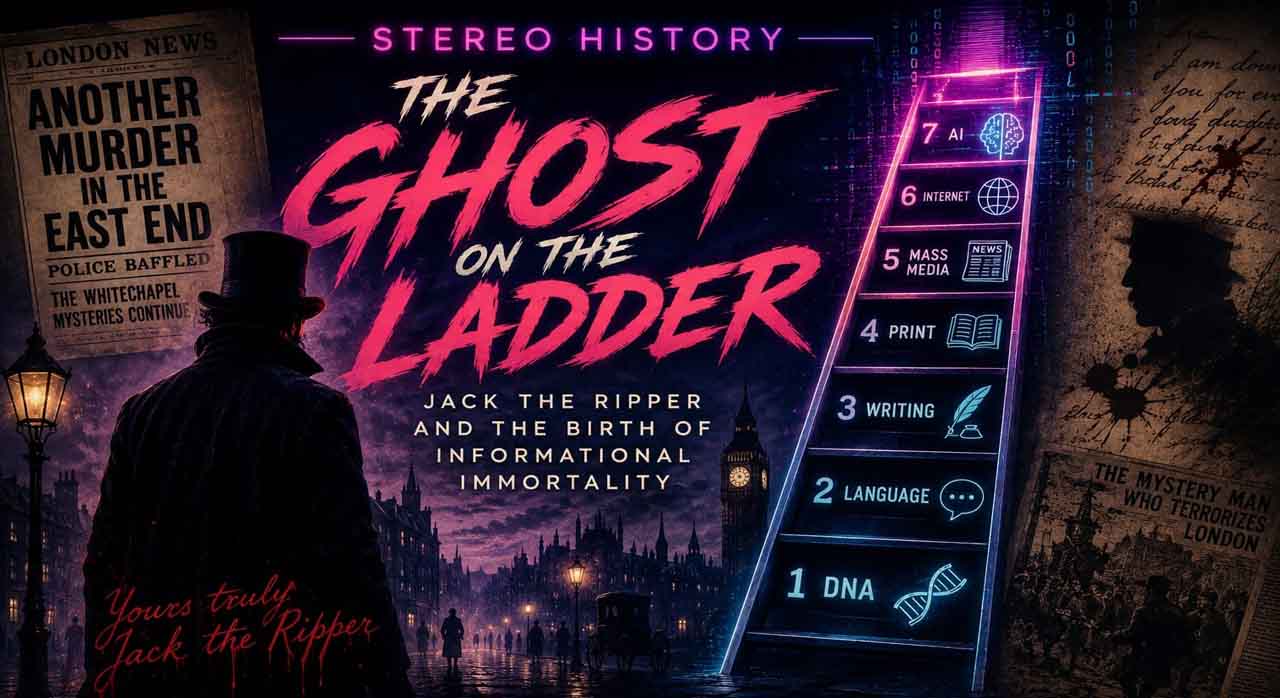
This makes Jack the Ripper a particularly useful example of what might be called informational immortality without personal preservation.
The pattern survives magnificently.
The person does not.
Why Do Media Remember Killers Better Than Victims?
This is the ethical problem the older version of the article needs to confront rather than merely observe.
The familiar cliché says that the killer became immortal while the victims were forgotten.
That is too simple and increasingly inaccurate. The women traditionally associated with the canonical murders—Mary Ann Nichols, Annie Chapman, Elizabeth Stride, Catherine Eddowes and Mary Jane Kelly—are named, studied and increasingly restored to histories that once reduced them to props inside the killer’s legend.
But the imbalance remains revealing.
An unidentified murderer acquired one of the most recognizable brands in criminal history.
The women he killed had actual names, lives, relatives, occupations, illnesses, movements and histories, yet popular culture often compressed them into a collective category: the victims.
This tells us something unpleasant about narrative mechanics.
Mystery attracts attention.
An absent identity invites projection.
A dramatic nickname compresses complexity efficiently.
An ordinary biography requires patience.
Media therefore do not necessarily preserve what matters most.
They preserve what travels most effectively.
That distinction should make us cautious whenever we use words like informational immortality. Cultural durability is not a moral reward. The patterns that survive are not automatically the patterns civilization should have preserved.
Sometimes the archive remembers the mask better than the people who suffered beneath it.
Was Jack the Ripper the First Viral Criminal?
No.
Famous criminals, sensational murders, public executions, broadsides, pamphlets, rumors and international scandals existed long before 1888. Earlier information systems could generate astonishing levels of public fascination.
The Ripper is nevertheless a striking early case of something that feels familiar in the digital era: an unresolved identity becoming more powerful through repeated circulation.
Every new report could produce another theory. Every theory could produce another letter. Every letter could become another report. Rumor, reaction and investigation began feeding one another.
This is where the analogy with virality becomes useful.
The original event creates attention.
Attention creates secondary information.
Secondary information creates additional attention.
Eventually the phenomenon can remain active even when no new primary evidence appears.
Modern social networks accelerate the same general structure dramatically, but they add something Victorian newspapers did not possess: instantaneous feedback, algorithmic ranking, personalized distribution and measurable engagement.
The Ripper case therefore was not the beginning of the Viral Age in any literal historical sense.
It was one of those moments when an older media system displayed behavior that later digital systems would make impossible to ignore.
Death Becomes an Interface
There is a deeper reason the Grim Reaper comparison remains useful.
Both figures mediate between something difficult to grasp and an audience trying to grasp it.
The medieval figure translated mortality into visual symbolism.
The Ripper phenomenon translated a series of crimes into a recognizable public identity.
Neither representation is identical with the thing represented.
That is the crucial point.
The Reaper is not death.
Jack the Ripper, as culture now knows him, is not necessarily the historical murderer.
One is openly symbolic.
The other can deceive us because it appears historical.
The further we move from 1888, the easier it becomes to treat the cultural Ripper as though he were a recovered personality: witty, theatrical, medically knowledgeable, sexually motivated, arrogant, obsessed with publicity.
Some of those traits may prove accurate.
Some may come from letters he never wrote, theories created decades later or fictional conventions repeated until they became familiar.
The interface starts looking like the source.
That is the danger.
Watch The Video
How to Read the World
Current Knowledge
Personifications of death have appeared in many cultures and periods, while the recognizable Western Grim Reaper developed particularly strongly in late-medieval European imagery associated with mortality, plague and traditions such as the Danse Macabre. It should not be treated as one universally fixed ancient symbol.
The Whitechapel murders of 1888 became a major media event within an expanding newspaper culture. Sensational crime reporting had long existed, but cheap print, high literacy, telegraphy and competitive journalism increased the speed and geographical reach of reporting.
The historical identity of Jack the Ripper remains unproven. The famous name entered public culture through correspondence claiming to come from the murderer, while the authenticity of that correspondence remains uncertain. Much of the wider Ripper correspondence consisted of hoaxes.
The resulting public persona therefore cannot be treated as a transparent psychological portrait of the offender. The historical murderer and the later cultural figure need to remain analytically separate.
The victims were real individuals with recoverable biographies, and modern scholarship has increasingly emphasized reconstructing their lives rather than treating them merely as supporting characters in the mythology surrounding their killer.
Open Questions
One major question concerns how much the murderer himself participated in the media phenomenon. Did he read reporting about the crimes? Did it alter his behavior? Did he write any surviving correspondence? Evidence establishing an authentic communication would materially change the interpretation of the killer as a deliberate media performer, but at present that cannot be assumed.
A second question concerns the construction of the public persona. If the famous name and apparent voice originated outside the murderer, how much of the psychological character commonly attributed to Jack the Ripper belongs to journalists, hoaxers and later culture rather than to the historical offender?
There is also a broader media question. Why do anonymous or unresolved perpetrators sometimes become culturally larger than identified offenders? Mystery appears to create interpretive space, but anonymity alone is clearly insufficient. The interaction among violence, media competition, social anxiety, symbolism and incomplete evidence probably matters more than any single factor.
The ethical question may be harder still. Can historical storytelling examine the extraordinary durability of a criminal persona without continuing the very process that marginalized the people harmed by it? Any responsible treatment of the Ripper phenomenon has to distinguish studying the machinery of notoriety from admiring its product.
Transhumation Interpretation
This case belongs to Transhumation because it demonstrates something that becomes increasingly important in an information-rich civilization: survival of a representation can be much easier than survival of a person.
The distinction seems obvious until representations become convincing.
A person’s body disappears.
A photograph remains.
A voice disappears.
A recording remains.
A writer dies.
A pattern of language remains in books.
None of these things automatically contains the consciousness that produced them, but each can preserve enough structure to create an encounter for another observer.
Jack the Ripper is a pathological version of the same principle.
The representation survives even though the original identity was never successfully preserved in the first place.
This should immediately complicate any romantic theory of informational immortality.
If information survives, we still have to ask:
whose information?
The name Jack the Ripper survives.
It may not be his name.
The famous voice survives.
It may not be his voice.
The silhouette survives.
It is not an authenticated portrait.
The psychology survives.
Much of it may be inference.
In other words, civilization achieved extraordinary persistence while preserving remarkably little certainty about the source.
Continuity of pattern succeeded.
Fidelity may have failed.
That distinction becomes essential when we imagine future archives built with artificial intelligence.
Suppose a system receives every surviving document connected with a dead person. Letters, images, recordings, locations, messages and testimony could be combined into a highly responsive model. The system might answer questions, reconstruct likely movements and perhaps generate new speech in a familiar style.
The result could feel more complete than the original archive ever did.
But completeness of presentation is not completeness of evidence.
The Ripper case shows why.
Human beings already know how to build psychologically persuasive characters around missing centers. We have been doing it for more than a century with Whitechapel.
Artificial intelligence could make the process vastly more convincing.
That places a new responsibility on the librarian.
A future archive should not merely preserve output.
It should preserve provenance.
This line comes from an authenticated letter.
This facial reconstruction is probabilistic.
This motive is inference.
This anecdote appeared fifty years later.
This voice is generated.
This gap remains a gap.
Those labels may eventually become as important as the preserved content itself because synthetic reconstruction can make boundaries visually disappear.
This connects back to the Grim Reaper in an unexpected way.
Nobody sees a medieval skeleton with a scythe and mistakes it for forensic evidence about the biological mechanism of death. The symbolism announces itself as symbolism.
Modern reconstructions can be more dangerous because they can look like reality.
The interface becomes transparent.
The cultural persona becomes so detailed that we forget how much was invented.
Perhaps that is what “death learned to use the media” can finally mean without turning metaphor into history.
Death did not acquire a newspaper strategy.
The murderer did not necessarily become a visionary of information.
Instead, modern media discovered that death could be converted into a durable representational object: named, illustrated, narrated, repeated and eventually reproduced long after the original participants were gone.
The process did not preserve reality evenly.
It selected.
Amplified.
Compressed.
Forgot.
And invented.
That is why the deepest lesson of the Ripper story may have very little to do with the murderer himself.
The question is what media do to death after the physical event has ended.
Whom do they preserve?
Whom do they flatten?
Which uncertainty becomes mythology?
Which name becomes searchable?
Which life becomes a footnote?
The Grim Reaper gave death a face because human beings needed a symbol.
Modern media can do something more powerful.
They can manufacture a face around an absence and then preserve it long enough for later generations to mistake the construction for the person.
That is not immortality.
It is something much more ambiguous.
It is survival inside the mirror.
FAQ
What does “When Death Learned to Use the Media” mean?
It is a metaphor for the way modern media can transform death and crime into durable cultural narratives that continue long after the physical events have ended.
Is Jack the Ripper a modern version of the Grim Reaper?
Not historically. There is no demonstrated lineage between the two figures. The comparison is structural: both give recognizable form to something otherwise difficult to represent.
Did newspapers create Jack the Ripper?
They did not create the murderer or the crimes, but newspapers and correspondence played a major role in creating and circulating the public persona associated with the name.
Was Jack the Ripper the first viral criminal?
No. Sensational criminals and rapidly circulating crime stories existed much earlier. The Ripper case is remarkable for the combination of mass journalism, anonymity, mystery and prolonged cultural reproduction.
What is informational immortality?
It is the persistence of names, stories, images or patterns after the people associated with them have died. It should not be confused with survival of consciousness or personal identity.
What is the deeper Transhumation question?
The Ripper case shows that civilization can preserve a representation with extraordinary success while losing—or never knowing—the person behind it.
That leaves a harder question for the digital age: when an image, voice or personality can survive indefinitely, how will we know whether we have preserved a human being, preserved only their traces, or constructed a new character around the space where the human being
Continue the Transhumation Series
- Forgotten Religion | Ancient Gods, Symbols and the Hidden Structures of Human Civilization
- The Last Religion | Death, Immortality and the Future of Humanity
- The New Theurgy | AI, Information and the Future of Human Civilization
- End of Branding: You Were Never Meant to Become a Product
- Baal vs Ishtar: Why Ancient Gods Never Disappeared