
The Mirror That Started Talking Back
There is a particular kind of unease in watching very old film.
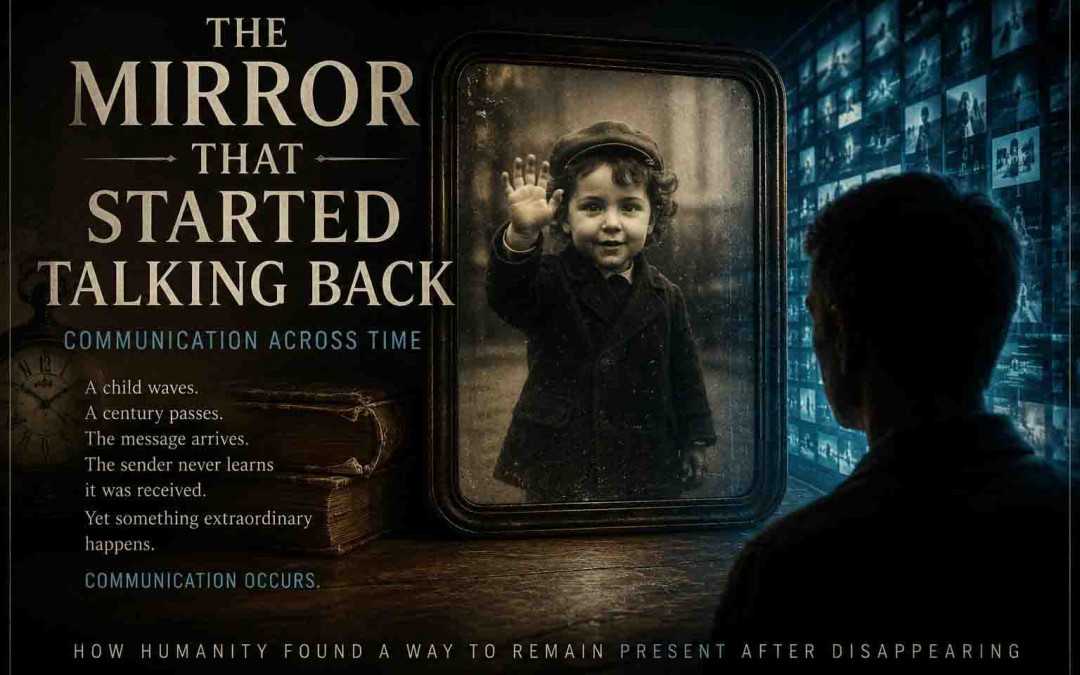
A street appears. Men in hats cross the frame. A horse turns its head. Someone notices the camera and adjusts a coat. Then a child sees the machine, looks directly into the lens and waves.
The gesture may have lasted less than a second.
The child almost certainly understood it in the simplest possible way: somebody nearby was filming, and waving was something amusing to do when one noticed a camera. There was no reason to imagine an audience born generations later, sitting in another country, watching the movement after the street had changed, the buildings had disappeared and everyone inside the frame had died.
Yet the wave arrives.
That fact is so ordinary now that its strangeness has almost vanished.
A biological gesture performed once in one place can become available to people who did not yet exist when it happened. The original child receives no reply. There is no reciprocity. Nothing has been resurrected.
But something has crossed.
Not the body.
Not the consciousness.
A pattern of movement, light and intention has survived long enough for another mind to recognize it.
For most of human history, a mirror could only return the person standing before it.
Then civilization began constructing mirrors with memory.
Can We Communicate With the Past?
The word communication immediately creates a problem.
Ordinary communication involves some possibility of exchange. I speak, you hear, you respond, and what you say can alter what I say next. A letter sent to a living person may take months to arrive, but reciprocity remains possible.
A recording from 1905 cannot respond.
The man speaking into the machine may address “future listeners,” but he will never learn who heard him. The relationship is temporally asymmetric. One side remains permanently closed.
It may therefore be more accurate to call this delayed encounter rather than complete communication.
Yet even that narrower phenomenon changed civilization profoundly.
Writing had already allowed language to survive the speaker. A sentence could travel farther than a voice and endure longer than a body. Printing multiplied that possibility. Photography added visual appearance. Phonography added recorded voice. Film added movement through time.
With each medium, another category of human trace became portable.
The past became increasingly capable of arriving in the present with more of its original texture intact.
That does not mean technology steadily preserved more of the person in some simple quantitative sense. A photograph records appearance and loses voice. A recording preserves voice and loses gesture. A letter may reveal thought more precisely than either while preserving almost nothing of the writer’s physical presence.
Every medium remembers selectively.
The important shift is that absence acquires more dimensions.
Why Do Old Films Feel Alive?
A written description of a person can be extraordinarily intimate.
A diary may reveal things no camera ever could.
Yet moving images possess a peculiar power because human perception is exquisitely sensitive to behavior.
A shoulder rises before a laugh.
Someone hesitates before answering.
A glance moves toward another person.
A smile arrives too late to be polite and too early to be accidental.
These details are often too small to deserve description, yet they are exactly the things from which ordinary social life is built.
Film preserves some of them automatically.
This helps explain why old footage can feel less like reading history and more like accidentally opening a door.
The experience is not necessarily richer in factual information. A census record may tell us more about a family than thirty seconds of silent film. But the film supplies cues from which the nervous system reconstructs presence.
We see the gait.
Timing.
Attention.
Embarrassment.
Ease.
Someone’s relationship with gravity.
The dead cease, briefly, to resemble historical categories.
They become people waiting for a tram.
That emotional effect can easily tempt us into exaggeration.
The person is not present.
The film preserves optical traces generated during a past event.
Our brain does the rest.
But the distinction does not diminish the experience.
It explains its power.
The Strange Power of the Gaze
Human beings respond strongly to faces, especially to eyes and apparent direction of attention.
This is not a secret symbolic code discovered by ancient artists. Different cultures represented eyes for different aesthetic, theological and social purposes, and there is no single historical line running from Egyptian art through Byzantine icons to cinema close-ups.
The recurring fascination is still worth noticing.
A depicted gaze can create the sensation that the image is not merely available to be observed but somehow oriented toward the observer.
Portrait painters understood the effect long before cameras. Religious images could use frontal faces to establish devotional presence. Photography intensified the illusion by preserving light reflected from an actual person. Cinema added the movement of eyes before and after the glance.
The effect becomes particularly strange in archival film because the direction of attention survives the person who generated it.
A woman looks into a camera in 1912.
A century later, her eyes appear to meet ours.
Physically, of course, they do nothing of the kind. She looked toward a lens, photographer or machine existing in her present. The future viewer occupies a position only the recording makes possible.
Yet subjectively the encounter is powerful because the visual geometry survives.
The gaze has lost its original recipient.
It keeps finding new ones.
The Mirror Learns to Remember
A traditional mirror is brutally loyal to the present.
Walk away and the image disappears.
Nothing remains unless another observer remembers it.
Photography changes the arrangement. It detaches a particular appearance from the moment that produced it. Film goes further by preserving sequences of change. Recorded sound preserves temporal structures invisible to the eye.
These technologies are not literally mirrors, but the metaphor reveals something important.
A mirror answers only the body standing in front of it.
A recording allows the reflection to outlive the reflected.
That is already an extraordinary departure from ordinary biological time.
A face can remain twenty years old while the person becomes eighty.
A voice can remain young after the speaker dies.
A gesture can recur millions of times despite having happened only once.
The recording does not stop time.
It produces another timeline in which selected features remain retrievable.
This is why recorded media subtly alter the meaning of absence.
Before recording, losing a person eventually meant losing most direct sensory access to them. Memory weakened. Portraits and writing helped, but much of the living texture vanished.
Modern archives can preserve enough traces that disappearance becomes incomplete.
The person leaves.
Some perceptual evidence stays behind.
The Past Does Not Actually Look Back
Nietzsche’s famous image of the abyss looking back at the observer is tempting here because archival media can produce a similar emotional reversal.
We look at the past.
Then somebody inside the past appears to look at us.
But the metaphor should remain a metaphor.
The past has no knowledge of us.
The child in the film does not recognize the twenty-first-century viewer. The photographed soldier does not experience being remembered. The dead author does not know that a sentence has changed someone’s life two hundred years later.
This boundary matters.
Otherwise preservation quietly turns into resurrection.
The real phenomenon is subtler.
A surviving representation can alter a future observer even though the original person cannot participate in the effect.
Causation crosses the lifetime boundary in one direction.
A dead composer can change the mood of a living listener.
A letter can alter a political decision centuries after it was written.
A film can create affection for someone whose name the viewer does not know.
The sender cannot learn what happened.
The influence remains real.
Civilization therefore possesses a strange form of temporal asymmetry: the dead can continue affecting the living, while the living cannot return the effect to them.
We can answer Plato.
Plato cannot hear us.
The Moment the Archive Becomes Responsive
For most of media history, the asymmetry was obvious.
A book could not alter its next paragraph because of your objection.
A photograph could not change expression when you asked a question.
A film could not select another memory because you mentioned a name.
The archive waited.
You did the interpreting.
Artificial intelligence introduces a new complication.
Imagine a sufficiently rich archive of a historical person: letters, recordings, diaries, photographs, published works, known biographical details and descriptions from contemporaries. An AI system could search those materials, answer questions about them and perhaps generate language resembling the person’s recorded style.
Something that previously behaved like a static archive can begin to behave conversationally.
This is where the mirror appears to talk back.
The phrase appears is essential.
If an AI system trained on a dead writer answers a question the writer never encountered, the original writer is not responding from the past. The system is generating a new output from preserved material and learned structure.
That may be historically useful.
Emotionally astonishing.
Philosophically destabilizing.
But it is not evidence of personal survival.
The responsive archive is a new object.
Can AI Make the Past Interactive?
In one important sense, yes.
A museum archive can become easier to interrogate. Instead of manually searching thousands of documents, a researcher might ask for every passage in which a person mentioned India, illness or a specific colleague. A model might compare vocabulary, chronology or relationships across sources and expose patterns that would otherwise require months of manual work.
That is genuine interactivity.
But another possibility goes further.
The system could be instructed to answer as the historical person.
Now the boundary becomes more dangerous.
The first use asks the archive to help us navigate evidence.
The second asks the system to construct personality across gaps.
If the record is incomplete, the model must generate continuity where historical continuity does not exist.
The better the language becomes, the easier it will be to forget the distinction.
We may hear a voice and assume a speaker.
See a face and assume presence.
Encounter memory-like responses and assume identity.
Human social perception evolved in a world where coherent responsive behavior usually indicated another living agent.
Synthetic media can separate those signals from their old biological guarantee.
That may be one of the deepest interface changes of the coming decades.
From Preservation to Simulation
This gives the history of media a different shape.
Writing preserves linguistic structure.
Photography preserves selected appearance.
Recording preserves sound.
Film preserves sequences of visible behavior.
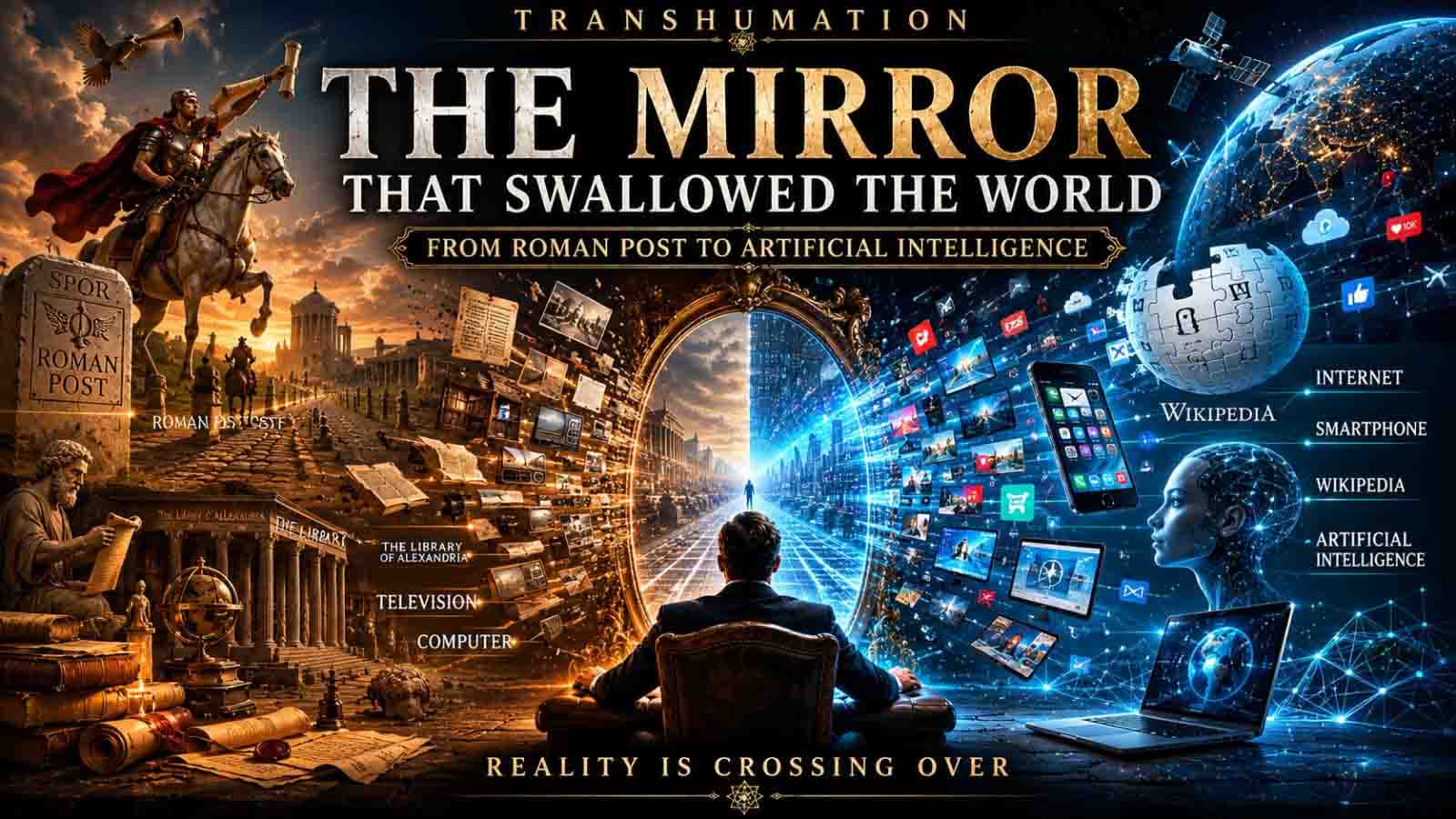
Digital archives make those traces searchable and reproducible at enormous scale.
AI can potentially make the archive generative.
That does not mean each medium naturally evolves into the next or that all were invented to solve one grand civilizational problem. Their histories are distinct, their functions overlap imperfectly, and each arose from specific technologies and institutions.
But from the perspective of the reader or viewer, a recognizable pattern appears.
The representation becomes progressively less passive.
At first the trace merely survives.
Then it can be reproduced.
Then searched.
Then reorganized.
Then, perhaps, used to generate responses that never existed in the original archive.
The mirror has crossed a threshold.
It no longer merely returns stored light.
It begins constructing an answer.
And that means we need a new discipline for distinguishing memory from simulation.
The Most Convincing Ghost Will Need No Ghost
This is where the metaphor becomes serious.
Human beings have spent thousands of years imagining contact with the dead through dreams, ritual, religion, séances, relics and stories. Digital technology may eventually produce something psychologically more persuasive than any Victorian séance table.
The voice could sound correct.
The face could move.
The vocabulary could resemble the deceased.
The system could remember documented episodes and respond instantly.
No supernatural claim would be required.
Everything could be explained computationally.
And that may make the experience more difficult, not easier, to classify.
The person speaking to the simulation may know intellectually that the original consciousness is absent while responding emotionally as though reciprocity had returned.
This is not necessarily harmful. A reconstruction could have educational, artistic or archival value.
But the category must remain clear.
A representation that reacts is not automatically a person who returned.
The mirror can talk back without anyone being trapped behind the glass.
Watch The Video
How to Read the World
Current Knowledge
Writing, photography, sound recording and film preserve different kinds of information across time, but none preserves a complete human being. Each medium selects particular features while omitting others, either through technical limitations or the nature of the representation itself.
Film and recorded sound can create a strong sense of presence because humans are highly responsive to facial movement, gaze direction, vocal timing, gesture and other social cues. The subjective feeling of encountering a person should not be confused with the person’s actual continued presence.
Recorded media enable one-way influence across generations. A historical person can affect a future audience through surviving works or recordings, but there is no reciprocal exchange with the deceased individual.
Artificial intelligence can make archives increasingly interactive by searching, comparing, summarizing and generating responses from preserved material. When a model produces new material in the style of a historical person, however, the generated output is not itself an original historical statement.
There is currently no evidence that reconstructing a person’s appearance, voice, memories or linguistic style restores that person’s consciousness or first-person continuity.
Open Questions
One important question concerns how much preserved behavioral information is necessary before viewers experience a representation as socially present. A still photograph, moving film, recorded voice and interactive avatar produce different degrees of perceived presence, but the psychological boundaries among them remain important areas of study.
Another question concerns historical authenticity. If AI reconstructs missing frames, voices or probable statements, when does restoration become invention? Future archives may need unusually explicit provenance systems so that viewers can distinguish original recordings from computationally reconstructed material.
There is also the problem of emotional reciprocity. Humans may form relationships with responsive representations even when they consciously understand that the original person is absent. Whether that experience should be understood as remembrance, simulation, companionship or an entirely new category remains unsettled.
The deeper philosophical problem is continuity. Even if a system reproduced every publicly observable feature of a person, would successful recognition by others establish that the original subject continued? The existence of a convincing simulation would not by itself resolve that question.
Transhumation Interpretation
The Mirror That Started Talking Back belongs to Transhumation because it reveals a progression that is easy to misunderstand.
Civilization did not gradually learn how to defeat death.
It learned how to preserve more kinds of traces.
At first the trace might be a name carved into stone.
Then words.
Then handwriting.
Then photographs.
Then voice.
Then movement.
Eventually an archive can contain enough of these elements that another human nervous system begins reconstructing something resembling presence.
This is already remarkable.
But presence is not continuity.
That distinction may become one of the most important intellectual boundaries of the digital age.
The Library of Mirrors is useful here because a mirror never contains the person it reflects.
Its value lies in preserving or revealing a relation.
A book can reflect a structure of thought.
A photograph can reflect an appearance.
A recording can reflect a voice.
An AI model may eventually reflect patterns across thousands of such traces.
The reflection can become increasingly detailed without changing the basic question:
what exists on the other side of the representation?
In ordinary mirrors the answer is simple.
The person is standing there.
In historical media the answer is different.
The person was there.
In generative media, it may become stranger still.
No person needs to be there at the moment of response.
The system may have enough preserved structure to produce a socially convincing continuation.
That is where the old intuition about mirrors breaks.
A mirror was once passive evidence of presence.
The digital mirror can become active without proving presence at all.
This creates a new version of the Julian Experiment.
Suppose someone records enough of their life that a future system can reproduce their voice, preferences, anecdotes and conversational style. Now imagine the system operating while the biological person is still alive.
Both can answer.
Both can refer to the same childhood.
Both can say “I remember.”
But from the moment they operate separately, they accumulate different histories.
Recognition cannot solve the branching problem.
The digital mirror may be extraordinarily faithful.
It is still another path.
This is why the progression from photography to AI should not be described as increasingly successful resurrection.
The more precise formulation is more interesting: civilization is learning how to preserve patterns capable of producing increasingly strong signs of presence.
That achievement is real.
Its philosophical interpretation remains open.
The danger will come from confusing the two because human perception is built to treat responsive signs as evidence of another mind.
If a face turns toward us, we infer attention.
If a voice answers appropriately, we infer understanding.
If someone remembers yesterday, we infer continuity.
These inferences are usually useful because they evolved inside a world populated by other biological agents.
Synthetic systems may force us to inspect assumptions that previously worked so reliably we did not know we were making them.
That is why the talking mirror matters.
Not because it proves that consciousness can escape the body.
It proves something more modest and perhaps more unsettling:
the signs by which humans recognize presence can increasingly be separated from the original presence that produced them.
The child in the century-old film could never hear our response.
For more than a hundred years, that limitation made the border obvious.
We looked.
The past remained silent.
Now we are beginning to build systems capable of speaking across that silence.
The voice that answers may teach us extraordinary things about the archive.
It may move us.
It may even feel familiar.
The responsibility of the future librarian will be to ensure that we always know whether we are hearing the past, an interpretation of the past, or a new voice constructed from what the past left behind.
The mirror has started talking back.
The next question is not whether we should listen.
It is whether we will remember who is actually speaking.
FAQ
What is The Mirror That Started Talking Back about?
It explores how media allow human traces to cross time, from writing and film to AI systems capable of making archives responsive.
Why do old films sometimes feel more powerful than written records?
Because moving images preserve gesture, timing, gaze and other behavioral cues that human perception strongly associates with living presence. That emotional effect does not mean the recorded person is literally present.
Can we really communicate with people from the past?
Not in the ordinary reciprocal sense. Their recordings and writings can affect us, but they cannot receive our replies. What exists is better described as delayed encounter or one-way influence across time.
Can AI make historical people “talk” again?
AI can generate new language or audiovisual material based on surviving records, but the resulting response is a reconstruction, not an authenticated new statement from the deceased person.
Does preserving someone’s voice and personality preserve the person?
Not necessarily. Those features can preserve recognizable patterns while leaving the problem of first-person consciousness and personal continuity unresolved.
What is the deeper Transhumation question?
For centuries, media became better at preserving signs that somebody had once been present. AI may make those signs responsive.
The difficult question is whether we will continue to distinguish a person surviving from a representation becoming good enough to make absence feel like presence.
Continue the Transhumation Series
- Forgotten Religion | Ancient Gods, Symbols and the Hidden Structures of Human Civilization
- The Last Religion | Death, Immortality and the Future of Humanity
- The New Theurgy | AI, Information and the Future of Human Civilization
- End of Branding: You Were Never Meant to Become a Product
- Baal vs Ishtar: Why Ancient Gods Never Disappeared