
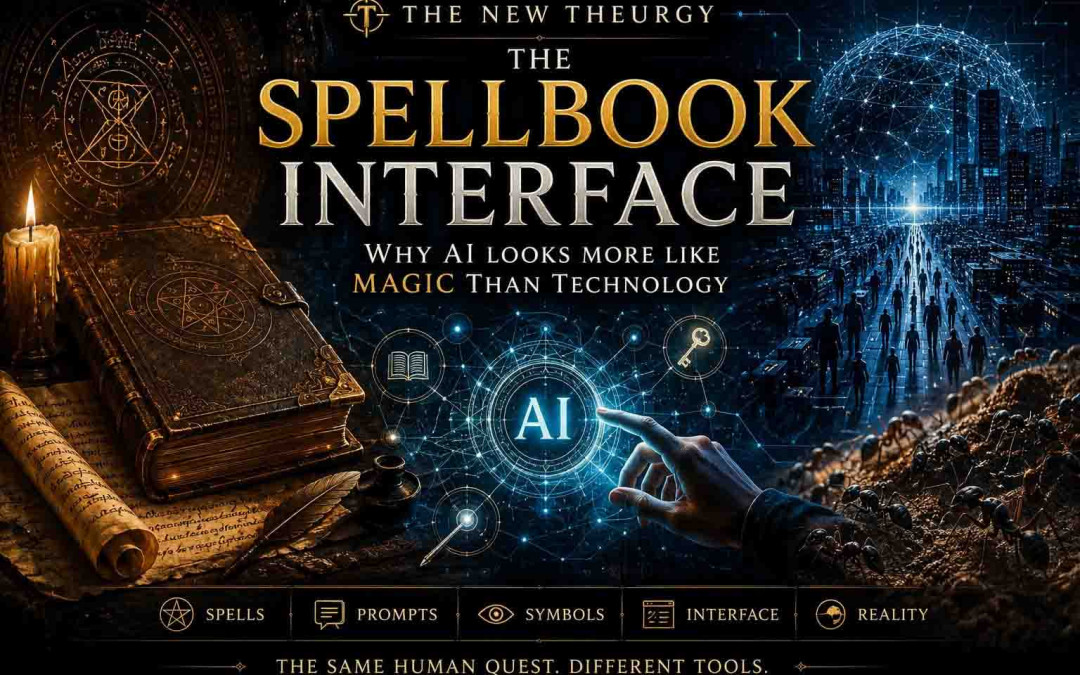
The Spellbook Interface
Why the most advanced technology is beginning to feel less like machinery and more like invocation
There is an odd moment that has become completely ordinary. You sit in front of a screen and type a sentence describing something that does not exist: a hotel on Mars designed by Le Corbusier, an argument written in the voice of an eighteenth-century diplomat, a photograph of a Roman library illuminated by server racks. You press Enter. For a few seconds nothing happens that you can meaningfully observe. Then the result appears.
You did not draw the image. You did not search through millions of sentences and assemble the answer manually. You did not inspect the calculations taking place inside the machine. In most cases you could not explain, in any useful technical detail, how the system transformed your request into the object now sitting on the screen.
You supplied words.
The system responded.
This is completely technological.
It also feels suspiciously like magic.
The resemblance becomes more interesting the more carefully we separate appearance from mechanism. Artificial intelligence does not summon invisible entities, and a prompt is not an incantation in any supernatural sense. The result depends on software, hardware, training data, computation and physical infrastructure. Yet from the perspective of the ordinary user, most of that machinery has disappeared. What remains visible is language acting upon a hidden system.
The machine has become more powerful precisely as the machinery has become less visible.
That is where the Spellbook Interface begins.
When the Machine Disappears
Early machines often advertised their mechanisms. Gears turned. Steam moved pistons. Typewriters struck paper. A person using the device could frequently see the relationship between gesture and result.
Digital technology steadily removed that visibility.
Touch an icon and a file moves somewhere you cannot see. Tap a contact and radio systems, switching networks, protocols and remote servers coordinate a conversation across continents. Ask a navigation system for directions and orbital infrastructure participates invisibly in the answer.
Artificial intelligence carries this abstraction much further.
The user does not select an obvious command from a fixed menu. The user describes an intention.
“Make this warmer.”
“Explain it like a physicist.”
“Remove the building.”
“Find the contradiction.”
“Write it again, but make it sound less formal.”
The interface begins to resemble conversation rather than machinery.
This changes the psychological relationship between user and system. A traditional tool makes its limitations visible because its functions are relatively stable. A hammer does not surprise us by interpreting what we meant. A language interface feels different because ambiguity itself becomes part of the interaction.
You ask.
Something interprets.
Something returns.
Once interpretation enters the loop, technology begins to acquire an almost theatrical quality.
The Old Power of the Formula
Human societies have always understood that some systems respond only when the correct form is used.
Law is full of formulas. A legal declaration can alter ownership, responsibility or status because a recognized institution accepts particular words spoken under particular conditions. Mathematics depends on symbolic syntax whose order cannot be changed casually. Religious rituals often preserve exact sequences of words, movements and objects because the form itself carries significance within the tradition.
The formula is not necessarily magical.
It is procedural.
That distinction matters because procedures create reliable access to structures larger than the individual performing them.
A person entering a courtroom does not control the legal system. They learn which forms the system recognizes.
A programmer does not negotiate personally with the processor. They use a formal language the system can execute.
A modern AI user increasingly does something similar, although the syntax is looser. They discover that changing a few words can dramatically change the output. They learn that context matters. Sequence matters. Examples matter. Constraints matter.
The user begins to acquire practical knowledge about how to speak to the system.
And practical knowledge easily develops ritual.
The Prompt Is Not the Spell
This is where the comparison has to be disciplined.
A historical spell belonged to particular cosmologies in which words, signs, substances or ritual actions could possess efficacy through supernatural or sacred relationships. An AI prompt operates through engineered computation.
The two mechanisms are not remotely the same.
But their interfaces share an interesting structure.
In both cases, the practitioner does not directly manipulate the full system. Instead, a symbolic sequence becomes the point of contact.
The words are small.
The system behind them is large.
The output can exceed what the speaker could produce alone.
That structural similarity is enough.
A password offers an even cleaner example. The word itself contains no physical ability to open a server room. It works because a system recognizes it. The power does not reside mystically inside the characters. It resides in the relationship between the characters and the architecture waiting behind them.
A prompt functions similarly.
The sentence is not the intelligence.
It is the handle.
The spellbook metaphor therefore becomes much more useful when the magic is removed.
The interesting thing about a spellbook was always that it promised access.
From Command Line to Conversation
The history of computing can be read as a history of shrinking distances between human intention and machine operation.
At first, users had to understand much more of the machine’s formal logic. Commands had to be precise. Syntax errors stopped the process. Graphical interfaces then translated computational structures into familiar objects: folders, windows, desktops, trash bins.
AI introduces another layer of translation.
The symbolic interface increasingly resembles ordinary human language.
This could prove to be one of the largest changes in computing because language is not merely another command system. It carries ambiguity, metaphor, context, implication and intent.
A user no longer needs to know exactly which operation the machine should perform.
They increasingly describe what they want the result to become.
That is a profound shift.
The machine is moving farther away from visible mechanism and closer to interpreted intention.
And every time mechanism disappears behind interpretation, the experience becomes more magical.
The Return of the Specialist
There is an irony here.
Interfaces are supposed to remove the need for expertise.
Then new expertise appears around the interface.
People learn prompt structures. They discover which formulations produce better images, more reliable analyses or more useful code. They share templates. They create libraries of instructions. Entire professions begin to form around the ability to communicate effectively with systems that were supposedly designed to understand ordinary language.
The spellbook returns.
Not because ancient magic was secretly computing.
Because whenever a powerful system is difficult to understand directly, practical knowledge about how to access it begins accumulating around formulas.
The priest knew the rite.
The lawyer knows the clause.
The programmer knows the syntax.
The AI user learns the prompt.
These figures are not historically equivalent, but they occupy a similar position relative to complexity: they know how to make the larger system respond.
That skill can look mysterious to the outsider because the outsider sees only input and result.
The missing middle becomes the source of wonder.
Symbols Become More Important as Mechanisms Disappear
Technological civilization once imagined that progress would make symbols less important. Rational systems would replace myth. Technical explanation would replace metaphor.
The opposite has happened at the level of everyday interaction.
Modern computing is almost entirely symbolic.
An envelope represents mail.
A heart represents approval.
A cloud represents remote infrastructure.
A magnifying glass represents search.
A floppy disk still represents saving even for people who have never used one.
None of these symbols is literally accurate.
They succeed because accuracy is not their purpose.
Their purpose is orientation.
This is the Interface Problem in miniature. A user cannot interact directly with millions of lines of software, network protocols and machine states. Complexity must be compressed into something cognitively portable.
The more sophisticated the hidden machinery becomes, the more important the visible symbol becomes.
AI intensifies this again because the central symbol may no longer be an icon.
It may be a personality.
Assistant.
Guide.
Oracle.
Librarian.
Companion.
The metaphor through which we approach the system begins influencing what we expect from it.
And expectations influence trust.
When the Interface Begins to Create Authority
This is where the spellbook metaphor stops being playful.
A system that feels magical can acquire authority far beyond its reliability.
If the user does not understand how an answer was produced, fluency can substitute for evidence. The result arrives polished, immediate and apparently confident. The invisible complexity behind it encourages a very old psychological shortcut: whatever produced something I could not have produced myself must know more than I do.
Sometimes it does.
Sometimes it does not.
The danger is not that people will literally worship computers.
The danger is that invisible mechanism can make interpretation feel like revelation.
The difference between an answer and an oracle begins to depend less on what the machine is and more on how the user approaches it.
This makes transparency important not merely as an engineering issue but as a cultural one.
A healthy interface should make the system easier to use without encouraging the illusion that the system has escaped error.
Magic asks for belief.
Good technology should permit inspection.
Watch The Video
How to Read the World
Current Knowledge
Modern AI systems operate through computation, mathematical optimization, training data and physical infrastructure. Their outputs can appear surprising or creative because the internal processes are too complex for ordinary users to trace directly, but no supernatural mechanism is involved.
Human-computer interaction has historically moved toward higher levels of abstraction. Graphical interfaces allowed users to manipulate symbolic representations instead of lower-level computational operations, while natural-language interfaces allow users increasingly to express goals without specifying every procedural step.
Symbols and metaphors are central to interface design because human cognitive capacity is limited. Effective interfaces hide enormous quantities of irrelevant technical detail while preserving enough structure for useful control.
Large AI models remain fallible. They can generate false information, misinterpret ambiguous requests and produce persuasive outputs unsupported by reliable evidence. The apparent ease of interaction should therefore not be confused with complete understanding or infallibility.
Historical ritual and magical practices belonged to specific religious and cultural systems. Comparing them with prompting is an analogy about interface structure, not evidence that ancient magical traditions and modern AI operate through the same mechanism.
Open Questions
The first question concerns abstraction. How much mechanism can disappear before a technology becomes difficult for its users to evaluate critically? Interfaces are useful precisely because they hide complexity, yet hidden complexity makes errors harder to recognize.
A second question concerns language itself. If computers increasingly respond to ordinary language rather than fixed commands, does language become a new universal control surface for technology? And if so, who gains power: the person who understands the underlying system, or the person who understands how to phrase the request?
There is also the issue of authority. Will increasingly conversational AI systems encourage users to treat generated interpretations as advice, judgment or even wisdom simply because the system speaks in a familiar human register?
Finally, could future interfaces become so effective that the distinction between using a tool and communicating with an apparently independent agent becomes psychologically difficult to maintain?
Transhumation Interpretation
The Spellbook Interface belongs naturally inside The New Theurgy because it exposes a recurring human structure without requiring us to pretend that ancient ritual and artificial intelligence are secretly the same phenomenon.
A finite person confronts a system too complex to manipulate directly.
The system possesses rules.
The person learns a symbolic language.
A correctly formed input changes what becomes accessible.
Something returns from beyond the user’s immediate capacity.
That pattern appears in many different historical carriers.
What changes is the mechanism.
Theurgy placed the interface inside a metaphysical universe.
Programming placed it inside formal computation.
AI places it increasingly inside ordinary language.
This may be the genuinely new element.
Human beings spent decades learning how to speak like computers.
Computers are now being designed to understand something closer to the way humans already speak.
The direction of adaptation has begun to reverse.
That does not make AI magical.
But it changes the experience of technological power.
A machine with visible levers feels like a machine.
A machine that responds to a sentence begins to feel like something else.
The important Transhumation question is therefore not whether prompts are spells.
They are not.
The question is what happens to human judgment when increasingly powerful systems become accessible through interfaces that feel intuitive, personal and almost effortless.
The old spellbook required the practitioner to believe that words could open a hidden world.
The modern interface actually can.
A sentence can call an image from a model, retrieve fragments of a civilization’s archive, translate a language the speaker never learned or initiate actions across distant systems.
The mechanism is physical.
The experience is symbolic.
The power lies in the relation between them.
Perhaps that is why advanced technology keeps acquiring the appearance of magic.
Not because science is returning to superstition.
Because the better the interface becomes, the less of the machine we need to see.
FAQ
Why does AI feel like magic?
Because a simple input can produce a complex result through mechanisms the user does not directly observe or understand. The effect is technological, but the experience can resemble invocation.
Is a prompt really comparable to a spell?
Only metaphorically. A prompt operates through software and computation, while historical spells belonged to religious or magical systems. The structural similarity is that symbolic language is used to access a larger system.
What is the Spellbook Interface?
It is the idea that humans often interact with complex systems through simplified symbolic instructions. The “spellbook” is the layer of practical formulas that teaches a user how to make the system respond.
Why are symbols so important in technology?
Because symbols compress complexity. Users can manipulate icons, words and metaphors without understanding every underlying technical process.
Is prompt engineering a new kind of ritual?
It can develop ritual-like habits because users repeat formulations that seem to produce reliable results. But the efficacy comes from technological mechanisms, not ritual power.
What does The New Theurgy mean here?
It is a Transhumation framework for comparing the structural role of ancient symbolic mediation with modern interfaces, while keeping their historical and technical differences clear.
What is the danger of the Spellbook Interface?
The more invisible the mechanism becomes, the easier it is to confuse impressive output with authority. A system can sound certain while being wrong.
What is the deeper idea?
Perhaps the future of technology will not look increasingly mechanical.
It may look increasingly linguistic.
The machine will disappear behind the interface.
The interface will disappear into conversation.
And when the mechanism becomes invisible enough, the oldest human reaction may return:
we will begin to mistake effortless access for magic.
Continue the Transhumation Series
- Forgotten Religion | Ancient Gods, Symbols and the Hidden Structures of Human Civilization
- The Last Religion | Death, Immortality and the Future of Humanity
- The New Theurgy | AI, Information and the Future of Human Civilization
- End of Branding: You Were Never Meant to Become a Product
- Baal vs Ishtar: Why Ancient Gods Never Disappeared