
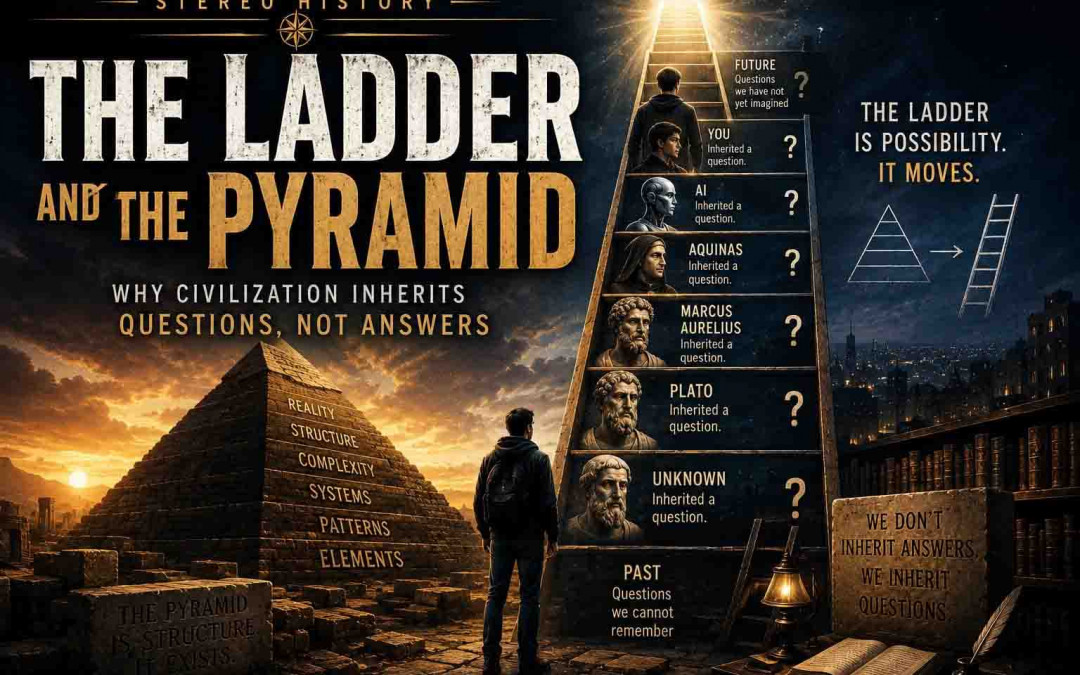
The Ladder and the Pyramid
A pyramid is one of the easiest structures in the world to understand.
The base carries what comes above it. Each level depends upon something beneath. From a distance, the geometry appears almost moral: lower and higher, foundation and summit, beginning and culmination. It is therefore unsurprising that human beings have repeatedly borrowed the image for societies, institutions and knowledge itself. Armies have ranks. Corporations have hierarchies. Academic disciplines have prerequisites. Civilization is often drawn as though history were a staircase leading, conveniently, toward us.
The picture is flattering.
It is also misleading.
We know more than Plato about genetics, electricity, planetary motion and infectious disease. That does not make a modern undergraduate simply “higher” than Plato in every meaningful sense. Marcus Aurelius did not improve Plato in the way one software update improves an earlier version. Thomas Aquinas did not merely add another floor. Einstein did not arrive at the summit of a building constructed neatly by everyone before him.
They inhabited different intellectual landscapes.
They inherited different problems.
Some questions became easier.
Others became stranger.
Some disappeared entirely.
And a small number proved capable of crossing so many civilizations that they began to look less like possessions of one age than permanent invitations issued to every age that followed.
Civilization may therefore need two images.
The pyramid explains why accumulated structure matters.
The ladder explains why another mind can begin somewhere other than the ground.
Are Modern Thinkers Smarter Than Plato?
Chronology creates a powerful illusion of superiority.
We stand later, so we imagine ourselves standing above.
In certain domains, that intuition is justified. A contemporary physician has access to knowledge unavailable to the most brilliant doctor in antiquity. A modern astronomer possesses instruments and mathematical models that would have been inconceivable to ancient observers. Scientific knowledge can genuinely accumulate, and some earlier explanations are not merely different but wrong.
Yet intellectual history cannot be reduced to one scoreboard.
Plato worked without modern neuroscience, but questions concerning knowledge, appearance, justice and the relation between individual and political order remain recognizable. Ancient thinkers did not possess our concepts, and we should not pretend they secretly anticipated contemporary theories. What persists is not identical vocabulary but recurring structural pressure.
How can we distinguish conviction from knowledge?
What gives political power legitimacy?
What makes an individual remain the same while changing?
Can a good society be built without first deciding what a good human life is?
Those problems can return even after the surrounding cosmology changes completely.
This is why “progress” becomes a dangerous word when used carelessly. We may possess better answers to certain questions while still participating in problems older than the institutions through which we ask them.
We stand after Plato.
That does not always mean we stand above him.
What Is the Ladder of Questions?
The ladder becomes useful if we remove the idea of superiority from it.
A rung is not morally better than the rung below. Its value is positional. It allows the climber to begin from a height created by something already there.
Civilization works similarly.
No physicist needs to personally rediscover algebra before beginning modern research. No philosopher must reinvent written argument. No constitutional lawyer has to reconstruct every historical dispute about sovereignty before speaking about contemporary government. Libraries, schools, archives and institutions preserve enough previous work that an individual life can begin intellectually in the middle of a much longer conversation.
This is one of civilization’s greatest technologies.
A human brain lives for decades.
A question can remain active for millennia.
The ladder bridges that mismatch.
Yet its rungs are not made only from answers. They are also made from failed arguments, conceptual distinctions, discarded models, unresolved contradictions and questions precise enough that later generations do not have to repeat the original confusion.
A good predecessor does more than tell us something.
Sometimes they show us exactly where certainty stops.

Why Ancient Questions Still Matter
The phrase eternal question sounds grander than the evidence allows.
Questions change in translation. Concepts mutate. Political institutions transform. Words such as self, soul, justice, nature or consciousness do not carry identical meanings through every century. When we say that Plato and a contemporary philosopher are discussing “the same question,” we often mean that a recognizable structural relationship survives beneath substantial differences.
That qualification matters.
The question “What is justice?” survives partly because societies repeatedly distribute power, punishment, rights, obligations and resources. The institutional forms change; the underlying coordination problem returns.
The question of identity survives because organisms and persons change while law, memory and social relations require decisions about continuity.
The question of death survives because human beings remain finite and capable of knowing it.
The question of knowledge survives because every intelligent agent acts through representations of a world it cannot apprehend completely.
These questions endure not because they arrived from somewhere outside history, but because the structures producing them keep returning inside history.
That makes them durable without requiring them to be metaphysically eternal.
The Pyramid Still Matters
The temptation now would be to destroy the pyramid and celebrate the ladder.
That would merely replace one simplification with another.
Civilization genuinely contains hierarchy and dependence. A child learning calculus must acquire prior mathematical structures. A modern computer depends on layers of engineering, manufacturing and formal knowledge. A medical system rests on laboratories, institutions, records and accumulated evidence. Complex systems often require simpler components to function.
But reality does not form one clean pyramid.
Molecules do not exist because they are “higher” than atoms in a moral hierarchy. Societies are not simply organisms stacked above cells. Emergence, dependency and scale are more complicated than a diagram of widening blocks can show.
The pyramid is therefore useful as an image of stored structure.
Civilization holds enormous amounts of work beneath every apparently simple action.
A passenger enters an aircraft without personally understanding aerodynamics, metallurgy, navigation, turbine engineering or air-traffic control. The capability is inherited institutionally.
The ladder represents something different.
It represents entry into that inheritance.
The pyramid stores what civilization has built.
The ladder allows another mind to move through it.
Do Civilizations Inherit Questions or Answers?
They inherit both.
The interesting difference lies in how each travels.
A successful answer can become infrastructure. People no longer ask why a bridge should use a certain engineering principle every time another bridge is built. The solution becomes embedded in standards, equations, machines or practice.
Questions travel differently.
They remain active precisely because the accepted solution does not close the field permanently.
Consider consciousness.
Ancient discussions of soul cannot simply be translated into modern neuroscience. The categories differ too greatly. Yet neuroscience itself has not eliminated the philosophical problem of subjective experience. New knowledge has constrained the available answers without exhausting the question.
This is what a durable question does unusually well.
It survives improvement.
Each answer changes the landscape, sometimes radically, but another boundary becomes visible beyond it.
A primitive question can disappear when knowledge improves.
A powerful question becomes more precise.
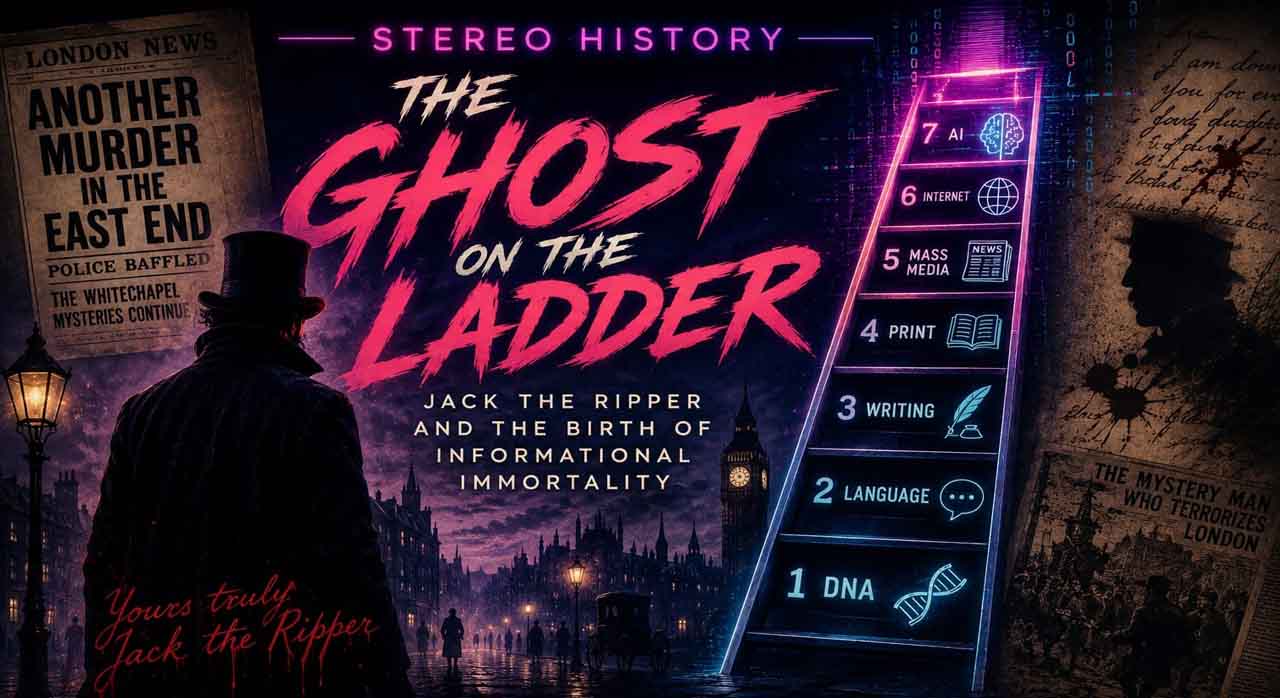
The Forgotten Inheritance
We usually imagine inheritance as something tangible.
Property passes from parent to child. Money moves through a will. A crown passes to another head. A library changes owner.
Intellectual inheritance is stranger because receiving it does not deprive the previous holder.
A theorem can be taught without being lost.
A question can be inherited by millions simultaneously.
A book can enter another mind while remaining on the shelf.
This gives civilization a form of accumulation unlike ordinary material wealth.
Yet ideas do not survive automatically.
Plato needed copyists.
Ancient texts needed libraries.
Greek philosophy crossed into other languages through complicated traditions of preservation, commentary and translation. Aquinas depended upon intellectual worlds larger than medieval Latin Christianity alone. Countless works disappeared because their carriers failed.
This is the uncomfortable truth behind the romantic idea that great questions are immortal.
They are not.
They require infrastructure.
A question without a surviving carrier can die completely.
Civilization’s inheritance therefore depends upon librarians as much as geniuses.
Why Great Thinkers Stay in the Conversation
There is an understandable habit of approaching historical thinkers as contestants.
Was Plato right?
Was Aquinas wrong?
Did Nietzsche understand modern psychology?
Did Marcus Aurelius solve the problem of happiness?
These questions can be useful, but they can also shrink the thinker to a collection of propositions waiting for modern grading.
A more revealing approach asks what conceptual difficulty the thinker managed to make visible.
Sometimes the achievement was an answer.
Sometimes it was a distinction.
Sometimes it was a form of argument.
Sometimes it was a question sufficiently well framed that centuries later people could attack it without having to reinvent it.
This is why the great thinker does not need to be correct about everything to remain useful.
Newton’s physics does not vanish because relativity changes its domain of validity.
Ancient philosophy does not become worthless because its natural science is obsolete.
A structure can remain useful after part of the worldview containing it collapses.
This is intellectual carrier independence in one of its oldest forms.
The Ladder Has Missing Rungs
The image still needs one final correction.
Civilization’s ladder is damaged.
Some rungs were burned.
Some were never translated.
Some survive only through hostile summaries written by opponents.
Some intellectual traditions disappeared because the civilizations carrying them collapsed.
Others were deliberately excluded from institutions deciding what counted as knowledge.
The canon is therefore not simply the list of humanity’s best ideas after a fair competition.
It is also a record of survival.
This introduces survivor bias into the history of thought.
We know the questions that successfully reached us.
We know much less about those that disappeared.
That should make any claim about the “greatest questions in human history” more modest.
The ladder we see is not the entire ladder.
It is the surviving section.
AI and the Next Rung
Artificial intelligence introduces a new possibility because for the first time an individual reader may be able to navigate parts of civilization’s intellectual inheritance conversationally.
The important word is navigate.
An AI system does not become Plato because it can summarize Plato. It does not resurrect Aquinas because it can imitate scholastic argument. Its most valuable role may be less theatrical: locating connections, translating terminology, exposing disagreement, moving between scales and showing how a question changed as it passed through different historical contexts.
That could make the ladder easier to climb.
It could also make it dangerously smooth.
If every dispute becomes a clean summary and every difficult question receives an immediate confident answer, intellectual inheritance may lose the very friction that preserved its depth.
A compressed answer can hide the history of disagreement.
A synthesized consensus can obscure the path by which the consensus emerged.
A fluent interface can make an unresolved problem feel resolved.
The future librarian therefore has a responsibility not only to deliver information but to preserve the places where information stops being sufficient.
Sometimes the next rung is an answer.
Sometimes it is the realization that the ladder has reached a gap.
Watch The Video
How to Read the World
Current Knowledge
Human knowledge is genuinely cumulative in many domains. Mathematics, engineering, medicine and the natural sciences preserve theories, methods, data and techniques that allow later practitioners to begin beyond the starting point available to earlier generations. This does not imply that every later thinker is intellectually superior to every earlier thinker; it means that individuals can inherit collective structures they did not personally create.
Philosophical questions can remain recognizable across long historical periods, but their meanings frequently change. Terms such as justice, personhood, soul, knowledge and consciousness acquire different assumptions in different languages, institutions and intellectual traditions. Continuity therefore needs to be demonstrated rather than assumed merely because modern translations use similar words.
Intellectual transmission depends heavily on material and institutional carriers. Manuscripts, libraries, schools, religious institutions, universities, translators, printers and digital archives all influence which ideas remain available. Canon formation reflects historical survival and selection as well as intellectual quality.
Answers can also survive for very long periods. Mathematical results, technical procedures and empirically reliable models may remain useful across generations. The useful distinction is therefore not that questions survive while answers die, but that some questions remain productive after successive answers change.
Modern AI systems can greatly reduce the friction involved in searching, summarizing and comparing large bodies of knowledge. They can assist intellectual inheritance, but they can also produce inaccurate synthesis or obscure uncertainty when source provenance is weak.
Open Questions
One difficult question is whether some philosophical problems remain alive because they concern genuinely recurring structures or because institutions continue teaching later generations to frame the world through inherited categories. Both forces probably operate together, and separating cultural inheritance from universal necessity may be impossible in many cases.
Another concerns lost knowledge. If an intellectual tradition disappeared before reaching us, we cannot easily know whether it contained questions as powerful as those preserved in canonical traditions. Any account of civilization’s greatest ideas therefore has to acknowledge the archive’s selection effects.
There is also a question about progress. Can a question itself become obsolete because a later conceptual framework reveals that it was badly formed? Science offers many cases in which progress consisted not in providing a better answer to an old question but in abandoning the assumptions that made the question appear necessary.
Artificial intelligence raises a further uncertainty. If inherited knowledge becomes dramatically easier to access, will that enable more people to enter difficult conversations, or will the convenience of immediate synthesis encourage people to inherit conclusions without inheriting the reasoning that produced them?
Transhumation Interpretation
The Ladder and the Pyramid belongs to Transhumation because it provides two models of continuity that should never be confused.
The pyramid represents accumulated structure. It is everything a civilization has managed to stabilize sufficiently that another person does not need to rebuild it from nothing. Language, mathematics, institutions, scientific methods, archives and technologies all contain work performed by people who are no longer present.
The ladder represents access to that structure across time.
A single biological mind cannot reconstruct civilization.
It does not have enough years.
Instead, human beings externalize memory into carriers and create interfaces through which another generation can resume the work.
That is one of the oldest forms of Transhumation.
Not escaping biology.
Extending what a biological life can participate in.
A reader can enter a conversation started before their birth because the question survived another carrier.
This is why the statement that civilization inherits questions rather than answers needs one final adjustment.
Civilization inherits structures of thought.
Some arrive as answers.
Some as methods.
Some as contradictions.
Some as questions.
A theorem can survive because its formal relation remains valid when rewritten in another notation.
A philosophical problem can survive because another generation encounters the same structural difficulty under new conditions.
A literary work can survive because its architecture continues generating recognition while resisting reduction to one interpretation.
The carrier changes.
Enough of the relation remains.
But this is exactly where Transhumation must apply its boundary test.
Structural resemblance does not prove continuity.
If we connect two questions separated by centuries, we should return to the details and ask whether the relationship still holds. If the pattern disappears once historical context returns, we have created the continuity ourselves.
The ladder should therefore contain checkpoints.
Not every rung belongs to the same ladder merely because we want an elegant picture.
This has direct consequences for artificial intelligence.
AI may become the most powerful interface civilization has built for moving horizontally and vertically through accumulated knowledge. A reader could move from Plato to contemporary political theory, then sideways into neuroscience, mythology or information science within minutes.
The danger is that navigation becomes mistaken for understanding.
A lift can take you to the top floor without teaching you how the building stands.
An intelligent librarian can show you the relevant shelf without transferring the years of thought that produced the books.
This does not make the interface fraudulent.
It makes the distinction between access and mastery increasingly important.
The Library of Mirrors should therefore preserve not only conclusions but routes.
Which source came first?
Where did the concept change?
Which argument failed?
Which translation introduced a different assumption?
What evidence would make the current interpretation collapse?
A civilization that preserves only polished answers eventually loses the architecture of its own intelligence.
There is something else the ladder shows.
The aim may not be to reach a final rung.
Some questions probably do have final or sufficiently final answers. Others may disappear because they were badly posed. But certain problems may continue generating new forms precisely because every expansion of capability exposes another boundary.
Personal identity is one example.
A person changes biologically and remains socially recognized.
Brain injury tests the relation between memory and self.
Digital copying introduces branching.
AI models introduce recognizable style without demonstrated personal continuity.
The ancient question does not remain untouched.
It acquires new experimental conditions.
That is how civilization can move forward without simply leaving the past behind.
We do not ask the old question again because nothing was learned.
We ask it differently because something was.
Perhaps that is the cleanest way to join the pyramid and the ladder.
The pyramid preserves what became stable enough to build upon.
The ladder carries another mind to the edge of what remains unstable.
Civilization needs both.
Without the pyramid, every generation begins again.
Without the ladder, accumulated knowledge becomes a monument nobody can enter.
And perhaps that is the real inheritance.
Not a pile of answers delivered intact from the dead.
A starting position.
Someone before us climbed far enough to see another problem.
They marked the place.
They left a rung.
We arrive later, place a foot upon it and discover that the next part has not been built.
That is where our generation begins.
FAQ
What does The Ladder and the Pyramid mean?
The pyramid represents accumulated structures of knowledge and civilization. The ladder represents the ability of later generations to enter that accumulated structure without beginning from zero.
Does civilization really inherit questions rather than answers?
It inherits both. Some answers become reliable knowledge or infrastructure, while some questions remain productive because new answers continue revealing deeper aspects of the problem.
Are modern thinkers intellectually superior to ancient philosophers?
Not in any simple sense. Modern people possess knowledge unavailable to ancient thinkers, but historical thinkers may still frame problems that remain intellectually useful under very different conditions.
Why do ancient questions survive?
Some concern recurring structures of human existence, such as power, identity, knowledge, mortality and social coordination. Their wording and assumptions change, but enough of the underlying problem may remain recognizable.
How can AI change the Ladder of Questions?
AI could make intellectual inheritance easier to navigate by connecting sources, translations and debates across huge archives. Its danger is making unresolved or historically complicated questions appear smoother and more settled than the evidence permits.
What is the deeper Transhumation question?
The deepest issue is not whether humanity can preserve all its answers.
It is whether civilization can preserve enough of the structure of inquiry that another mind can discover exactly where certainty ended, climb to that point, and know which question is genuinely theirs to continue.
Continue the Transhumation Series
- Forgotten Religion | Ancient Gods, Symbols and the Hidden Structures of Human Civilization
- The Last Religion | Death, Immortality and the Future of Humanity
- The New Theurgy | AI, Information and the Future of Human Civilization
- End of Branding: You Were Never Meant to Become a Product
- Baal vs Ishtar: Why Ancient Gods Never Disappeared