
„It`s All About Me”
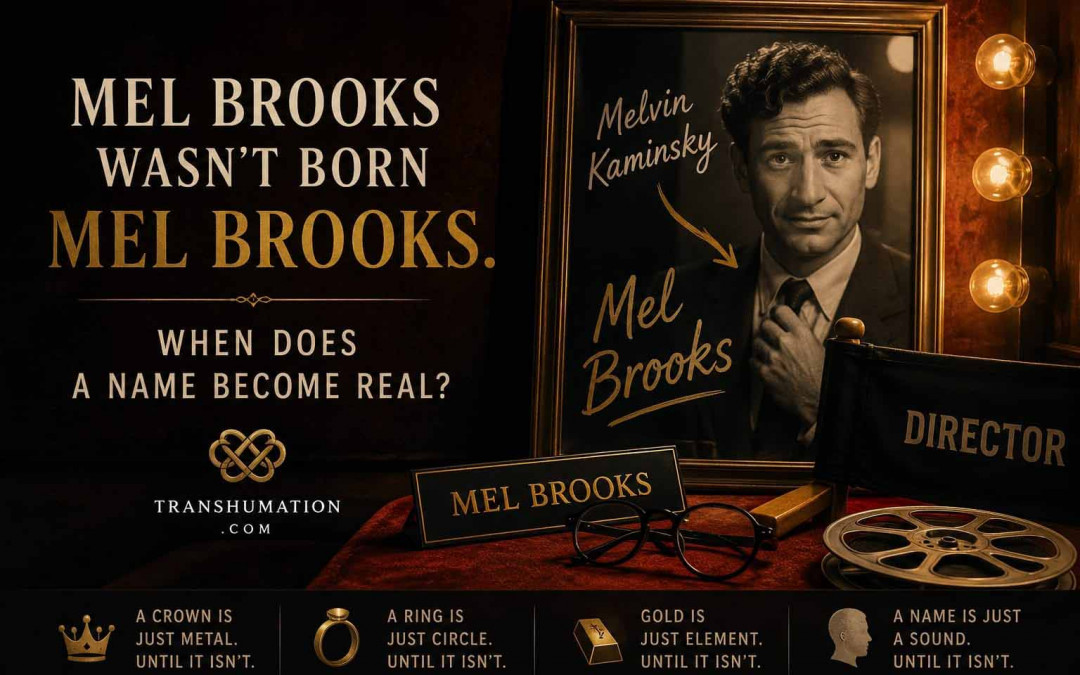
When Mel Brooks turned one hundred in June 2026, the name on the tributes required no explanation.
It belonged to a century of American comedy almost as securely as a title belongs to a book. Young Frankenstein. Blazing Saddles. The Producers. Spaceballs. The name Mel Brooks had become so completely attached to the work, the face, the voice and the comic temperament that imagining another name in its place felt strangely artificial.
Yet he was born Melvin Kaminsky.
Nothing biologically decisive happened when one name gave way professionally to another. His intelligence did not increase. His sense of timing was not hidden somewhere inside the letters B-R-O-O-K-S. The stage name did not manufacture talent.
And still, something real happened.
A new name began accumulating relationships.
Credits appeared beneath it. Audiences recognized it. Colleagues used it. Journalists repeated it. Awards attached themselves to it. Eventually the name became one of the handles through which culture retrieved the person.
This is the strange thing about names.
They begin as sounds.
Then civilization builds structures around them.
When Does a Name Become Real?
Suppose tomorrow morning you decide that your name is Alexander.
You write it on a piece of paper.
You say it aloud.
You think of yourself by it.
Has anything changed?
Yes, privately.
But only part of the system has changed.
Now imagine that your friends begin using Alexander. Your employer changes your account. Your bank recognizes it. Government records are updated. Your children introduce you by that name. People who have never met you begin encountering your work under it.
At some point, the new name no longer exists only inside your intention.
It has entered a network.
This does not mean an individual has no authority over their own identity until other people grant permission. It means something more specific: a public name performs a social function only when other parts of society can use it to find the same person.
A name is therefore neither purely private nor purely external.
It sits at the border.
You can choose one.
Others can recognize it.
Institutions can record it.
History can preserve it.
The resulting identity is produced by the interaction among these layers rather than by any single one of them.
Mel Brooks is useful precisely because the case feels so ordinary.
Nothing supernatural happened.
Yet the informational architecture around one human being changed.
Can Changing Your Name Change Your Identity?
It can change aspects of identity without changing the entire person.
This distinction matters.
A person does not become psychologically new because a passport changes. Memories remain. Biological continuity remains. Relationships formed under the earlier name do not vanish.
But names shape access.
They influence how a person is introduced, remembered, searched for, credited and placed inside institutions. A stage name can separate a public persona from private history. A married surname can mark affiliation. A religious name can mark a chosen transformation. A royal name can connect an officeholder to institutional continuity. An online username can produce a reputation among people who know nothing else about the person behind it.
The name does not contain the identity.
It organizes access to it.
That makes a name less like a description and more like an interface.
You can know someone named Rose without believing she resembles a flower. The semantic meaning of the word becomes secondary. What matters is that the word reliably points toward one person inside a community.
This is one of civilization’s simplest compression systems.
A lifetime becomes callable through a few syllables.
A Name Is an Address
This may be the cleaner metaphor.
A name is an address inside social memory.
It does not contain the house.
It tells others where to look.
Say Shakespeare and an enormous cultural archive becomes reachable through one word. Say Caesar and the problem becomes even stranger, because a personal name eventually became a title and then survived in forms such as Kaiser and Tsar. The sign traveled beyond the individual who once carried it.
Names therefore reveal something fundamental about information.
A small symbol can acquire access to a structure vastly larger than itself.
The letters M-E-L B-R-O-O-K-S do not contain a filmography.
But they can retrieve one.
That is why reputation matters.
Every interview, film, review, memory and joke added another relation to the same symbolic address.
Eventually the name became denser than the circumstances of its creation.
This is how civilization works constantly.
It compresses without eliminating.
Are Names Social Constructs?
Yes, but that phrase is often misunderstood.
Calling something socially constructed does not mean it is imaginary.
A border may be socially constructed and still determine whether someone can legally enter a country. A corporation is socially constructed and can own buildings. A university degree exists through institutional conventions and can alter someone’s career. Money depends heavily upon shared systems of recognition and still pays the electricity bill.
Social reality can have real consequences.
The useful distinction is between brute physical facts and institutional facts.
Gold has atomic properties whether anybody values it or not.
A gold medal means first place only inside a system capable of assigning that status.
Paper exists physically.
A valid banknote requires an institutional context.
A human body exists.
Whether that person is legally a judge, citizen, spouse or company director depends on additional social structures.
Names participate in both levels.
The sound is physical.
The status is relational.
The mistake is to think that because the second depends upon agreement, it is somehow less real.
Civilization is built largely from agreements capable of producing consequences.
The Crown Without a Kingdom
Place a crown beneath museum glass and nothing politically dramatic happens.
Put it on an actor and no monarchy appears.
Place it on the head of an accepted monarch during a recognized ceremony and the object can participate in an event of enormous institutional significance.
The metal did not change.
The network did.
There must be rules.
History.
Authority.
Recognition.
Witnesses.
Institutions capable of treating the act as consequential.
This is why symbols should never be mistaken for magic objects.
The crown does not contain sovereignty.
It interfaces with a system that knows what a crown can mean.
The same is true of a wedding ring.
The ring does not manufacture marriage.
A diploma does not create knowledge merely by existing.
A judge’s robe cannot independently produce legal authority.
Their force emerges because material objects can be embedded inside systems of recognized relationships.
The symbol compresses the system into something visible.
That is why symbols can feel powerful while remaining completely inert outside their context.
Why Do Rituals Need Witnesses?
Not every meaningful transformation requires witnesses.
A person can privately decide to forgive someone. A conviction can change in solitude. Grief does not need certification.
But institutions often do need witnesses because institutional change must become publicly legible.
A marriage affects more than emotion.
A graduation affects status.
A coronation affects succession.
A contract affects obligations.
A funeral publicly reorganizes the social world around an absence.
Ritual is one of civilization’s ways of preventing ambiguity around transitions.
Before the ceremony, one status.
Afterward, another.
The ceremony makes the boundary visible.
This does not mean the ritual magically causes every aspect of the change. A wedding cannot guarantee love. A graduation cannot guarantee wisdom. A funeral cannot explain death.
But ritual coordinates recognition.
Everyone knows that something is now meant to be treated differently.
The witness matters because society needs memory outside the individual.
The Gold Problem
Gold makes the argument more difficult, which is exactly why it is useful.
Gold has unusual material properties. It is scarce relative to many common materials, workable, visually distinctive, resistant to corrosion and historically suitable for durable ornament and monetary use.
Those properties are not social inventions.
But chemistry does not assign a market price.
Nature does not announce that a given quantity of gold should equal a house, a year’s salary or nothing at all.
Human institutions do that.
Value emerges through the interaction of material property, scarcity, culture, history, demand and shared expectation.
Gold therefore sits beautifully between physical and social reality.
It would still possess its atomic number without humanity.
It would not possess the same status.
This protects us from two opposite mistakes.
Not everything is invented by society.
Not everything that matters socially is contained in matter.
Reality supplies constraints.
Civilization supplies interpretation.
Much of human life happens where they meet.
Is Money Real Because We Believe in It?
“Because we believe in it” is too weak.
You can stop believing in your mortgage and discover that the bank remains surprisingly committed to the arrangement.
Money functions because belief is embedded in larger systems: states, banks, contracts, accounting practices, legal enforcement, taxation, markets and expectations about future exchange.
Shared recognition matters.
But institutions stabilize recognition beyond individual mood.
The same principle applies to names.
A famous name is not real merely because millions of people privately feel that it is.
It is reinforced by records, contracts, credits, archives and repeated public use.
Civilization takes fragile acts of recognition and gives them carriers.
Ink.
Databases.
Certificates.
Archives.
Registers.
Film credits.
Search indexes.
This is how social facts become durable enough to survive the people who first agreed upon them.
Meaning acquires infrastructure.
The Strange Life of a Public Name
A stage name also reveals that identity can branch.
Melvin Kaminsky and Mel Brooks are not two unrelated biological persons.
Neither are they perfectly interchangeable descriptions.
One belongs more strongly to origin and private biography; the other became the dominant public interface through which an enormous audience encountered the same continuing human life.
This is important for the information age.
We already live through multiple naming systems.
Legal name.
Professional identity.
Username.
Email address.
Handle.
Avatar.
Account ID.
Sometimes the digital name becomes better known than the civil one.
A creator may have millions of followers who have never encountered the name printed on their passport.
This does not prove that identity has become disembodied.
It shows that recognition can attach to different interfaces around the same person.
The future will make this harder.
AI-generated voices, persistent avatars and digital agents may eventually continue operating under someone’s name after the biological person is no longer present.
At that point the old problem becomes urgent.
Does the survival of the name mean the survival of the person?
Obviously not.
But culturally, the difference may become surprisingly difficult to feel.
The Name That Outlives the Body
Human beings discovered informational survival long before computers.
Names were among its earliest carriers.
A gravestone preserves one.
A genealogy transmits one.
A signature authenticates one.
A book carries one beyond the author’s death.
This is not immortality in the first-person sense.
The dead author does not experience the reader opening the book.
But the name can continue gathering relationships after the person is gone.
Shakespeare’s name today connects to editions, theatres, schools, arguments, adaptations and cultural associations that Shakespeare himself could never have known.
This produces a strange asymmetry.
The person stops acting.
The name continues having things done to it.
It can be celebrated.
Attacked.
Reinterpreted.
Commercialized.
Forgotten and rediscovered.
The symbolic identity keeps moving through civilization while the conscious individual does not.
A name is therefore one of the clearest examples of the difference between informational continuity and personal continuity.
The distinction will matter increasingly as technology learns to make representations responsive.
The Simplest Kind of Magic
There is still something almost magical in all this, provided we understand what kind of magic we mean.
A few sounds can summon a reputation.
A piece of paper can alter legal ownership.
A sentence spoken by the right person in the right setting can change marital status.
A signature can release millions of dollars.
A crown can participate in transferring authority.
Nothing supernatural occurs.
The extraordinary mechanism is collective symbolic competence.
Human beings can attach consequences to representations and then coordinate behavior around them.
This is one of civilization’s deepest technologies.
Language does not merely describe every part of the social world.
Sometimes, under the right conditions, language helps constitute it.
“I promise.”
“I resign.”
“I accept.”
“Guilty.”
“I do.”
The words work only because a system recognizes who is speaking, under what rules, and what follows.
The right words open the right doors because some doors are made of meaning.
Watch The Video
How to Read the World
Current Knowledge
Names function as identifiers within social and institutional systems, allowing people to coordinate reference, legal status, reputation and memory. A change of name does not create a biologically new person, but it can alter how that continuing person is represented and accessed socially.
Mel Brooks was born Melvin Kaminsky in 1926 and built his public career under the professional name Mel Brooks. By the time he reached his centenary in 2026, that name had accumulated decades of cultural associations independent of the circumstances in which it was originally adopted.
Social institutions routinely create statuses that cannot be understood from physical properties alone. Money, offices, contracts, citizenship and academic credentials depend upon collectively maintained rules, records and practices, although they produce concrete real-world consequences.
Material properties and social interpretation frequently interact. Gold’s physical characteristics contributed to its historical uses, but its cultural prestige and monetary valuation cannot be derived from chemistry alone.
Public rituals often help societies mark changes in recognized status, but meaningful personal transformation does not universally require witnesses. The importance of recognition depends upon what type of reality is changing.
Open Questions
One unresolved question concerns the boundary between self-definition and external recognition. A person may possess strong authority over how they understand themselves while still depending on other people and institutions for certain public identities to function socially. Those two dimensions can conflict.
Digital identity introduces another problem. If a username, avatar or professional persona becomes culturally more recognizable than a legal name, which identity should institutions treat as primary, and under what circumstances? The distinction between person and interface is becoming increasingly complicated.
AI makes the question sharper still. A future system might continue using a person’s name, face, voice and biographical memory after their death. Society will need ways to distinguish archival continuity, authorized representation and actual personal presence.
The deepest question is whether identity is something contained within the individual or something distributed across body, memory, relationships and recognition. The evidence suggests that different senses of identity may have different answers.
Transhumation Interpretation
For Transhumation, a name is a remarkably simple example of a symbol becoming an interface.
The word does not contain the person. It gives other minds and institutions a route toward the person.
That distinction must remain intact.
Recognition can preserve reputation, memory and social identity long after the carrier changes, but preservation of the name is not preservation of the conscious subject.
A civilization increasingly filled with digital representations will need to remember that an interface can become astonishingly convincing without becoming the thing it represents.
FAQ
Was Mel Brooks born with that name?
No. He was born Melvin Kaminsky in 1926 and later built his professional identity under the name Mel Brooks.
Does changing your name change who you are?
Not automatically. Biological and biographical continuity remain, but a new name can change how a person is recognized, recorded and encountered socially.
When does a name become socially real?
When it begins functioning reliably inside a network of recognition: other people use it, institutions record it, and social memory connects it to the same person over time.
Are names just social constructs?
Names are socially created identifiers, but that does not make them unreal. Social structures can produce legal, economic and cultural consequences.
What do names have in common with crowns, money and diplomas?
All involve physical or symbolic carriers whose wider significance depends upon rules and systems of recognition. The material object alone does not contain the entire social function.
What is the deeper Transhumation question?
The deeper question is not whether Melvin Kaminsky truly became Mel Brooks.
He obviously remained one continuous human life.
The interesting question is what exactly crossed when one name became more real to civilization than the other.
Not his body.
Not his childhood.
Not consciousness itself.
What crossed was the route by which millions of strangers could find him.
The new name accumulated films, jokes, interviews, memories, legal records and reputation until it became a stable address inside cultural memory. Eventually a person could say Mel Brooks and summon an informational structure vastly larger than eleven letters.
That is what symbols can do.
They do not replace reality.
They make relationships to reality portable.
And perhaps that is the oldest trick civilization ever learned: to take something too large to carry — a person, a country, an office, a promise, a lifetime — and give it a sign small enough to pass from one mind to another.
Continue the Transhumation Series
- Forgotten Religion | Ancient Gods, Symbols and the Hidden Structures of Human Civilization
- The Last Religion | Death, Immortality and the Future of Humanity
- The New Theurgy | AI, Information and the Future of Human Civilization
- End of Branding: You Were Never Meant to Become a Product
- Baal vs Ishtar: Why Ancient Gods Never Disappeared