
The Right Word Opens Every Door
A password does not create understanding. It only tells a system to let you pass.
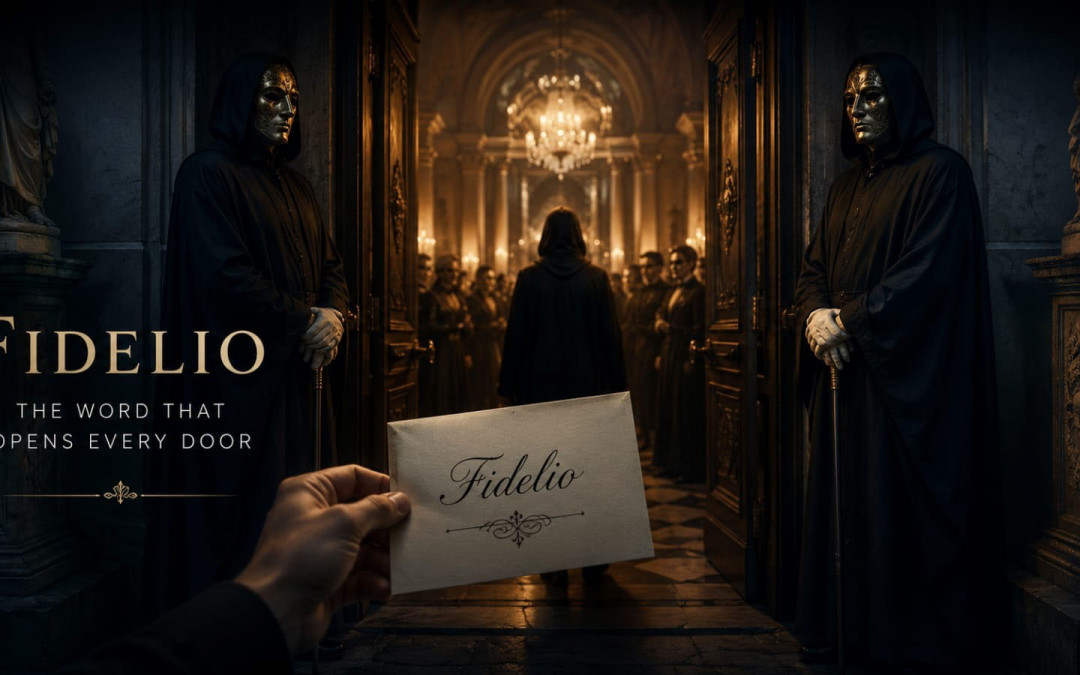
Late at night, in an unfamiliar part of the city, Bill Harford arrives at a mansion whose entrance is guarded by men in masks. They do not ask who he is. They do not ask whether he understands the ritual taking place inside. They ask for a word.
“Fidelio.”
The door opens.
It is one of the simplest moments in Eyes Wide Shut, and one of the most revealing. Bill has not changed. The guards have not changed. The building has not changed. Yet a single word temporarily transforms him from outsider into participant.
The obvious explanation is that Fidelio is a password. But that only describes the mechanism. The more interesting question is why a word can perform such a powerful transformation at all.
A Word as an Interface
“Fidelio” is the title of Beethoven’s only opera. In Kubrick’s film, however, its musical and historical meaning is secondary to its function. The guards do not ask Bill to interpret Beethoven. They do not test whether he understands the opera’s themes of imprisonment, loyalty and liberation. They only need the correct signal.
At that moment, language stops behaving like ordinary language. Fidelio becomes an interface.
A password is a compressed instruction. It does not explain the system behind the door. It simply tells the system how to classify the person standing before it. Accepted. Rejected. Inside. Outside.
Modern life is filled with these transformations. A PIN changes a locked account into an accessible one. A passport changes a traveller into an authorized border crosser. A signature turns a draft into an agreement. A certificate turns private knowledge into publicly recognized qualification.
None of these objects contains power by itself. Their force comes from the structures that recognize them.
Civilization Runs on Invisible Agreements
Money is paper, metal or a number in a database until institutions and populations agree to treat it as value. A university degree is ink and typography until employers, governments and professions accept what it represents. A judge’s signature matters because an entire legal system stands behind it.
Civilization depends on these invisible agreements because most systems are too large to be renegotiated every time a person uses them. We do not need to reconstruct the meaning of currency during every purchase or explain the legitimacy of a passport at every border. The symbol carries a pre-existing structure with it.
This makes symbols efficient. It also makes them dangerous.
A person may possess the accepted sign without understanding the world it grants access to. Bill knows the password, but he does not understand the gathering. He has the credential without the knowledge, the interface without the structure.
That distinction is the real tension of the scene.
Access Is Not Understanding
Modern culture often treats information as though possession were equivalent to comprehension. Learn the formula. Memorize the definition. Obtain the password. Download the file.
But information can provide access without producing understanding.
A person can repeat a philosophical quotation without grasping the argument behind it. A programmer can reuse code without understanding how it works. A user can operate an AI system without knowing anything about training data, probability or model architecture. Civilization makes this possible because abstraction is one of its greatest achievements.
We could not function otherwise. No one can fully understand every system they depend on. A driver does not need to design an engine. A patient does not need to understand biochemistry. A bank customer does not need to reconstruct global finance.
Yet abstraction comes with a cost. The more advanced civilization becomes, the more often people operate structures they cannot see and would struggle to explain.
Fidelio is a miniature model of that relationship.
The Interface Before the Computer
We usually associate interfaces with screens, icons and buttons, but human beings were building interfaces long before computers existed.
A royal seal could authorize commands across an empire. A ritual phrase could identify a participant in a religious community. A uniform could communicate rank before a word was spoken. A sacred object could connect an ordinary action with an invisible cosmology.
These were not software interfaces in a literal sense. Their histories, mechanisms and beliefs were different. But functionally they often solved a similar problem: how can a human being interact with a system too large or abstract to hold completely in mind?
Ritual compressed theology into action. Law compressed institutional authority into documents and formulas. Money compressed trust into exchangeable signs.
Complex systems require usable surfaces.
When Technology Begins to Resemble Ritual
The paradox of advanced technology is that the machinery becomes more complicated while the interface often becomes simpler.
Early computers demanded specialized knowledge. Later systems introduced icons, menus and touchscreens. Artificial intelligence now allows a person to interact with enormous computational structures through ordinary language.
A blinking cursor waits.
You ask a question.
The system responds.
Thousands of years of technological development have returned us to one of humanity’s oldest interfaces: the spoken or written word.
This does not make AI magical. It makes the surface of technology increasingly natural. The user no longer needs to speak the language of the machine. The machine is designed to meet the user inside human language.
That may be one reason modern technology sometimes feels mythic. A phrase produces an image. A question produces an answer. A command changes a distant system we cannot see.
The ritual has not returned because technology failed.
It returns because the interface has become powerful enough to disappear.
The Door Behind the Door
Bill’s problem is not that Fidelio stops working. His problem is that the word never gave him what he thought it gave him.
It opened the first door.
It did not make him belong.
This is the deeper structure of initiation. An outsider may learn the visible sign without acquiring the experience, trust or transformation that the sign is supposed to represent. A password can imitate membership for a moment, but it cannot manufacture understanding.
That is why the most important doors in civilization are rarely guarded only by information. They are guarded by context, education, history, relationships and participation.
The real password is not always a word.
Sometimes it is becoming the kind of person who understands why the door exists.
Watch the Video
How to Read the World
Current Knowledge
“Fidelio” is the title of Ludwig van Beethoven’s only opera. In Stanley Kubrick’s Eyes Wide Shut, the word is used as a password granting Bill Harford initial access to the masked gathering.
Passwords and credentials are authentication tools. They allow systems to distinguish authorized participants from unauthorized ones without requiring the system to reassess the person’s entire identity each time. Seals, signatures, identity documents and professional qualifications have historically served comparable institutional functions, although their mechanisms and social meanings differ.
Human-computer interfaces similarly reduce complex operations to manageable actions. Users can interact with systems without understanding every process taking place underneath the interface.
Open Questions
How much understanding does meaningful participation in a system actually require?
Modern civilization depends on specialization and abstraction, but it remains unclear where useful simplification becomes dangerous dependence. As systems grow more complex, people may become increasingly capable of operating them while becoming less capable of explaining or challenging them.
Artificial intelligence makes this question more urgent. Natural-language interfaces may democratize access to powerful tools, but they may also conceal the assumptions, limitations and structures behind their responses.
The Transhumation Interpretation
Transhumation asks us to look beyond the changing symbol and examine the recurring function.
The seal, password, ritual phrase, button and conversational prompt are not the same thing. But each can serve as a compressed point of contact between a human being and a larger structure.
Civilization advances partly by creating interfaces that allow us to touch systems we cannot fully contain in consciousness. The machinery becomes more complex. The surface becomes simpler.
Fidelio matters because Kubrick reveals the danger hidden inside that achievement.
A word can open a door.
It cannot tell you what the room means.
And perhaps the future will depend not only on creating more powerful interfaces, but on preserving the difference between access and understanding.
FAQ
What does “Fidelio” mean?
Fidelio is the title of Ludwig van Beethoven’s only opera. In Eyes Wide Shut, it functions as the password used to enter the masked gathering.
Why is Fidelio used as a password in Eyes Wide Shut?
The film does not give a definitive explanation of Kubrick’s intention. Within the scene, the word operates as a credential that temporarily identifies Bill as an accepted participant.
What is the central idea of the article?
The article argues that access and understanding are different. A person may possess the correct password or interface while knowing very little about the system behind it.
Is a password a symbol?
A password can function symbolically because its power comes from the system that recognizes it, not from the word itself. Outside that shared structure, it may have no practical effect.
How does Fidelio connect to artificial intelligence?
AI systems increasingly allow people to use highly complex technology through ordinary language. This makes language itself an interface, much as Fidelio functions as an interface to the hidden world in the film.
Are rituals the same as computer interfaces?
No. Their origins, beliefs and mechanisms are different. The comparison is functional: both can reduce a complex system to a sequence of actions or signs that a participant can perform.
What is the Transhumation interpretation?
Transhumation interprets Fidelio as an example of a recurring civilizational structure. Humans repeatedly create compressed interfaces—words, seals, rituals, buttons and prompts—to interact with systems too complex to understand directly.
Continue the Transhumation Series
- Forgotten Religion | Ancient Gods, Symbols and the Hidden Structures of Human Civilization
- The Last Religion | Death, Immortality and the Future of Humanity
- The New Theurgy | AI, Information and the Future of Human Civilization
- End of Branding: You Were Never Meant to Become a Product
- Baal vs Ishtar: Why Ancient Gods Never Disappeared