
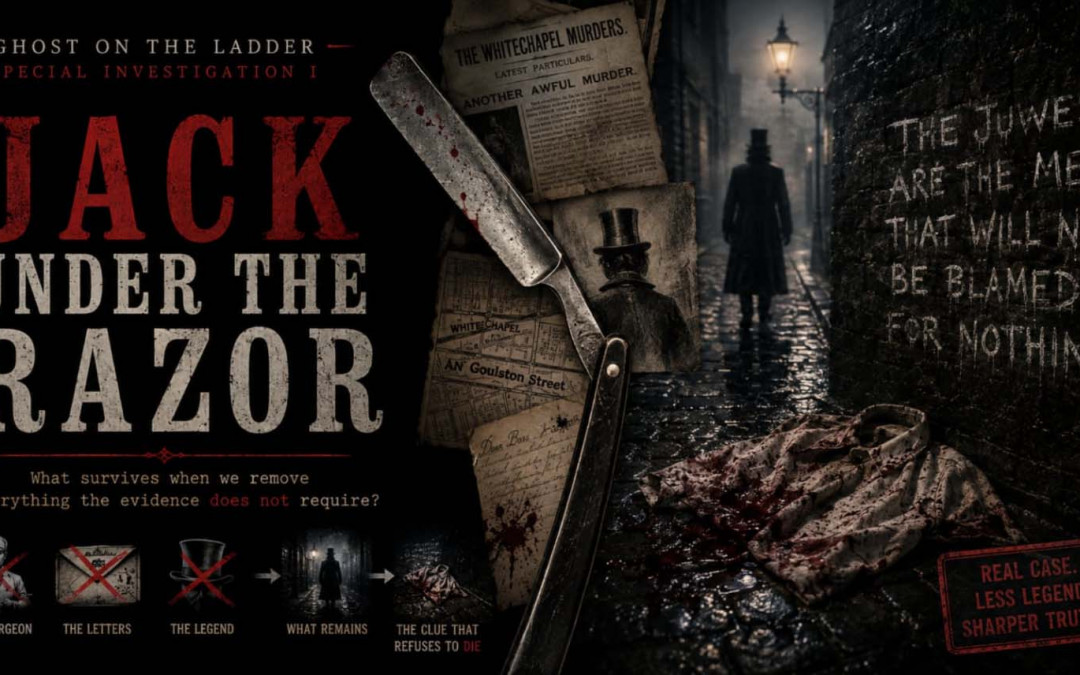
Ghost on the Ladder — Special Investigation Part I
What survives when we remove everything the evidence does not require?
There is a useful cruelty in Occam’s razor. It does not care whether a theory is beautiful, frightening or famous. It asks only how much machinery we have built around the facts, and whether the facts can survive after some of that machinery is removed.
Jack the Ripper has accumulated an extraordinary amount of machinery. He has been a surgeon, butcher, aristocrat, sailor, soldier, madman, sexual psychopath, occultist, journalist and conspirator. He has been assigned letters he may never have written, motives he may never have possessed and a face nobody can authenticate. More than a century of books and films have made the silhouette so familiar that it is easy to forget how little of the man is actually visible.
So imagine putting the whole case on a table and taking a razor to it.
We will not begin by asking who Jack was. We will remove every characteristic the surviving evidence does not force us to keep. No genius unless genius is required. No surgeon unless surgery is required. No elaborate media strategy unless the murders cannot be explained without one. Even the famous correspondence goes into a separate box until it earns its way back.
What remains should be smaller than Jack the Ripper.
The interesting question is whether it is also stranger.
How Much Can We Remove?
The first thing to go is the profession.
After Annie Chapman’s murder, Dr George Bagster Phillips believed the manner in which portions of the body had been removed indicated some anatomical knowledge. Contemporary reports also recorded his view that a long, very sharp knife was involved and that a well-ground slaughterman’s knife could have produced the wounds. The argument about whether the killer was medically trained therefore began almost immediately, and contemporary doctors themselves did not provide the neat occupational answer later mythology would prefer.
Occam does not give us a surgeon from that evidence.
It gives us something much less glamorous: a person who could do certain things with unusual speed and without obvious paralysis in the presence of blood, tissue and extreme violence.
The distinction matters. A job title is expensive information because it carries many assumptions we do not need. A set of transferable abilities is cheaper. Someone may acquire familiarity with knives in a slaughterhouse, anatomical exposure in a hospital, composure around severe injury in military service, or some combination we have not imagined. Earlier experience does not need to resemble murder exactly in order to make parts of the act less novel.
Modern research on motor learning gives a cautious reason to take this seriously. Practice changes later performance, and experience with one motor structure can sometimes transfer to related tasks; previous learning can shape adaptation to a novel task even when the new task is not identical. That does not allow us to infer what Jack had practised, but it warns against equating “first murder” with “first time the hands had performed any of the relevant operations.”
This gives us a cleaner question than Was Jack a doctor?
How much of what happened in Whitechapel would have had to be genuinely new to him?
The Problem of the Perfect First Time
There is no honest percentage we can assign to the probability of “doing murder very well the first time.” The category is too vague, the historical evidence too incomplete, and we do not possess a control group of people committing identical crimes under identical Victorian conditions.
But we can ask something more useful.
Suppose the canonical sequence represented the beginning of the offender’s homicidal career. That does not mean every component of those crimes began at the same moment. A complete novice model would ask us to imagine a man learning, under extreme time pressure, several demanding things at once: approaching a vulnerable stranger without creating sufficient alarm, using a blade decisively, coping with the physical reality of severe wounds, operating in weak light, making rapid decisions when interrupted or exposed, and then moving back through the ordinary city without behaving so conspicuously that he was immediately stopped.
None of those abilities is individually miraculous.
Their conjunction is the interesting part.
This is where Occam can work in the opposite direction from what people expect. The simpler hypothesis is not always “he had never done anything remotely similar before.” Sometimes one prior cause explains several later observations more economically. Some earlier transferable experience may require fewer assumptions than a cluster of independent first-time successes.
Notice how little this tells us.
It does not prove earlier murder. It does not prove military service, surgery or butchery. It does not even prove exceptional skill. The surviving medical opinions are themselves contested, and nineteenth-century estimates of what the killer “must” have known should not be converted into modern forensic certainty. What survives the razor is much smaller:
Murder may have been new. Some of the component skills need not have been.
That is almost disappointingly ordinary.
It also makes the man harder to find.
A profession appears in a census.
A lifetime of accumulated abilities often does not.

Then the Letters Disappear
The correspondence is where the razor cuts hardest.
The Metropolitan Police received hundreds of letters claiming to come from the Whitechapel murderer. The National Archives preserves examples it explicitly identifies as hoaxes, and the authorship of the most famous communications, including Dear Boss, has never been established.
So for the moment we remove them.
No red ink.
No “Saucy Jacky.”
No promises concerning ears.
No witty psychopath addressing the police.
No theatrical narrator.
The murders do not require any of those things to have occurred.
This produces a rather striking result. Much of what makes Jack feel like a modern fictional villain can disappear without damaging the physical core of the case. A murderer can kill women in Whitechapel while journalists, hoaxers and members of the public independently create a voice around him. In fact, once the crimes became famous, that model requires very little additional explanation: notorious events attract imitation.
Occam therefore leaves us with a quieter offender.
He does not need to crave publicity. He does not need to stage-manage a newspaper narrative. He may not even have chosen the name by which history knows him.
And yet one alleged communication does not leave the table quite so easily.
Because it is not a letter.
It is attached to a route out of a murder.
The Object the Razor Cannot Easily Separate
After Catherine Eddowes was killed, a portion of her apron was found in the entrance to the Wentworth Model Dwellings in Goulston Street. Contemporary evidence connected the fragment physically with the apron associated with her body. Above or near the cloth was a chalk inscription whose relationship to the murder has been disputed ever since.
Here Occam becomes more interesting than the slogan usually attributed to him.
One possible model is straightforward:
the murderer carried the apron fragment and wrote the sentence.
Another model is also straightforward:
the murderer carried the apron fragment and happened to leave it beneath an unrelated piece of graffiti.
Neither requires magic.
But the second model is not assumption-free. It introduces an independent writer, an earlier act of writing and a coincidence of location. That coincidence may be completely ordinary; graffiti existed, and a busy East End doorway could contain unrelated information. But “coincidence” should not be treated as though it costs nothing merely because it sounds sceptical.
Likewise, the first model has costs. The murderer needs a reason to write, some access to chalk, enough time and the intention to leave a communication. We have no direct evidence for any of those mental steps.
The razor therefore does not settle authorship.
What it does is prevent us from cheating in either direction.
We cannot declare the graffito Jack’s because it makes an irresistible scene.
We also cannot declare it irrelevant merely because accidental proximity is logically possible.
The two objects appeared together. One was materially connected to the murdered woman. The other concerned, at least linguistically, blame. A common origin is therefore a reasonable model to test before multiplying actors; accidental conjunction is a reasonable competing model because common origin remains unproven.
For once, the safest answer is not the flattest one.
It is simply:
these things deserve to be tested together.
What the Razor Leaves on the Table
At this point our Jack has become surprisingly small.
We no longer need an aristocrat.
We do not need a master surgeon.
We do not need an occult conspiracy.
We do not need a brilliant correspondent.
We do not even need a man who looked particularly frightening.
We need an offender capable of exploiting a very specific urban structure. Street prostitution could provide a socially plausible mechanism by which an unknown man and woman moved toward privacy without abduction. Darkness and crowded streets supplied anonymity. If some of the surviving witness sightings involved the killer, ordinary social behaviour may have been more useful to him than menace.
We also need some tolerance for the physical acts involved and possibly transferable manual familiarity. Contemporary evidence concerning Chapman was enough for Phillips to perceive anatomical knowledge, while later medical opinion within the case was not uniform enough to force a single professional identity.
And then we are left with Goulston Street.
That is an interesting outcome because Occam’s razor is usually imagined as a machine for making mysteries boring. It removes the ghosts, conspiracies and elaborate explanations until only the mundane remains.
Here it does something more useful.
It removes much of the theatrical Jack and leaves one very small theatrical-looking object behind.
A fragment of cloth.
A chalk sentence.
A doorway.
That does not make the sentence authentic.
It makes it expensive to ignore.
The Razor Has a Second Edge
There is one final trap.
Suppose we say that earlier experience is the simplest explanation for the killer’s apparent fluency. We may then be tempted to build a biography around it: slaughterhouse, army, hospital, anatomy room, overseas service. Soon the supposedly minimalist model becomes another elaborate suspect portrait.
Occam should cut that too.
“Prior transferable experience” is not a profession.
It is not even necessarily one experience.
A person accumulates abilities from many parts of life. The important observation is precisely that we cannot safely reconstruct the label from the residue of the skill.
The same discipline applies to Goulston Street. If common authorship is presently the more economical working hypothesis, we still do not get to add “linguistic genius,” “master manipulator” or “planned philosophical riddle” unless the sentence itself pays for those claims.
That is where our next investigation begins.
Because after cutting away almost everything Jack the Ripper has acquired during 138 years of retelling, we arrive at a peculiar result.
The murderer looks less extraordinary.
The sentence looks more extraordinary.
Perhaps that is the useful purpose of the razor. Not to make history simple, but to reveal which complexity actually belongs to the evidence and which complexity we brought with us.
We began with one of the most elaborately mythologized murderers in history.
After the cutting, very little remains.
And sitting among the scraps is a line of chalk that we still cannot decide whether to throw away.
Watch the Video
How to Read the World
Current Knowledge
The Whitechapel murders generated theories concerning medical, anatomical and occupational expertise during the original investigation. In Annie Chapman’s case, Dr George Bagster Phillips testified that the wounds indicated some anatomical knowledge; contemporary reports also noted that a long, sharp knife such as a slaughterman’s knife could have produced them. These observations did not establish the killer’s profession.
Modern motor-learning research supports the general proposition that prior experience can influence performance on later novel tasks and that some learned motor structures can transfer. It does not provide a basis for identifying the Ripper’s prior experience or calculating the probability that a particular murder was someone’s “first time.”
Hundreds of communications claiming to come from Jack the Ripper entered police files, and surviving archival examples include known hoaxes. Authorship of the famous Dear Boss letter by the murderer has never been proven.
A portion of Catherine Eddowes’s apron was discovered in Goulston Street after her murder, with chalk writing observed above or near it. The physical association between the cloth and Eddowes is substantially firmer than the proposed association between the graffito and her killer. Whether the murderer wrote the inscription remains unresolved.
Open Questions
How much practical fluency in the Whitechapel murders actually requires previous relevant experience, and how much could result from circumstance, luck or abilities learned during the sequence itself?
If previous experience existed, how broad could the source have been before occupational profiling becomes meaningless?
Does Occam’s razor favour common authorship of the apron deposit and Goulston Street inscription because they appear in one evidential configuration, or does the ordinary existence of unrelated graffiti make accidental proximity the cheaper model?
Most importantly, what evidence would make us change our mind in either direction?
Transhumation Interpretation
Occam’s razor is useful to Transhumation not because the simplest story is automatically true, but because it forces every interpretation to pay for itself.
Applied to Jack the Ripper, much of the familiar character disappears. The evidence does not require a gentleman, surgeon, philosopher or media genius. It may require only a much less romantic combination of opportunity, transferable skill, social camouflage and the ability to operate inside an existing urban structure.
But simplification does not remove every anomaly.
Sometimes the purpose of cutting away assumptions is to discover which object remains difficult after the mythology has gone.
In this experiment, that object is Goulston Street.
The larger lesson travels beyond Jack. When analysing any mysterious structure, we can ask two questions:
How much explanation did the evidence actually require?
And:
Which remaining complexity belongs to the world rather than to our story about it?
The first question protects us from fantasy.
The second protects us from mistaking scepticism for understanding.
FAQ
Does Occam’s razor prove who Jack the Ripper was?
No. It is a method for comparing explanations and avoiding unnecessary assumptions, not a device for identifying a suspect automatically.
Does the evidence prove Jack was a surgeon?
No. Contemporary medical evidence generated debate about anatomical knowledge, but it does not establish one profession for the murderer.
Could the murders have been Jack’s first killings?
Yes. Nothing establishes earlier murders. The article distinguishes a first homicide from a first encounter with every practical skill involved in committing it.
Is it possible to calculate the probability that someone performed these acts successfully on a first attempt?
Not responsibly from the surviving evidence. There are too many unknown variables and no adequate statistical comparison group.
Does Occam’s razor suggest Jack wrote the Goulston Street graffito?
It makes common authorship a reasonable economical hypothesis because a genuine piece of Eddowes’s clothing and the writing occurred together, but accidental proximity remains a viable alternative. The authorship is not proven.
What survives the razor?
A relatively modest profile based on required capabilities rather than legend—and one unresolved physical-and-linguistic configuration at Goulston Street.
Continue the Transhumation Series
- Forgotten Religion | Ancient Gods, Symbols and the Hidden Structures of Human Civilization
- The Last Religion | Death, Immortality and the Future of Humanity
- The New Theurgy | AI, Information and the Future of Human Civilization
- End of Branding: You Were Never Meant to Become a Product
- Baal vs Ishtar: Why Ancient Gods Never Disappeared