
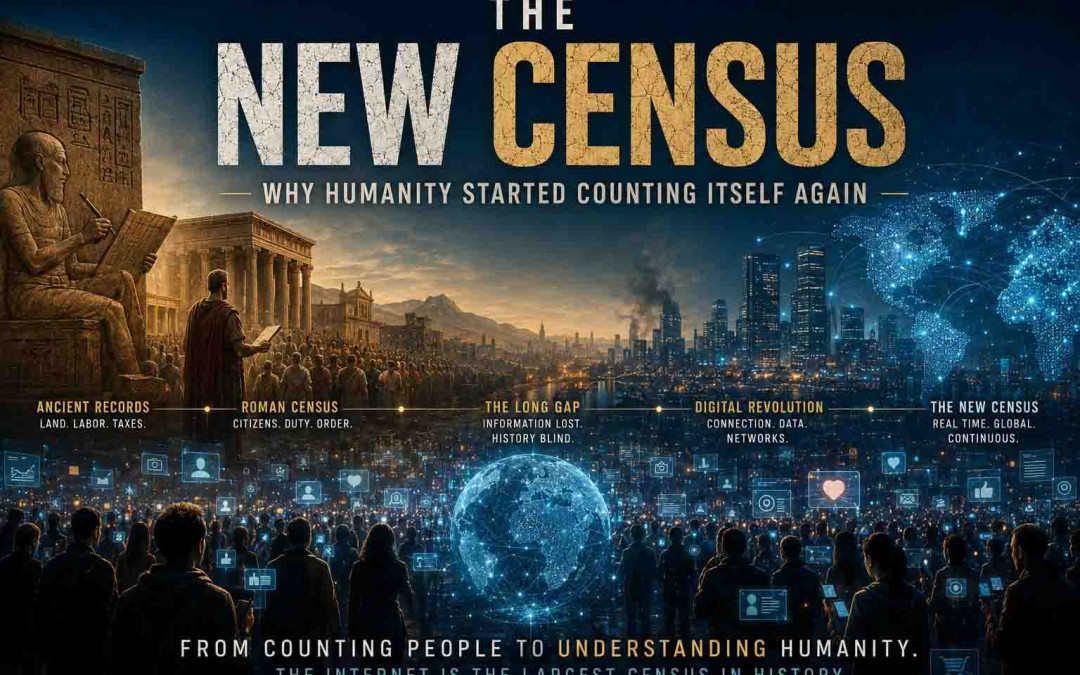
The Census That Never Ends
For thousands of years, rulers counted people to understand their kingdoms. Then humanity built a system in which people began counting themselves.
Once every ten years, a civilization performs a peculiar ritual. Millions of people who spend most of their lives as individuals become entries in a larger picture. Age, address, household, occupation, education: details that seem ordinary at the scale of one life acquire another meaning when assembled across an entire population.
The transformation is almost magical in its simplicity. A person becomes a number, but millions of numbers become something else.
A country can suddenly see itself.
Governments have understood the value of this trick for thousands of years. Fields could be measured because fields could be taxed. Households mattered because households contained workers, property and potential soldiers. Population was not merely something a ruler possessed; it was something a ruler needed to make visible. An empire containing ten million people but knowing almost nothing about them was, in an important sense, partially blind.
Then, within little more than a generation, we built a census of an entirely different kind.
Nobody arrives carrying a form. There is no census day. Much of the information is not collected every ten years, every year or even every day.
It is produced continuously.
We call the system the Internet.
Perhaps that name describes only the wires.
When a Population Became Visible
The census is much older than the modern state. Ancient societies in Egypt, Mesopotamia, China and elsewhere developed systems for recording populations, property, agricultural production and obligations. Rome made the census particularly important to its civic and political organization. Roman citizens could be registered according to property and status, helping determine taxation, military obligations and political position.
The details changed enormously across places and centuries, but the underlying problem remained recognizable: large societies require information about themselves.
This sounds obvious until we imagine governing without it.
A village can be known personally. A kingdom cannot. Once political systems expand beyond the scale of direct human relationships, reality has to be compressed into records. People become names, categories, properties and totals. Land becomes a survey. Grain becomes an inventory. Distance becomes a map.
Administration begins by creating a representation.
That representation is necessarily incomplete. The Roman state could count citizens without knowing what they discussed over dinner. A tax register might know that a household existed while knowing almost nothing about the relationships inside it. Ancient governments could measure some of the things they needed, but vast areas of ordinary life remained informationally dark.
People were born, argued, desired, travelled, bought things, changed opinions and died without leaving enough evidence for anyone centuries later to reconstruct more than fragments of their lives.
For historians, that darkness is normal.
For us, it is becoming strange.
The Census Without a Census Taker
Imagine explaining Instagram, Google Maps, online shopping and a fitness tracker to a Roman census official.
The individual technologies would be incomprehensible. The underlying ambition might not be.
Here is a system that can record where people go, what they search for, whom they communicate with, what they buy, which images hold their attention, what music they play, how quickly they move and sometimes even how they sleep. Much of this information is not gathered by a state census office. It emerges because ordinary participation in digital life produces traces.
The comparison must be handled carefully. The Internet is not literally a census, and no single institution possesses a complete database of humanity. Different companies, governments and individuals hold different fragments under different legal regimes, while large parts of human life remain unrecorded or inaccessible.
But as a structural comparison, something extraordinary has happened.
The traditional census asked questions.
The digital world observes events.
A census might record that a person lives in Manchester and works in finance. Digital systems may record that the same person searched for flights to Lisbon at 11:43 p.m., watched three apartment videos, abandoned a purchase, returned two days later and finally booked after receiving a lower price.
One is a portrait.
The other begins to resemble a film.
The difference is not simply more data. It is time.

When the Map Began to Move
Traditional administrative information resembles photography. A census freezes a population at a particular moment and then attempts to describe it. Almost immediately, reality begins moving away from the picture. People migrate, marry, separate, die, change jobs and create businesses. The map ages while the territory continues living.
Networked information changes this relationship because the map can increasingly move with the territory.
Traffic systems can detect congestion while it is forming. Search data can reveal changes in attention. Financial networks register transactions as they occur. Online platforms observe communities forming, dissolving and reorganizing. Supply systems respond to changing demand. Smartphones generate location information at a scale that would have appeared almost supernatural to earlier administrators.
The map has not become the territory. That distinction remains crucial. Digital traces are selective, commercially shaped and often misleading. A click is not a belief. A location coordinate does not explain why somebody went there. What is measurable can easily be mistaken for what matters.
Yet the map has acquired something maps rarely possessed before.
Feedback.
The represented world can act, generate information about the action and receive a response from the system quickly enough for the response to influence what happens next. The territory changes the map; the map changes the territory; another measurement follows.
At that point we are no longer dealing only with an archive.
We are dealing with a loop.
The Colony Looking Back at Itself
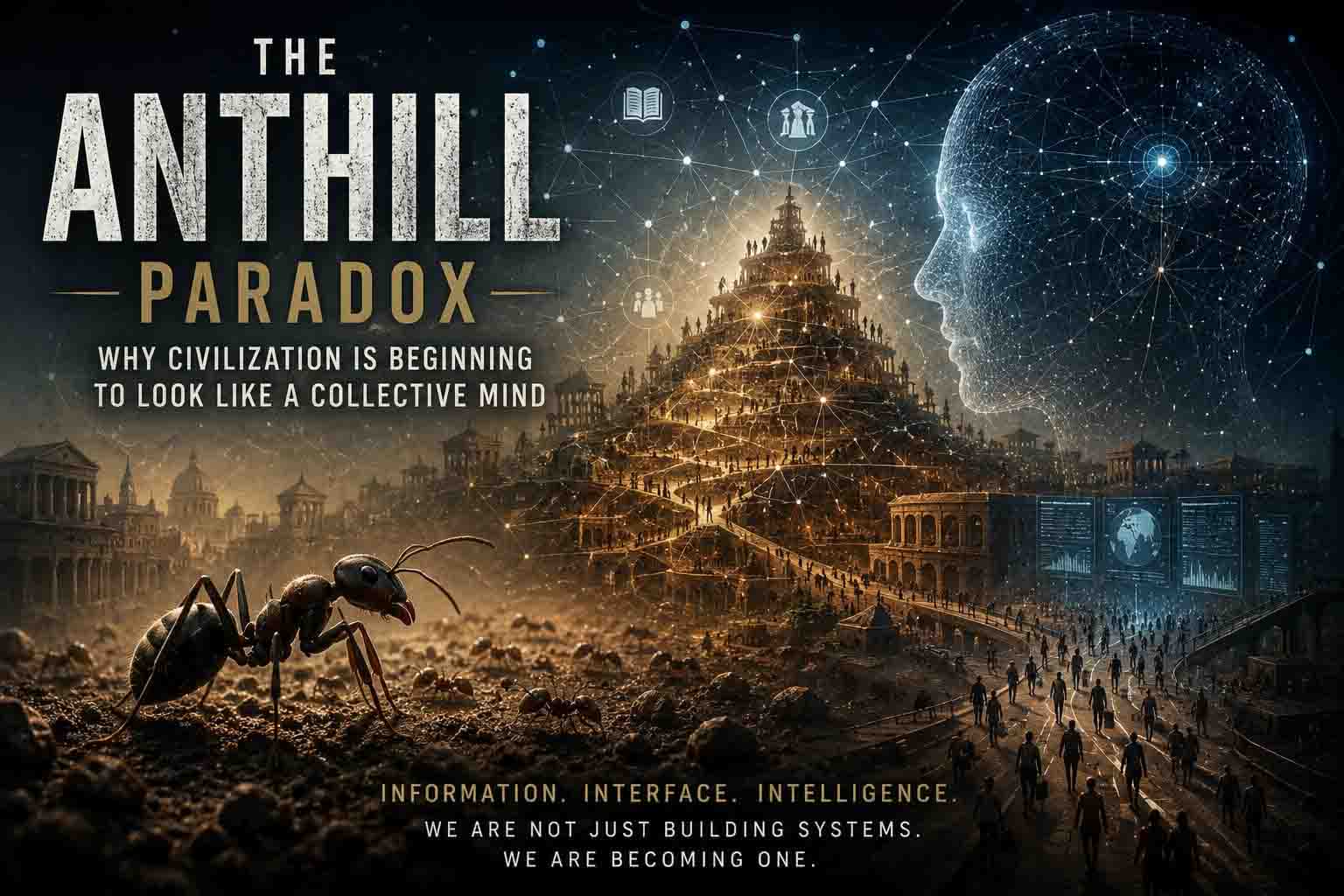
An ant colony offers an irresistible analogy because its coordination does not require one ant standing above the nest with a master plan. Information circulates locally. Conditions change, signals spread and collective behavior emerges from interactions that no individual ant needs to comprehend globally.
Human civilization is vastly different, of course. Humans possess symbolic language, institutions, reflective consciousness and deliberate planning. There is no reason to pretend that a social network is simply a technological pheromone trail.
But move far enough away and a structural resemblance appears.
Modern civilization consists of billions of participants producing signals. Prices change. Searches rise. roads become congested. Messages spread. Products become popular and disappear. Markets respond. Governments measure. Algorithms rank. Individuals alter their behavior after seeing what other individuals have done.
Information returns to the system that produced it.
This may be more important than the sheer quantity of data. Civilization has always generated information, but much of it once disappeared before it could return as useful feedback. Today enormous parts of human activity leave traces quickly enough to affect subsequent activity.
The anthill has begun acquiring mirrors.
And now AI is being placed in front of them.
The Librarian Learns to Read the Census
For years, the great problem of digital civilization appeared to be storage. We were producing astonishing quantities of information and building increasingly enormous systems to preserve and retrieve it.
Artificial intelligence changes the problem.
The question becomes not only how much can we record?, but what patterns can be found inside what has been recorded?
This is a profound distinction. A library may contain more knowledge than any person could read, but possession is not comprehension. A billion photographs, transactions, documents and measurements are not automatically useful simply because they exist. Civilization needs interfaces capable of moving through the archive.
Search engines represented one step. They helped humans find needles inside increasingly large haystacks. Contemporary AI systems add another possibility: comparison, classification, synthesis and pattern recognition across bodies of information too large for one person to examine directly.
The library is no longer merely growing.
We are building tools that can read parts of it with us.
That development does not mean humanity has created a conscious planetary brain. Nor does the existence of enormous datasets mean that somebody somewhere knows everything about everyone. The reality is fragmented, uneven and constrained by technical, legal and commercial boundaries.
The more interesting development requires no science fiction.
For the first time, civilization is building increasingly powerful tools for interpreting traces generated by civilization itself.
The observer and the observed belong to the same system.
The Mirror Has a Blind Side
There is an obvious temptation here. If enough information can be collected, perhaps society can finally understand itself completely.
History gives us reasons to be suspicious of that dream.
Every census creates categories, and categories decide what can be counted. Every measurement privileges something measurable. Every database has fields and therefore has things that do not fit comfortably inside those fields. The new digital census is incomparably richer than an ancient population register, but it inherits the same fundamental limitation.
Visibility is not understanding.
A system may know that millions of people clicked on something without knowing what it meant to them. It may predict behavior accurately without possessing a satisfying explanation of the person behaving. It may identify patterns that are statistically real while overlooking experiences that leave almost no digital trace.
There is also a political question the Roman censor would have understood immediately: who gets to see the census?
Information creates asymmetry. The person being measured does not necessarily possess the same view as the institution performing the measurement. Modern civilization may therefore become more visible to itself while individual participants remain unable to see the structures through which they are being represented.
The mirror exists.
That does not mean everyone is standing on the same side of it.
The Day Humanity Saw Its Own Movement
Perhaps future historians will find our terminology quaint. We call it social media because people socialize there. Search because people search. E-commerce because people buy things. Maps because people need directions. Smartphones because the telephone happened to be the object from which many of these functions evolved.
From inside an era, technologies are usually named for what they appear to do.
Their deeper historical function may become visible only later.
Writing was more than a better way to make lists. Printing was more than faster copying. Photography became more than portraiture. The Internet may ultimately prove to have been more than a communication network.
It created an environment in which enormous portions of civilization began leaving continuous traces of their own movement.
The ancient census asked:
Who is here?
The modern network can increasingly ask:
What is happening?
And artificial intelligence introduces another question:
What does the pattern mean?
We should be careful with the word self-awareness. There is no evidence that civilization possesses a unified subjective consciousness looking back at itself. But there is a weaker and perhaps more interesting sense in which something genuinely new is occurring.
A civilization can increasingly observe aspects of its own behavior while that behavior is happening.
The census has begun to move.
And for the first time, the thing being counted may be learning how to read the numbers.
Watch The Video
How to Read the World
Current Knowledge
Censuses and administrative records have existed in many ancient civilizations, although their purposes, methods and coverage differed substantially. Ancient states used population and property records for taxation, military obligations, labor organization and administration. In Rome, the census was particularly connected with citizenship, property assessment, social classification and civic obligations.
Modern national censuses remain periodic statistical exercises and should be distinguished from commercial or governmental digital data collection. There is no single continuous global database containing a complete record of humanity.
Digital technologies nevertheless generate unprecedented quantities of behavioral and transactional data. Search activity, online purchases, social-media interactions, mobile devices, financial systems and connected infrastructure can create continuously updated records of selected aspects of human activity.
These records remain incomplete representations. Digital data can exclude populations, contain measurement errors and reflect the categories and incentives of the systems collecting it. Behavioral traces also do not necessarily reveal motivations, beliefs or subjective experience.
Artificial intelligence and machine-learning systems can identify patterns across large datasets, but this does not establish that civilization itself possesses consciousness or literal self-awareness.
Open Questions
At what point does measurement become observation, and observation become governance? Can a civilization become better at predicting its members while simultaneously understanding them less?
If more human activity becomes measurable, will societies begin optimizing what can be counted while neglecting what cannot? Who should control access to civilization-scale behavioral information, and what rights should individuals retain over the traces their participation creates?
There is also a deeper question: if a civilization can observe its own behavior, model it and modify its behavior in response to those models, at what point does the metaphor of self-observation become more than a metaphor?
We do not yet know.
Transhumation Interpretation
Transhumation treats the census, map, library, Internet and artificial intelligence not as identical technologies but as different carriers of a recurring civilizational function:
making the larger system visible to itself.
The census converted populations into records. Maps converted territory into representation. Libraries preserved collective memory. Networks began recording movement and interaction. AI increasingly helps interpret patterns inside the resulting archive.
At each stage, civilization gains another way of looking at itself.
That does not mean a planetary consciousness has appeared. The stronger and more defensible claim is also more interesting: the feedback loop between civilization and its representation is becoming faster.
The map watches the territory.
The territory responds to the map.
The map changes again.
Perhaps the Internet’s deepest historical significance will therefore turn out not to be that it allowed every human being to speak to everyone else.
It may be that civilization finally built a mirror large enough to watch itself move.
FAQ
What does “the census that never ends” mean?
It is a metaphor for the continuous production of digital traces through modern life. Unlike a traditional census conducted periodically, digital systems can record selected activities as they occur.
Is the Internet literally a global census?
No. There is no single database recording every person or activity. The comparison describes a structural change from periodic population snapshots toward continuous, distributed measurement.
What were ancient censuses used for?
Ancient governments used population, property and resource records for purposes including taxation, military service, labor obligations, social classification and administration.
Why was the Roman census important?
The Roman census was associated with citizenship, property assessment, civic status and obligations. It helped Roman authorities organize aspects of an increasingly complex society.
What makes digital data different from a traditional census?
Traditional censuses primarily provide periodic snapshots. Digital systems can capture selected behaviors, transactions and interactions continuously, making it possible to observe change over time.
What does “the map began to move” mean?
It describes the transition from static representations of society toward systems that can update as human behavior changes.
Is digital data an accurate representation of humanity?
Only partially. Digital records capture measurable traces, not complete human experience. They may omit context, motivation and people whose lives produce fewer digital records.
Why does the article compare civilization with an anthill?
The analogy illustrates distributed information processing. Complex collective behavior can emerge even when no individual participant understands the entire system.
Is human society really like an ant colony?
Only in a limited structural sense. Humans possess language, reflective consciousness, institutions and deliberate planning that make human societies fundamentally different from insect colonies.
What role does feedback play in the new census?
Feedback allows information about behavior to influence subsequent behavior. Traffic information can change routes, rankings can change what people view, and market data can influence economic decisions.
How does AI change the relationship between civilization and data?
AI can help classify, compare and interpret extremely large collections of information, potentially making patterns visible that individual humans could not detect unaided.
Does AI give civilization self-awareness?
There is no scientific evidence that civilization or current AI systems possess unified subjective consciousness. “Civilizational self-awareness” is better treated as a metaphor for increasingly sophisticated self-observation.
What is the difference between visibility and understanding?
A system may measure behavior accurately without understanding why the behavior occurred. More data therefore does not automatically produce deeper knowledge.
Why is control of data important?
Information can create power asymmetries. Institutions capable of observing large populations may possess knowledge unavailable to the individuals being observed.
What does the mirror metaphor mean?
The mirror represents technologies that allow civilization to create representations of itself. The Internet and digital data make aspects of collective behavior visible at unprecedented speed and scale.
What is the Transhumation interpretation of the census?
Transhumation sees the census as one carrier of a recurring function: civilization developing tools through which it can observe itself. Maps, libraries, networks and AI extend that function in different ways.
What is the central argument of the article?
The Internet may ultimately be historically important not only because it connected humanity, but because it created an environment in which enormous portions of human activity continuously produce observable information.
Did humanity become conscious through the Internet?
There is no evidence for a literal collective consciousness. The more defensible idea is that civilization gained increasingly powerful mechanisms for observing, modelling and responding to its own activity.
What might future historians consider the Internet’s greatest achievement?
They may regard communication as only part of its significance. Another possibility is that the Internet marked the point at which civilization began observing its own movement in something approaching real time.
Continue the Transhumation Series
- Forgotten Religion | Ancient Gods, Symbols and the Hidden Structures of Human Civilization
- The Last Religion | Death, Immortality and the Future of Humanity
- The New Theurgy | AI, Information and the Future of Human Civilization
- End of Branding: You Were Never Meant to Become a Product
- Baal vs Ishtar: Why Ancient Gods Never Disappeared