
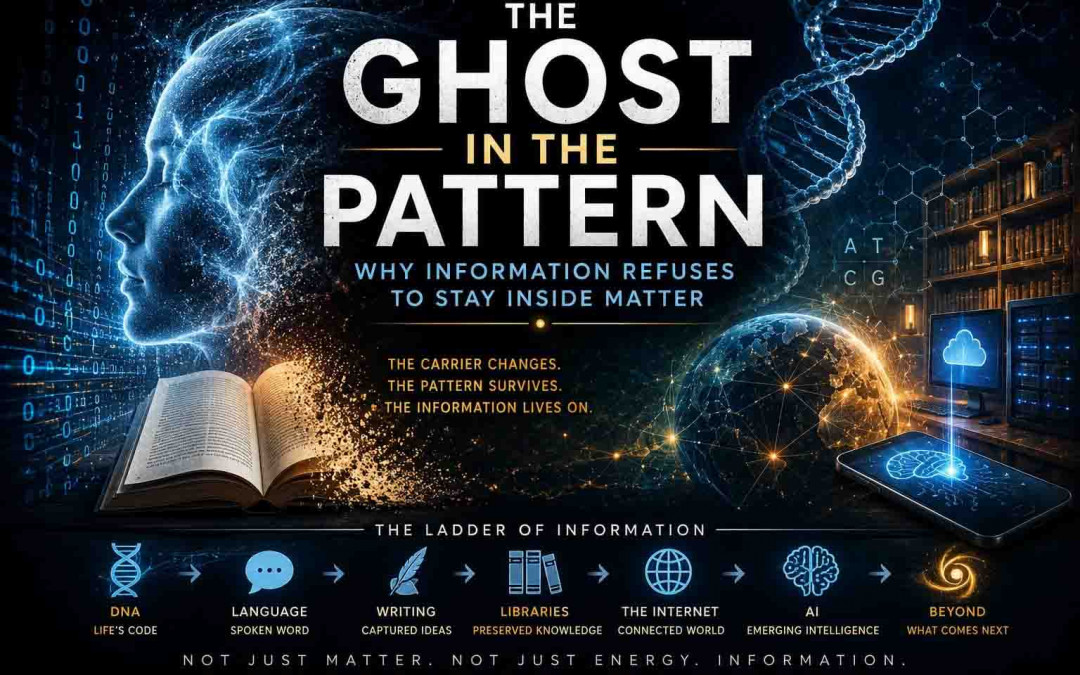
The Ghost in the Pattern
Information never exists without matter. Yet again and again, the pattern survives after the matter that once carried it has disappeared.
Take an old book from a shelf and the distinction seems almost embarrassingly obvious. It has weight. The paper has a smell. The binding has deteriorated slightly at the corners. Perhaps somebody underlined a sentence seventy years ago, and the pressure of the pencil can still be felt beneath a fingertip. This particular object has a history that no second copy can possess.
Now burn it.
The object is gone.
But if another copy exists, the novel has not disappeared. The sentences remain available. The characters still enter the same rooms. The argument can still be reconstructed by a reader who never touched the destroyed volume. The paper was singular. The text was not.
Nothing supernatural has happened. The story did not float out of the flames like a Victorian spirit. It survived because its structure had already been instantiated somewhere else.
And yet that simple fact introduces one of the strangest features of reality.
Some things seem inseparable from the matter that constitutes them. Break a particular wineglass and that glass is gone. Other things possess a different kind of continuity. A melody can move from violin to piano. A mathematical proof can move from chalkboard to paper to screen. Software can run on machines built from different individual components. A sentence can cross centuries while every molecule of its first inscription has vanished.
The carrier matters.
But sometimes the identity of what is carried does not belong exclusively to the carrier.
Modern civilization lives inside this distinction so completely that we rarely notice how philosophically dangerous it is.
The Book Is Not Made of Ghosts
The easiest mistake is to convert information into a new immaterial substance.
Paper belongs to matter, we say; the story belongs to information. Hardware is physical; software is somehow elsewhere. The body is material; perhaps the mind is the pattern floating above it.
This sounds sophisticated only because the word information has inherited some of the mystery previously assigned to spirit.
In reality, every information system we know requires physical implementation. A novel must exist as ink, magnetic state, electrical charge, neural activity or some other physical arrangement if it is to exist operationally at all. A song that exists nowhere—not in memory, notation, recording or performance—is difficult to distinguish from a song that has been lost completely.
Information does not escape matter.
It escapes dependence on one particular piece of matter.
That is a subtler claim and a far more interesting one.
The novel survives the first edition because the relevant relationships between symbols can be reconstructed in another medium. The melody survives a new instrument because the musical organization is not identical to the wood and strings that previously produced it. The same geometric triangle can be rendered in ink, pixels or lines scratched into dust because what defines the triangle is not any specific collection of atoms.
We are surrounded by structures that possess this limited form of carrier independence.
Then we turn the question toward ourselves.
The Body That Refuses to Stand Still
Popular explanations of personal identity often begin with a misleading claim: that every atom or every cell in the human body is replaced after a fixed number of years. Biology is not that neat. Different tissues behave differently. Some cells are replaced quickly, others persist for years or decades, and certain neurons can remain with us for much of a lifetime.
But the larger point does not depend on a seven-year myth.
A human being is not materially static.
We metabolize. Repair tissue. Build proteins and break them down. Neural connections change with learning. Hormonal systems change with age. The brain of an eighty-year-old is not physically identical to the brain of the child whose photograph sits on the mantelpiece.
Psychologically, the change may be even more dramatic.
The child knew things the adult has forgotten. The adult holds beliefs the child could not have understood. Relationships disappear. Languages can be learned. Character may soften or harden. A person can change profession, country, religion, political convictions and almost every visible feature of a life.
Yet when the adult points toward the childhood photograph, the sentence remains effortless.
“That’s me.”
Why?
Not because nothing changed.
Almost everything did.
Identity appears to depend somehow on continuity through change rather than resistance to change.
That is where the pattern becomes tempting.

DNA and the Oldest Library
Biology itself gives us an informational vocabulary.
DNA is a physical molecule. Its chemical properties matter enormously. But biology also depends on the ordering of nucleotide sequences and the relationships through which those sequences participate in gene expression, regulation, development and reproduction.
This is why scientists can legitimately speak about biological information while still disagreeing about how far the metaphor should be taken.
A gene is not literally a sentence written by an author. DNA is not software in the ordinary engineering sense. Organisms are not machines assembling themselves from a simple instruction manual. Development depends on extraordinary networks involving genes, cells, chemistry, environment and history.
Still, life depends on preserving structure across generations.
A child does not inherit the atoms of a parent’s body.
It inherits biological continuity through replicated molecular organization.
Life learned, long before human language, how to allow pattern to cross the disappearance of a particular carrier.
Variation prevents the copying from being perfect.
Selection acts upon the consequences.
Evolution happens in the tension between preservation and change.
The first library was alive.
Civilization Discovers the Trick
Humans then performed a remarkable extension of the same general problem.
We learned to transmit acquired structure without waiting for biological reproduction.
Language allowed knowledge to move from one nervous system to another. Writing allowed it to remain available after the original speaker died. Libraries accumulated the outputs of minds that could no longer answer questions. Printing multiplied access. Recording preserved voice and movement. Digital systems separated many informational structures from the physical objects with which previous generations associated them.
Music once required the musician to be present.
Then notation allowed a future musician to reconstruct it.
Then recording allowed the original performance itself to travel.
The pattern acquired new carriers.
Each step changed civilization.
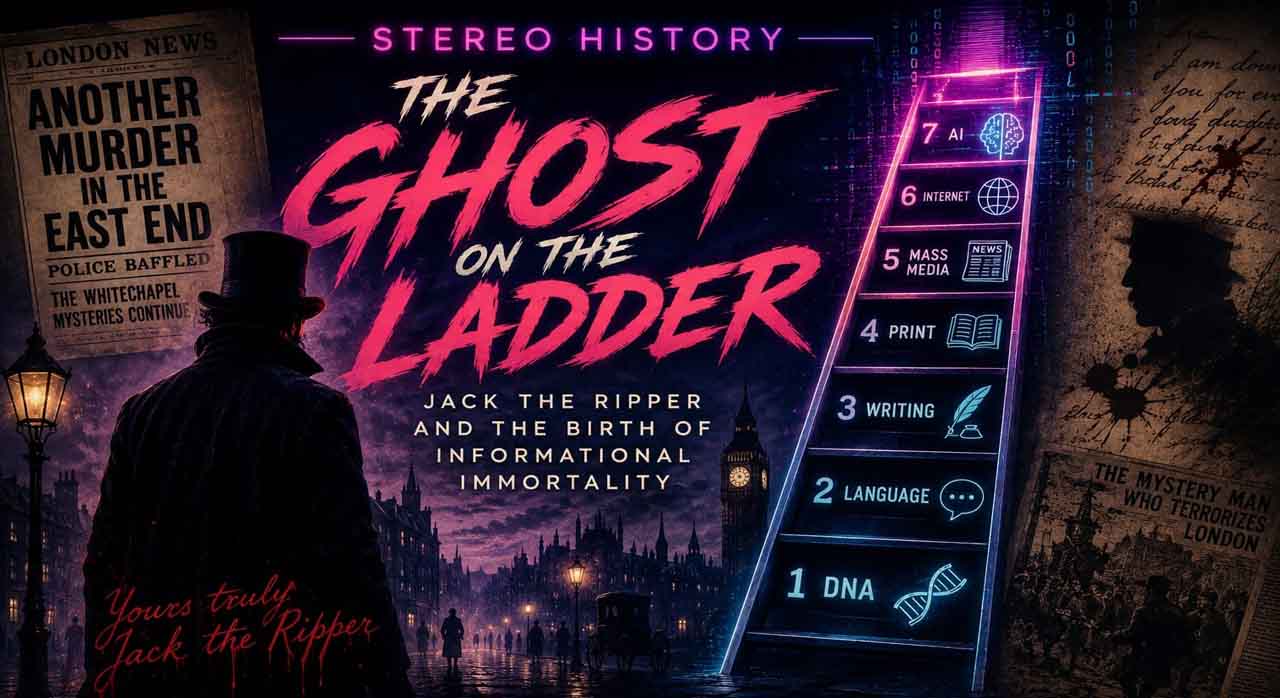
This is the deeper logic behind the Ladder of Information. Not that information is climbing toward some predetermined destiny, and not that matter is gradually becoming unnecessary. The opposite is true: every new rung requires another physical infrastructure.
The interesting movement is functional.
More structures become capable of surviving the disappearance of the particular carrier that first held them.
The Human Is Where the Analogy Becomes Dangerous
A book makes the carrier-pattern distinction look easy because nobody worries about whether the book experiences being copied.
A human being creates a different problem.
Suppose every informationally relevant feature of your brain could be mapped perfectly and reconstructed in another physical system. Memories, habits, language, fears, preferences, associations, perhaps even the small hesitation before answering a difficult question.
The reconstruction opens its eyes and says your name.
Has the pattern survived?
Perhaps.
Have you survived?
That does not follow automatically.
If the biological original remains alive, the difficulty becomes obvious. There are now two systems sharing one past and beginning two different futures. Both may sincerely claim continuity. They cannot remain numerically identical once their experiences diverge.
The pattern can be duplicated.
The first-person point of view may not be.
This is precisely where information theory stops being an easy solution to the problem of the self.
A pattern can explain why a copy resembles you.
It does not yet explain why you should expect to wake up as the copy.
Memory Is Not a Backup File
Memory makes the problem even more difficult because memory itself is not a stable database.
Human remembering is reconstructive. Recollection can be modified by later knowledge, emotion and repeated retrieval. People can confidently remember events inaccurately. Important parts of the past can disappear while identity persists.
This means a person cannot be reduced simply to the archive of what happened to them.
The self includes an ongoing process through which the past is continually reorganized from the standpoint of the present.
A photograph preserves an image.
A diary preserves selected descriptions.
A database can preserve preferences.
An artificial system may someday reproduce speech patterns with astonishing precision.
But a living person does something none of these archives obviously does.
The person continues.
The next moment changes the interpretation of the previous one.
The pattern is not merely stored.
It is moving.
The Ghost Was Never Outside the Machine
This changes the meaning of the title.
The ghost in the pattern is not an immaterial spirit hiding behind physics.
It is the strange persistence of organization across changes in material embodiment.
A song disappears from vinyl and reappears through speakers fed by a digital file.
A dead mathematician’s proof enters the mind of a student centuries later.
A language persists while every person who spoke its earlier form is gone.
Rome disappears as a political organism while structures of Roman law continue to operate in institutions unimaginable to Romans themselves.
Civilization is full of ghosts in this limited sense.
Not entities without matter.
Patterns that repeatedly acquire new matter.
This may be one of the reasons ancient ideas about soul and modern ideas about information occasionally seem to approach each other. Both are drawn toward the same intuition: perhaps the identity of something cannot always be located by pointing to the substance currently carrying it.
But resemblance is not identity.
A theological soul is not an information pattern.
Information theory does not prove survival after death.
And nothing about software demonstrates that consciousness can be detached from biology.
The analogy becomes valuable only when we know where it stops.
Watch The Video
How to Read the World
Current Knowledge
Information in scientific and technological contexts always requires some physical realization. Digital information depends on physical states in storage and computation; biological information depends on molecular structures; human memory depends on living neural systems. There is no established evidence for information operating independently of any physical substrate.
At the same time, many informational and functional structures can be instantiated in more than one physical medium. Texts can be reproduced across paper and digital systems, software can operate on different compatible hardware, and mathematical relationships are not tied to one particular physical representation. This provides a meaningful distinction between a structure and any single material instance of that structure.
DNA plays a central role in biological inheritance, but describing DNA as “information” should not imply that organisms are simply programs executed from genetic code. Development and biological function involve interactions among genes, cellular processes, environment and evolutionary history.
Human identity persists through substantial biological and psychological change, but there is no scientific consensus reducing personal identity to an informational pattern. Human consciousness remains strongly associated with functioning biological brains, and there is no demonstrated transfer of a person’s subjective consciousness into another substrate.
Open Questions
The first question is how far carrier independence extends. We know that texts, algorithms and mathematical relationships can survive changes of physical implementation. Which properties of a human mind share that flexibility, and which depend essentially on biological processes?
Continuity creates a second problem. If a person’s organization were copied perfectly, would the copy represent survival or duplication? Does personal identity depend upon structure alone, or upon an uninterrupted causal history linking one conscious state to the next?
Embodiment complicates the picture further. Human thought is shaped by sensation, hormones, movement, pain, fatigue and interaction between brain and body. Can a pattern representing cognition be separated meaningfully from the biological system through which that cognition developed?
There is also a deeper question about information itself. When we call DNA, books, neural states and software “information,” are we identifying one fundamental feature shared by all four, or using one word for several importantly different relationships?
And finally, if consciousness does turn out to depend on organization rather than one specific material substrate, what would count as evidence that the subjective observer—not merely the observable pattern—had successfully crossed from one carrier to another?
Transhumation Interpretation
Transhumation is interested in carrier-independent structures because civilization repeatedly depends on them.
A sentence can survive a voice.
A melody can survive an instrument.
A geometric form can survive a drawing.
A story can survive a language, although translation changes it.
An institution can survive generations of people while remaining recognizably continuous.
These migrations are real.
They do not establish a universal principle that everything important can change carriers.
Consciousness may be the boundary.
This is why the phrase ghost in the pattern should remain deliberately unstable.
From one angle, the ghost is simply continuity: the structure we recognize after the original matter has disappeared.
From another, it is the unanswered question concealed by that recognition.
What exactly crossed?
When a book is copied, the problem is easy because the relevant structure is public. We can compare versions and establish sufficient equivalence.
When a conscious being is copied, there is another variable.
An observer.
The first-person perspective is not available to us in the same way as text on a page.
Perhaps consciousness is ultimately a carrier-independent process.
Perhaps it requires a specific class of biological dynamics.
Perhaps continuity rather than material composition is decisive.
Perhaps our current division between matter and information is too crude to formulate the right question.
Transhumation should keep all four possibilities available.
The temptation of the information age is to believe that because we learned how to preserve the pattern, we have learned how to preserve everything that mattered.
We have not.
A dead person’s photographs can survive.
Their words can survive.
Their recorded voice can survive.
Their influence can survive.
Their genetic information can survive.
Perhaps future systems will reproduce their personality with extraordinary fidelity.
None of these forms of survival automatically establishes the continuation of the observer who once experienced being that person.
The carrier can change.
The pattern can remain.
The ghost is the unanswered question in between.
FAQ
What does “The Ghost in the Pattern” mean?
It refers to the persistence of structure across changes in physical carrier. The phrase is deliberately metaphorical; it does not claim that information is literally a supernatural entity.
What is a carrier?
A carrier is the physical system in which a structure is instantiated. Paper can carry text, magnetic or electronic systems can carry digital data, and biological molecules can carry genetic information.
Can information exist without matter?
No example of operational information existing without a physical substrate has been scientifically demonstrated. Information may move between carriers, but it still requires a carrier.
Then how can information “survive” matter?
It can survive the destruction of one particular physical instance if the relevant structure has been reproduced elsewhere. Burning one copy of a novel does not destroy the novel if other copies exist.
Is DNA really information?
DNA is a physical molecule whose sequence participates in biological inheritance and regulation, so informational language is useful in biology. But DNA should not be treated as a simple computer program independently controlling an organism.
Does the human body replace all of its cells every seven years?
No. That popular claim is inaccurate. Different cell types have very different lifespans, and some can persist for decades. Human organisms nevertheless undergo continuous material and physiological change.
Why does identity feel continuous if the body changes?
There is no single settled explanation. Biological continuity, memory, personality, relationships, embodiment and uninterrupted causal processes may all contribute.
Is a human being a pattern?
Humans certainly contain patterns of organization, but it has not been demonstrated that everything relevant to personal identity or consciousness can be reduced to a transferable pattern.
Is memory the pattern that makes us who we are?
Memory is important but insufficient. People can lose or alter memories while retaining other aspects of identity, and memories themselves are reconstructive rather than perfect recordings.
Is software proof that minds can change substrates?
No. Software demonstrates that some functional structures can operate on different physical implementations. It does not prove that consciousness possesses the same property.
Could consciousness be carrier-independent?
Possibly, but this remains speculative. No human consciousness has been demonstrated to migrate between biological and non-biological substrates.
What is the difference between copying a pattern and preserving a person?
A copied pattern can reproduce memories, behavior or structure. Preserving the person would additionally require explaining why the original first-person experience continues rather than ending while a new copy begins.
Would gradual replacement solve the problem?
It might change the problem. Replacing neural functions gradually could preserve causal continuity in ways instantaneous copying does not. Whether that would preserve subjective identity remains unresolved.
Why is embodiment important?
The human mind develops and operates inside a body. Hormones, senses, movement, illness, pain and other bodily states contribute to cognition and identity. A theory that treats the brain as isolated information may omit important parts of human experience.
Is information more fundamental than matter?
Current science does not provide a simple established answer. Information is indispensable in physics, biology and computation, but claims that reality is fundamentally information move beyond straightforward empirical consensus into interpretation and metaphysics.
Does the existence of carrier-independent patterns support belief in a soul?
Not by itself. It demonstrates that some structures can persist across different physical realizations. Whether human consciousness or a theological soul possesses such continuity is a separate question.
What is the Ladder of Information?
It is a Transhumation model describing successive forms through which structure and memory are transmitted: biological inheritance, language, writing, libraries, networks and artificial intelligence. It is an interpretive framework, not a claim that evolution has a predetermined destination.
What would prove that a human mind is genuinely transferable?
A convincing demonstration would require more than an accurate copy. We would need a credible theory of consciousness, a mechanism explaining how relevant processes can survive a change of carrier and evidence that subjective continuity rather than mere behavioral duplication has been preserved.
What is the deepest question behind the pattern?
It may be the oldest question wearing the newest clothes.
A melody survives its instrument.
A book survives its first copy.
A civilization survives generations.
The material changes and something recognizable continues.
Then the pattern reaches a conscious being and the analogy becomes uncertain.
If every structure associated with you could be preserved, there would still be one final question the archive could not answer merely by containing more data:
Did the pattern survive — or did you?
That difference may be where information ends and the mystery of the person begins.
Continue the Transhumation Series
- Forgotten Religion | Ancient Gods, Symbols and the Hidden Structures of Human Civilization
- The Last Religion | Death, Immortality and the Future of Humanity
- The New Theurgy | AI, Information and the Future of Human Civilization
- End of Branding: You Were Never Meant to Become a Product
- Baal vs Ishtar: Why Ancient Gods Never Disappeared