
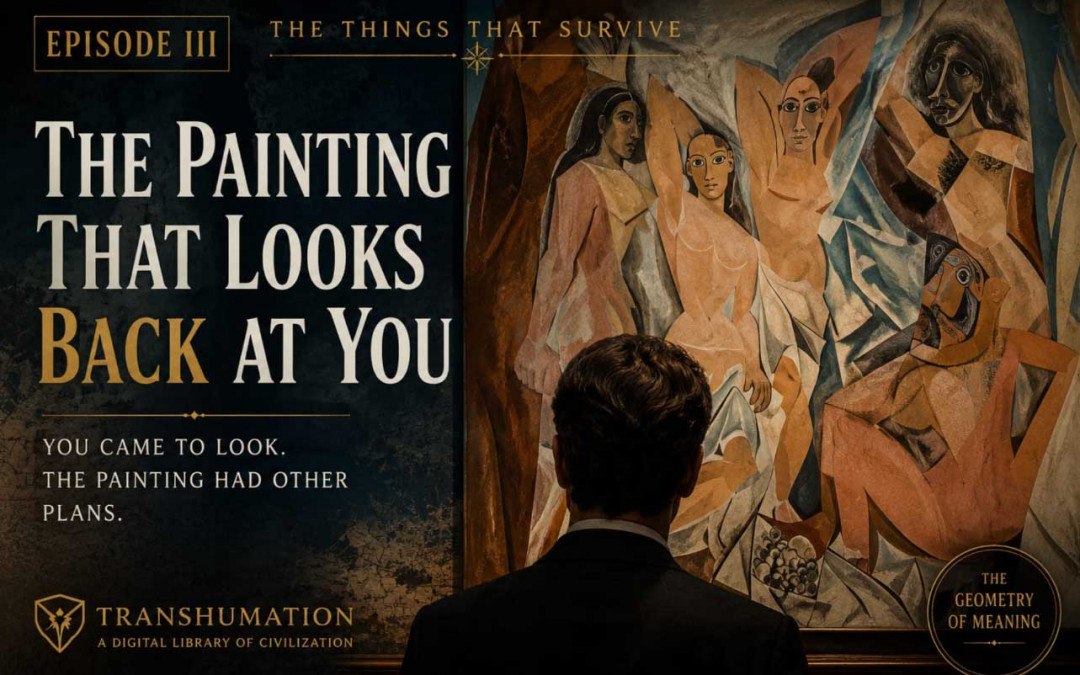
The painting has not changed. You Have
Five women still occupy the same enormous canvas Pablo Picasso completed in Paris in 1907. The same angular bodies press toward the surface. The same blue, rose and ochre shapes collide in a space that seems too shallow to contain them. The same faces look outward. More than a century has passed, Picasso is dead, generations of viewers have stood before Les Demoiselles d’Avignon, and yet the women remain exactly where he left them.
Then somebody tells you something.
They are prostitutes.
Nothing has happened to the painting. No figure has moved. No expression has changed. No new object has appeared in the room. And yet it is surprisingly difficult to look at the picture in precisely the same way again. One word has entered the space between you and the canvas, bringing with it sex, commerce, vulnerability, desire, exploitation, danger, perhaps judgment. The strange thing is that most of those things were not added to the painting.
They were added to the observer.
That leaves us with a small mystery. If the object did not change but the experience of the object did, where exactly did the transformation take place?
The Word Beside the Painting
Try a simple experiment. Forget the title for a moment.
There are five female figures. Some are nude, some partly covered. One appears to pull aside a curtain. The space around them has been compressed almost to disappearance, leaving remarkably little distance between their bodies and yours. Several look directly outward. They do not seem particularly interested in making the encounter comfortable.
Now restore the historical information. The title Les Demoiselles d’Avignon refers not to the French city of Avignon, as a modern viewer might reasonably assume, but to Barcelona’s Carrer d’Avinyó, associated with prostitution. Picasso worked on the painting through hundreds of preparatory studies before completing it in 1907.
Those facts matter. We should not erase them merely because another interpretation is more attractive.
But facts can sometimes create better mysteries rather than close them.
Once we know the women are associated with a brothel, how much of what follows are we actually seeing? Where, precisely, is prostitution painted? Which brushstroke contains commerce? Which angle contains shame? At what point does historical knowledge stop describing the object and begin organizing our response to it?
The little museum label beside a painting suddenly becomes more powerful than it looks. It appears merely to identify what we are seeing. Sometimes it also quietly tells us how to begin seeing it.
And once that happens, returning to innocence is difficult.
The Moment the Port Changes
There is a wonderful moment in Michael Mann’s Heat that seems to have nothing whatsoever to do with Picasso.
Police detectives are watching a professional robbery crew at an industrial location. The obvious assumption is that the criminals are studying a potential target. So the detectives begin studying the same environment. What is valuable here? What could be stolen? Why would experienced thieves be interested in this particular place?
The physical evidence refuses to cooperate.
Then the interpretation turns.
Perhaps the criminals are not studying the location.
Perhaps they are studying the police studying them.
It is one of those rare reversals in which almost nothing visible needs to change. The buildings remain where they were. The men remain where they were. The evidence remains essentially identical. What changes is the position of the observer inside the structure.
Return to Picasso.
We thought we had come to inspect five women. Yet several of those women are looking directly back at us. Their bodies are exposed, but their gaze does not behave like passive scenery. There is remarkably little comfortable pictorial distance in which the spectator can hide.
And suddenly the Heat problem appears again.
Who is observing whom?
Perhaps Les Demoiselles d’Avignon is not simply an image containing women who have already been categorized. Perhaps the painting can also make us notice the machinery doing the categorizing.
That possibility is much more disturbing, because the interesting object is no longer entirely inside the frame.
Part of it is standing in front of the painting.
The Temptation to Solve Picasso
At this point the adventure becomes dangerous, because we are close enough to an interesting interpretation that it is tempting to promote it into an explanation. We could say that Picasso deliberately constructed the painting to expose the prejudices of the male viewer, or that his real subject was never prostitution but the act of categorizing women. Both claims would make the essay satisfyingly neat. Neither is established by the historical evidence.
The painting has accumulated more than a century of arguments concerning sexuality, fear, desire, disease, primitivism, colonial appropriation, Iberian art, African art, formal experimentation and the emergence of Cubism. Picasso himself later described Les Demoiselles in terms of an “exorcism,” a remark that suggests a more complicated personal relationship to the work than any single contemporary interpretation can comfortably contain. The responsible thing is therefore not to make Picasso secretly agree with us.
But perhaps we have been asking too much of intention.
An artist can intentionally construct a form without consciously anticipating every event that form will later make possible. Shakespeare could not anticipate psychoanalysis. A medieval architect could not anticipate modern tourism. Picasso could not know what categories a viewer born more than a century later would carry into a museum. Once the work survives its creator, it begins encountering minds for which the creator could not have designed specific instructions.
This does not make meaning arbitrary. There are still three different questions, and keeping them separate protects the inquiry. What is demonstrably present in the work? What can reasonably be established about the historical circumstances and intentions surrounding its creation? And what experiences does the surviving structure make possible for later observers?
The third question begins where the first two stop.
That was already implicit in Episode II. Art may survive because it preserves not an identical experience but a structure capable of generating experience again. Les Demoiselles allows us to push the idea one step further. What if the regenerated experience can reveal something that was never physically stored in the work at all?
What if it reveals the observer?
The Part of the Painting Outside the Frame
Return once more to the museum. The five women remain exactly where Picasso left them. The fruit at the bottom of the canvas has not moved. The fractured planes are unchanged. The little card beside the painting contains approximately the same historical information it contained before we began.
But you now possess a history with the picture.
Perhaps you first saw five strange women. Then you learned that they were prostitutes. Then you noticed how rapidly that word reorganized them. Perhaps you became conscious of their gaze and wondered whether your position in front of the canvas was as neutral as it initially felt. Perhaps you rejected that entire interpretation as a modern projection onto Picasso. Even that rejection requires you to inspect the machinery by which you were interpreting the work.
The woman did not change.
The observer acquired history.
This may be why returning to a powerful artwork is fundamentally different from replaying a stored message. A message should become clearer once decoded. A sufficiently complex artwork can become less settled as the observer learns more, because each new piece of knowledge changes the conditions of the next encounter. The work accumulates not only interpretations but versions of the person who has encountered it.
Ten years from now, the same canvas may perform another reversal. Age, experience, politics, relationships, loss or knowledge may make visible something that today remains invisible. The remarkable part is that Picasso does not need to repaint anything for this to occur. The second half of the mechanism is standing outside the frame.
And now the little museum experiment with which we began becomes considerably stranger. We thought the label changed the painting because it gave us information about Picasso. In fact, it also gave us information about ourselves. We watched a word enter perception and alter what perception delivered back.
The painting became a mirror without ever ceasing to be a painting.
You Cannot See It for the First Time Twice
Now imagine returning to the painting tomorrow.
The canvas will be the same. The five women will still occupy the same positions. The right-hand faces will remain strange. The title will still refer to the same Barcelona street.
But you will arrive carrying something you did not possess before.
Perhaps you noticed the gaze. Perhaps you noticed what happened when the word prostitute entered your interpretation. Perhaps you rejected this entire argument and decided that it reveals more about contemporary viewers than about Picasso.
Even that changes the next encounter.
You can return to the painting.
You cannot return to your first viewing.
This may be one of the peculiar things that separates a powerful work from an object we merely consume. Its physical structure can remain almost motionless while the person encountering it accumulates history. The relationship therefore remains capable of changing even when only one side of it does.
And that brings us back to the mystery with which we began.
Nothing happened to the painting.
Something happened to you.
In the previous episode of The Things That Survive, we asked whether art might preserve not an experience itself but the conditions under which an experience can happen again. Les Demoiselles d’Avignon suggests an even stranger possibility.
Sometimes the experience being reconstructed is not contained entirely in the artwork.
The observer supplies the missing material.
Memory. Desire. Knowledge. Assumption. Fear. Classification. Expectation.
The painting provides the structure.
And for a moment the two meet.
We entered the room believing the treasure was hanging on the wall. We examined Picasso, the women, the masks, the fractured space and a Barcelona street from more than a century ago.
Then the structure quietly turned around.
The painting had not changed.
We had.
Watch the Video
How to Read the World
Current Knowledge
Pablo Picasso completed Les Demoiselles d’Avignon in Paris in 1907 after an extensive preparatory process involving hundreds of studies. The large painting depicts five nude or partly nude women and takes its title from Barcelona’s Carrer d’Avinyó, a street historically associated with prostitution.
The painting represented a major break with conventional Western pictorial space, perspective and idealized representation and is widely regarded as pivotal to the development of modern art and an important precursor to Cubism. Research into Picasso’s process indicates substantial revisions to the composition. Scholars have connected aspects of the central figures to Iberian sculpture and the transformed right-hand figures to Picasso’s encounter with African visual traditions.
There is no historical evidence establishing the specific argument of this essay — that the painting was consciously designed by Picasso to expose the observer’s categories. That distinction is essential: the historical properties of the painting and an interpretation of what the surviving work can produce in later observers are not the same claim.
Open Questions
How much authority should an artist’s intention retain once the work has survived into circumstances the artist could never have anticipated? Can a structure produce legitimate meanings that its creator never consciously intended, and if so, where does interpretation end and projection begin?
More strangely, what exactly survives when a work remains culturally active for centuries? Is it Picasso’s original message, the physical configuration of the canvas, the historical information surrounding it — or a relationship capable of being reconstructed between that structure and successive observers?
And if the same unchanged painting can become a different experience as the observer changes, where does the artwork finally end?
The Transhumation Interpretation
Transhumation treats Les Demoiselles d’Avignon as a test of a larger proposition: information may survive not by carrying one immutable meaning through time, but by preserving relationships capable of generating meaning again.
The material carrier matters, but it is not sufficient. Picasso supplies bodies, gazes, fractured geometry, visual tension and historical traces. The observer supplies another part of the system: memory, expectation, categories and lived experience. Neither side alone necessarily contains the event that occurs when they meet.
This is why cultural continuity may be stranger than simple preservation. What survives need not be a perfectly sealed message from 1907. It may instead be a structure sufficiently durable to keep doing something to people who were not yet alive when it was created.
A library preserves a book. A museum preserves a canvas.
But perhaps civilization’s more remarkable achievement is preserving encounters.
We thought the painting had survived because we could still look at it.
Perhaps the stronger test is that, after more than a century, it can still look back.
FAQ
What is Les Demoiselles d’Avignon about?
Picasso’s 1907 painting depicts five nude or nearly nude women and developed from a subject associated with prostitution and Barcelona’s Carrer d’Avinyó. Its meaning has generated extensive debate involving sexuality, formal experimentation, primitivism and the emergence of Cubism.
Why is Les Demoiselles d’Avignon important?
The painting radically disrupted conventional representation, perspective and pictorial space and became an important precursor to Cubism and a landmark in the development of modern art.
Why do some of the women have mask-like faces?
Picasso substantially revised the painting during its development. The faces have been discussed in relation to Iberian sculpture and, particularly for figures on the right, his encounter with African visual traditions.
Did Picasso intend the painting to expose the viewer’s prejudices?
There is insufficient historical evidence to establish that as Picasso’s deliberate intention. It is an interpretive possibility explored in this essay rather than a claim about proven authorial intent.
What is the Transhumation interpretation of the painting?
Transhumation asks whether an artwork can preserve a structure that does more than regenerate an experience. In some cases, the structure may redirect attention toward the observer, making their own categories and assumptions part of what becomes visible.
Continue the Transhumation Series
- Forgotten Religion | Ancient Gods, Symbols and the Hidden Structures of Human Civilization
- The Last Religion | Death, Immortality and the Future of Humanity
- The New Theurgy | AI, Information and the Future of Human Civilization
- End of Branding: You Were Never Meant to Become a Product
- Baal vs Ishtar: Why Ancient Gods Never Disappeared