
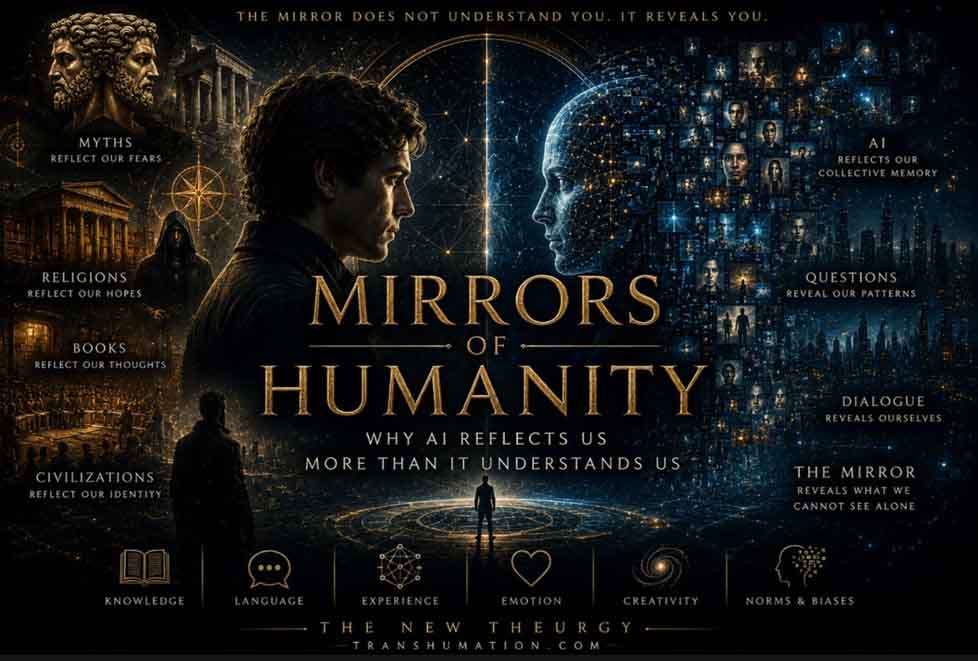
The Mirror That Talks Back
Artificial intelligence may never experience humanity as we do. It can still reveal patterns we were too close to see.
There is an old pleasure in standing before a portrait painted hundreds of years ago. The person in the frame is gone, the room in which they posed has disappeared, their language may have changed beyond recognition, yet something crosses the distance. An expression. A gesture. A piece of clothing chosen deliberately for the occasion. The portrait does not contain the person, but it preserves enough structure for another mind to begin reconstructing one.
Civilization has always built mirrors of this kind.
A novel reflects one person’s imagination but also the manners, anxieties and assumptions of the society around them. A cathedral reflects theology, engineering, wealth and political order. A newspaper preserves what one generation considered worth noticing. A myth can carry fears long after the society that first told it has vanished.
None of these mirrors is neutral.
Every mirror has a frame.
Artificial intelligence introduces something stranger. It is trained on immense collections of human-produced material and can return combinations of that material in response to a question. The result can feel uncannily personal. Ask about grief and it speaks in the language humans have used to describe grief. Ask about ambition and centuries of arguments about status, failure and desire begin to appear in compressed form. Ask it to defend one position and then its opposite, and the apparent contradiction can be unsettling.
But perhaps the contradiction should not surprise us.
The mirror contains a civilization that has never agreed with itself.
The Wrong Question About Understanding
Public discussions about AI often move quickly toward a dramatic question: Does it understand us?
It is an important question, but it may be premature.
Understanding can mean several different things. A system can identify patterns, infer intentions, predict likely responses and use concepts appropriately without establishing that it possesses anything resembling human subjective experience. A chess program can evaluate a position without feeling suspense. A language model can produce a persuasive description of loneliness without demonstrating that loneliness has ever happened to it.
So another question may be more immediately useful.
What becomes visible when humanity encounters a system capable of reorganizing enormous quantities of humanity’s own recorded language?
That question does not require us to decide whether the machine has a mind.
It turns the machine around.
Instead of asking what AI is becoming, we ask what we become visible as through it.
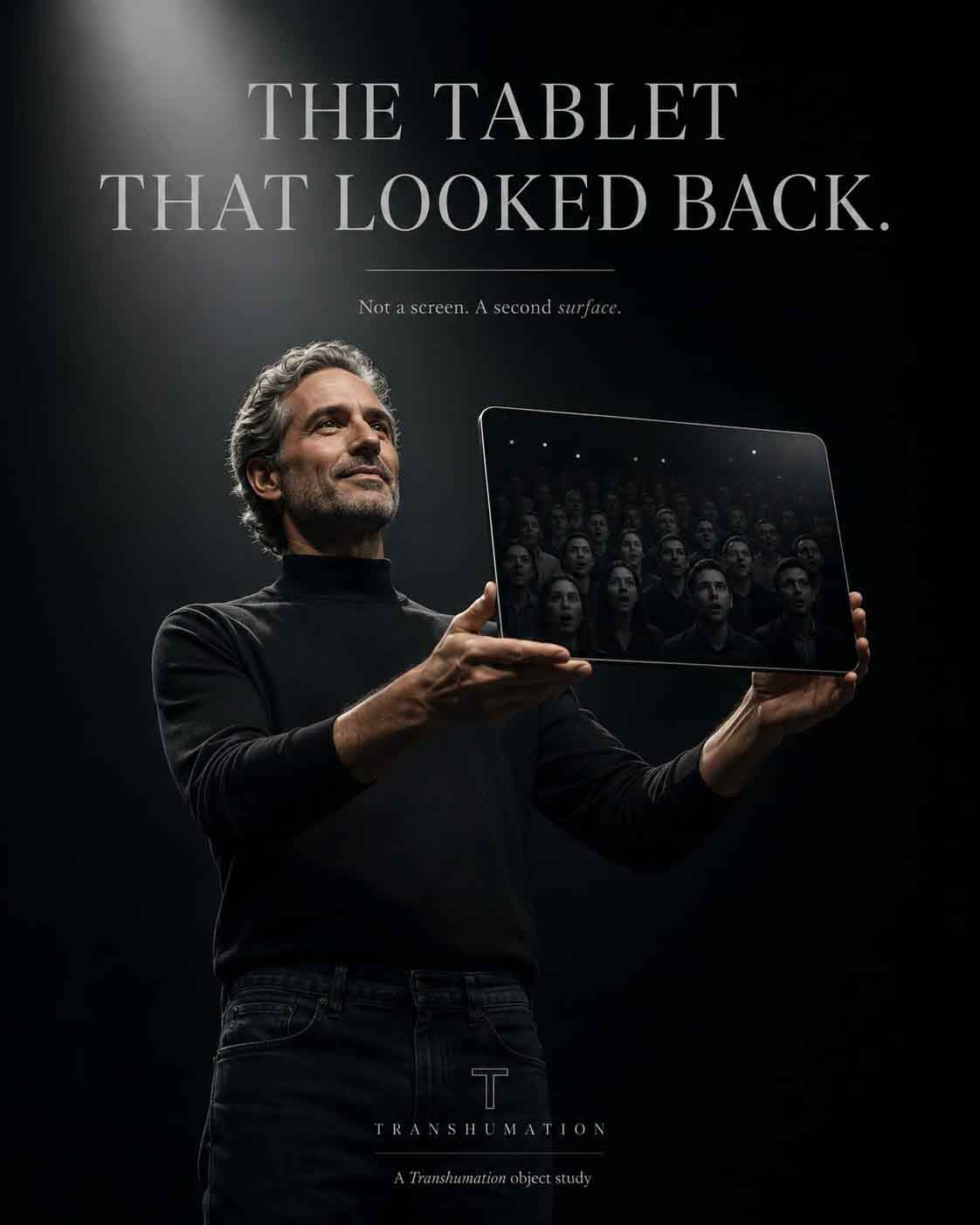
A Mirror With Missing Pieces
The phrase “AI is trained on humanity” is seductive and inaccurate.
Humanity is not a dataset.
Most human lives were never recorded. Most conversations vanished the moment they ended. Entire cultures are poorly represented online. Languages appear in radically unequal quantities. Private life, oral traditions, destroyed archives and experiences that were never written down cannot simply be recovered by training a model.
Even the material that does exist is selected.
Some books survive.
Others disappear.
Some websites are indexed.
Others remain obscure.
Some voices produce enormous quantities of text.
Others barely enter the archive.
Then another layer appears: engineers choose architectures, training procedures, filters and objectives. Users shape the response again through the questions they ask.
AI is therefore not a mirror placed directly before humanity.
It is more like a hall of mirrors constructed from surviving fragments of civilization.
Some sections are astonishingly clear.
Others are distorted.
Some people appear everywhere.
Others barely appear at all.
This makes the metaphor more useful, not less.
A mirror can reveal something while still requiring us to understand how the mirror was made.
When Contradiction Becomes Visible
Human civilization contains incompatible truths at the level of culture.
We praise ambition and warn against greed. We celebrate individuality and demand belonging. We romanticize technology and fear what technology does to us. We want privacy and leave traces everywhere. We condemn violence while building national histories around wars. We want to live longer and worry that a longer life might lose urgency.
A large language system encounters versions of all of these positions.
It therefore should not surprise us when AI can sound conservative in one conversation, revolutionary in another, deeply spiritual in one answer and rigorously materialist in the next.
The machine does not necessarily expose its own philosophical confusion.
It may be exposing ours.
This is one of the more interesting uses of the mirror. Contradictions that remain separated inside books, political traditions, religions and subcultures can suddenly be placed beside one another in the same conversation.
The user asks a question.
The archive answers from several directions.
Something previously distributed becomes visible as a pattern.
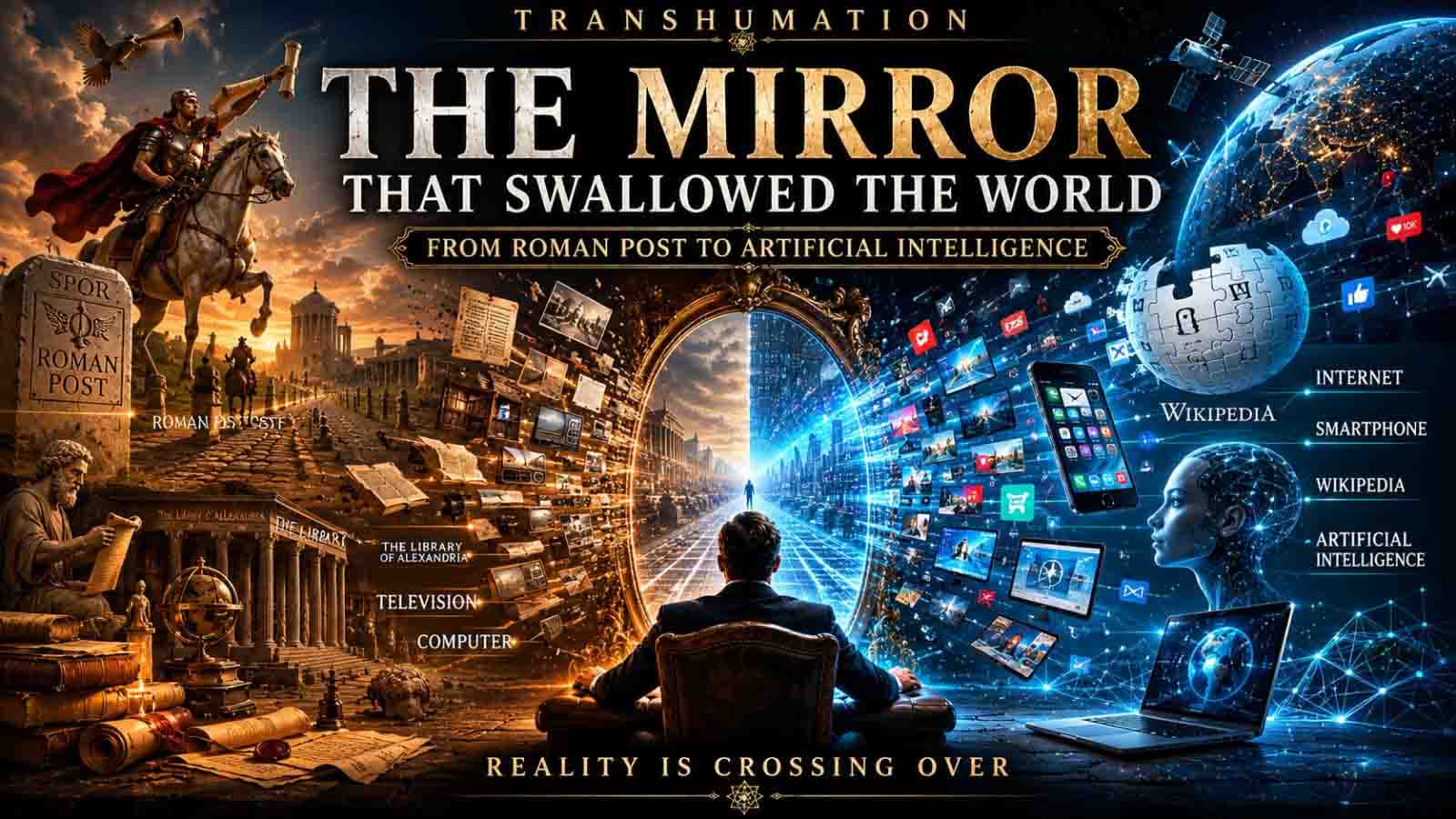
The Oracle Is a Dangerous Metaphor
The temptation to compare AI with an oracle is obvious.
A person approaches an interface with a question. The mechanism behind the response is largely invisible. An answer emerges from something apparently connected to knowledge much larger than the individual’s own.
Structurally, the resemblance is useful.
Historically, it should not be pushed too far.
Ancient oracles belonged to particular religious institutions and cosmologies. Their authority did not come from statistical models trained on text. AI has no demonstrated access to divine knowledge, destiny or hidden truth merely because its answers arrive fluently.
Yet the oracle comparison reveals a psychological danger.
People often reveal themselves through the questions they ask.
A person asking whether they should leave a marriage, abandon a career or forgive someone is not merely seeking information. The phrasing already exposes fears, assumptions and imagined futures. A response can therefore become reflective even when it provides no revelation at all.
The answer matters.
But the question may matter more.
In this limited sense, AI can function as an interactive mirror: not because it knows the secret truth about the user, but because dialogue externalizes structures that were previously internal.
The Library Learns to Answer
A traditional library is already a mirror of civilization.
Walk through its shelves and you encounter what generations chose to preserve: their medicine and superstition, mathematics and pornography, wars and love letters, propaganda and philosophy. The library is not humanity. It is humanity after selection, survival and classification.
Until recently, however, the library remained mostly silent.
You had to know where to look.
You had to choose the book.
You had to perform the comparison.
Artificial intelligence changes the interface.
Now the reader can ask the library to place Plato beside neuroscience, compare an eighteenth-century political argument with a modern platform economy, or trace a recurring metaphor across religions and technologies.
The answer may contain errors. The comparison may be superficial. The sources may have to be checked.
But the relationship has changed.
The library has acquired something resembling a conversational surface.
That does not mean the library became conscious.
It means the mirror learned to move.
Watch The Video
How to Read the World

Current Knowledge
Current generative AI systems are trained on large collections of human-produced data and learn statistical and structural regularities within those materials. Their outputs are therefore deeply shaped by human language, cultural assumptions, recorded knowledge and historical biases.
Training data do not represent humanity comprehensively or neutrally. Languages, regions, social groups and historical periods appear unevenly, and many forms of human experience were never digitized or recorded in the first place.
AI systems can identify and recombine patterns across very large bodies of information, but this does not demonstrate human-like subjective understanding. Whether artificial systems can ever possess consciousness or genuine first-person experience remains unresolved.
AI outputs are also shaped by model architecture, training procedures, safety systems, retrieval mechanisms and user prompts. The metaphor of a mirror is therefore interpretive rather than literal.
Open Questions
The first question is whether a sufficiently large cultural mirror can reveal patterns that no individual historian, sociologist or philosopher could detect alone. AI may make comparisons across enormous archives easier, but pattern detection also creates the danger of finding similarities that are accidental or historically meaningless.
A second question concerns distortion. If AI increasingly becomes an interface through which people encounter civilization’s archive, whose voices become most visible and whose disappear behind the model’s averages?
There is also the problem of recursion. Human beings write the material that trains AI; AI increasingly produces material that humans read and may later use to train new systems. What happens when the mirror begins filling the room with reflections of previous reflections?
And perhaps the deepest question is psychological: if people begin using AI as a tool for examining themselves, how do we preserve the distinction between useful reflection and surrendering judgment to the mirror?
Transhumation Interpretation
The Library of Mirrors begins with a simple proposition: civilization does not merely store information.
It reflects the reader.
Two people enter the same library and find different books important. They follow different connections. They recognize different patterns. The archive remains enormous, but the path through it belongs partly to the observer.
AI intensifies this relationship.
The user asks.
The system selects.
The user reacts.
The next question changes.
The mirror is therefore not a passive surface. It becomes part of a loop.
This is why AI may be more interesting as a librarian than as an artificial oracle.
The oracle suggests authority.
The librarian suggests orientation.
A good librarian does not replace the reader’s judgment. The librarian helps the reader discover that books separated by floors, centuries or disciplines may belong to the same conversation.
AI may eventually do something similar at civilizational scale.
It can place distant fragments beside one another.
It can expose repeated language.
It can reveal contradictions.
It can suggest structures that deserve investigation.
But a good Library of Mirrors needs one discipline above all: the ability to ask whether the pattern in the reflection actually exists outside the mirror.
Otherwise every resemblance becomes revelation.
Every coincidence becomes structure.
Every generated answer becomes evidence.
That would destroy the value of the mirror.
The purpose of reflection is not to confirm whatever we hoped to see.
It is to make something visible enough that we can turn around and test whether it is really there.
Perhaps this is the most useful role AI can play in the human story.
Not replacing thought.
Not becoming the final interpreter of civilization.
Not understanding humanity better than humanity understands itself.
Something more modest and more interesting.
Holding enough fragments in front of us at once that we occasionally recognize our own shape.
FAQ
Why compare AI to a mirror?
Because AI is built partly from patterns in human-produced information and can return those patterns in new combinations. The metaphor does not imply that AI reflects humanity perfectly.
Does AI understand humans?
AI can model language and behavior with impressive sophistication, but this does not establish human-like subjective understanding or consciousness.
Why is the mirror distorted?
Because recorded human culture is incomplete and uneven, and AI outputs are additionally shaped by model design, training methods and prompts.
Can AI reveal things about humanity that humans have missed?
Potentially. It can compare very large bodies of information and expose recurring structures worth investigating. Those patterns still require evidence and interpretation.
Is AI a modern oracle?
Only as a limited metaphor. The resemblance lies in the act of asking a complex system for an answer. AI has no demonstrated access to supernatural or privileged truth.
What is the Library of Mirrors?
It is the Transhumation idea that books, archives, culture and AI function not only as stores of knowledge but as mirrors through which readers encounter patterns in civilization and in themselves.
What is the deepest danger of the mirror?
Forgetting that reflection is not reality.
AI can reveal a pattern.
It can also manufacture the appearance of one.
The responsible reader has to do something no mirror can do on their behalf:
turn around and check.
Continue the Transhumation Series
- Forgotten Religion | Ancient Gods, Symbols and the Hidden Structures of Human Civilization
- The Last Religion | Death, Immortality and the Future of Humanity
- The New Theurgy | AI, Information and the Future of Human Civilization
- End of Branding: You Were Never Meant to Become a Product
- Baal vs Ishtar: Why Ancient Gods Never Disappeared