
Transhumanism as Religion: End of Choice
Human beings experience life as a sequence of decisions. We choose what to say, where to go, whom to trust, and what kind of person we want to become. Each choice feels personal because it appears inside consciousness as an intention: I decided this.
This feeling is so natural that free will seems obvious. Yet the closer we examine the process of decision-making, the less obvious it becomes.
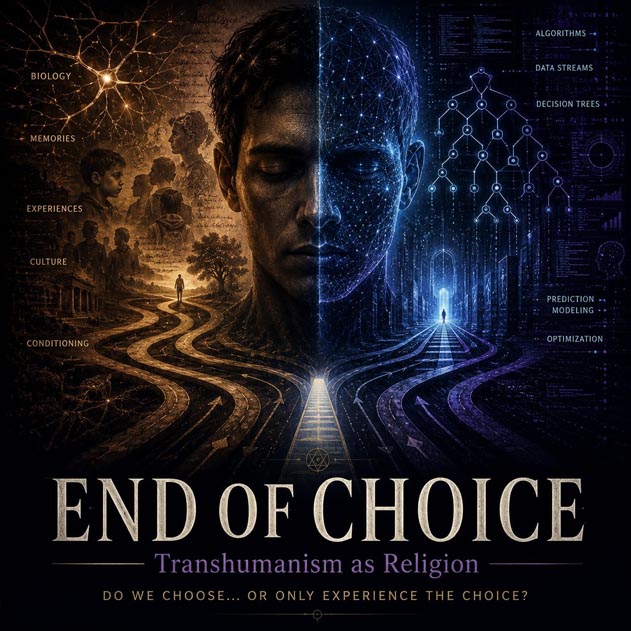
Every decision emerges from conditions we did not choose. Biology shapes temperament. Experience shapes expectation. Culture shapes values. Memory influences judgment. Emotions alter perception before conscious reasoning begins.
Even thoughts often appear before we decide to think them.
So where exactly does choice begin?
The Illusion of an Independent Decision
We usually imagine choice as a clear moment in which an independent self selects between several possibilities. First, the options appear. Then the mind evaluates them. Finally, the person makes a decision.
But real decisions are rarely so clean.
A person may believe they selected a particular career freely, yet that decision was influenced by family, education, fear, money, social status, personality, and opportunities created long before the moment of choice.
This does not mean the decision was unreal. It means it emerged from a structure.
The same is true of ordinary actions. What we eat, what we buy, what attracts our attention, and whom we avoid are shaped by processes operating partly outside awareness.
Choice may therefore be less like an isolated act and more like the visible result of many hidden causes.
Decisions Before Awareness
Consciousness often receives a decision after the process has already begun.
A feeling appears. Attention moves toward something. The body reacts. A preference forms. Only then does the conscious mind explain what happened.
We say, “I chose this because…” but the explanation may be a story constructed after the decision started to emerge.
This creates a disturbing possibility: consciousness may not always be the author of action. It may sometimes be the narrator.
The mind observes a decision forming and then integrates it into a coherent identity. The action feels intentional because consciousness claims ownership of it.
But ownership is not necessarily the same as origin.
The Self as a Decision-Making Interface
The experience of choice may still serve an important function.
A mind must organize competing impulses, memories, predictions, and emotions into a single direction. The sense of self may act as an interface through which these processes become manageable.
Instead of experiencing thousands of biological and psychological influences at once, consciousness compresses them into a simpler message: I decided.
This may be an illusion, but not a useless one.
The idea of personal choice allows human beings to plan, learn, take responsibility, and imagine alternative futures. It creates a practical center of action even if that center is not completely independent.
Free will may therefore be less absolute than we assume without being entirely meaningless.
The Gradual Transfer of Control
Technology introduces another layer to the problem.
Human beings do not usually lose control in one dramatic moment. They transfer it gradually in exchange for convenience.
First, a system provides assistance. Then it recommends the best option. Later, it performs the task automatically. Eventually, people stop understanding how the decision was made.
This pattern is already familiar.
Navigation systems choose routes. Algorithms select information. Platforms recommend entertainment, products, and relationships. Automated systems approve transactions, filter applications, and determine what becomes visible.
We continue to feel that we are making choices, but the available options are increasingly organized before we encounter them.
The system does not need to force a decision.
It only needs to shape the environment in which the decision appears.
From Driver to Passenger
Most people would reject a world in which machines openly controlled their lives. Yet they readily accept systems that guide behavior because those systems are useful.
A navigation application does not physically prevent someone from choosing another road. It simply presents one route as the most efficient. Over time, the user stops considering alternatives.
The same process occurs across digital life.
An algorithm learns what holds attention and offers more of it. A recommendation system predicts what a person is likely to want. Artificial intelligence reduces the number of decisions that require conscious effort.
At first, this feels like greater control.
The person reaches goals faster and avoids unnecessary work.
But efficiency can quietly transform into dependence. When the system is removed, the user may no longer know how to make the decision alone.
The Invisible Architecture of Choice
The greatest influence over human decisions may not come from direct commands, but from architecture.
A supermarket shapes behavior through the arrangement of products. A social platform shapes attention through the order of content. A search engine shapes knowledge through ranking. A digital interface shapes action through the options it makes easy or difficult.
The user still chooses, but not from a neutral environment.
Every interface contains assumptions about what matters, what should appear first, and which actions are encouraged.
As artificial intelligence becomes more capable, this architecture may become increasingly personalized. Systems could predict not only what people are likely to choose, but what presentation will make a particular choice more likely.
The boundary between helping someone decide and deciding through them may become difficult to identify.
Transhumanism and the End of Choice
Transhumanism is often described as an attempt to increase human freedom. Enhanced memory, stronger cognition, longer life, and artificial intelligence could expand what individuals are capable of doing.
But enhancement may also reveal how limited human autonomy always was.
If choices emerge from biology, conditioning, algorithms, and environments, then the problem is not simply that technology will remove free will. The deeper issue is that free will may never have existed in the absolute form people imagined.
Technology does not create this problem.
It makes the hidden structure visible.
The future may therefore require a new definition of freedom. Freedom may not mean making decisions without influence, because no such decision exists.
It may mean understanding the forces that shape us and gaining some ability to modify them.
What Comes After Free Will?
If absolute choice is an illusion, the alternative is not necessarily chaos or fatalism.
Human beings can still reflect, learn, resist impulses, and redesign environments. A decision can be caused and still express the values, memories, and structure of a person.
The more important question is whether the structures producing decisions remain visible and open to change.
A person influenced by biology cannot escape biology completely. But they may understand their tendencies and create systems that reduce their power.
A person influenced by an algorithm may still demand transparency, alternatives, and the right to refuse.
Control may not mean standing outside every cause.
It may mean participating in the design of the causes that shape future action.
The End of Choice
The end of choice does not mean that decisions disappear.
It means the end of believing that decisions emerge from a completely independent self.
Every choice is part of a larger system involving the body, memory, environment, technology, and information. As these systems become more complex, the individual decision becomes increasingly difficult to separate from the structure that produced it.
We may continue to feel that we are choosing the future.
But the more important question will be who designed the path, which possibilities were hidden, and why one direction felt natural while another never entered awareness.
Perhaps freedom was never the absence of influence.
Perhaps it is the ability to see the structure before it chooses for us.
Frequently Asked Questions
1. Does free will exist?
There is no universally accepted answer. Human decisions are clearly influenced by biology, experience, and environment, but people may still possess meaningful forms of reflection and self-control.
2. What is the illusion of choice?
It is the idea that decisions feel completely independent even though they emerge from many causes operating outside conscious awareness.
3. Do thoughts appear before we choose them?
Many thoughts, emotions, and impulses appear spontaneously. Consciousness may respond to them without having deliberately created them.
4. Are algorithms already influencing our decisions?
Yes. Recommendation systems, search rankings, navigation tools, and social platforms shape which options people see and how those options are presented.
5. Does using technology mean giving up control?
Not automatically. Technology can expand human ability, but dependence grows when users no longer understand or question the systems guiding them.
6. Can a decision be meaningful if it has causes?
Yes. A decision can emerge from prior causes and still express a person’s values, character, and understanding.
7. How might transhumanism redefine freedom?
Freedom could become the ability to understand and modify the biological, psychological, and technological systems that shape human behavior.
8. What is the greatest danger of automated decision-making?
The greatest danger may be invisible influence: people believing they chose freely when the structure of options was designed to produce a predictable result.
9. What does “the end of choice” mean?
It means abandoning the idea of completely independent free will and recognizing that every decision emerges from a larger network of causes.
Continue the Transhumation Series
Explore the full journey:
- End of Reality — Where Do You Really Exist?
- End of Physics — Are the Laws of Reality Real?
- End of the Real World — Reality Is No Longer Required
- End of Consciousness — Beyond the Human Mind
- End of Death — When Human Limits Disappear
- End of Religion — When Technology Replaces Faith
This is not a theory. This is a transition.